
What Is a Montessori Munari Mobile? A Complete Guide
At first glance, the Munari Mobile doesn’t look like a typical baby mobile.
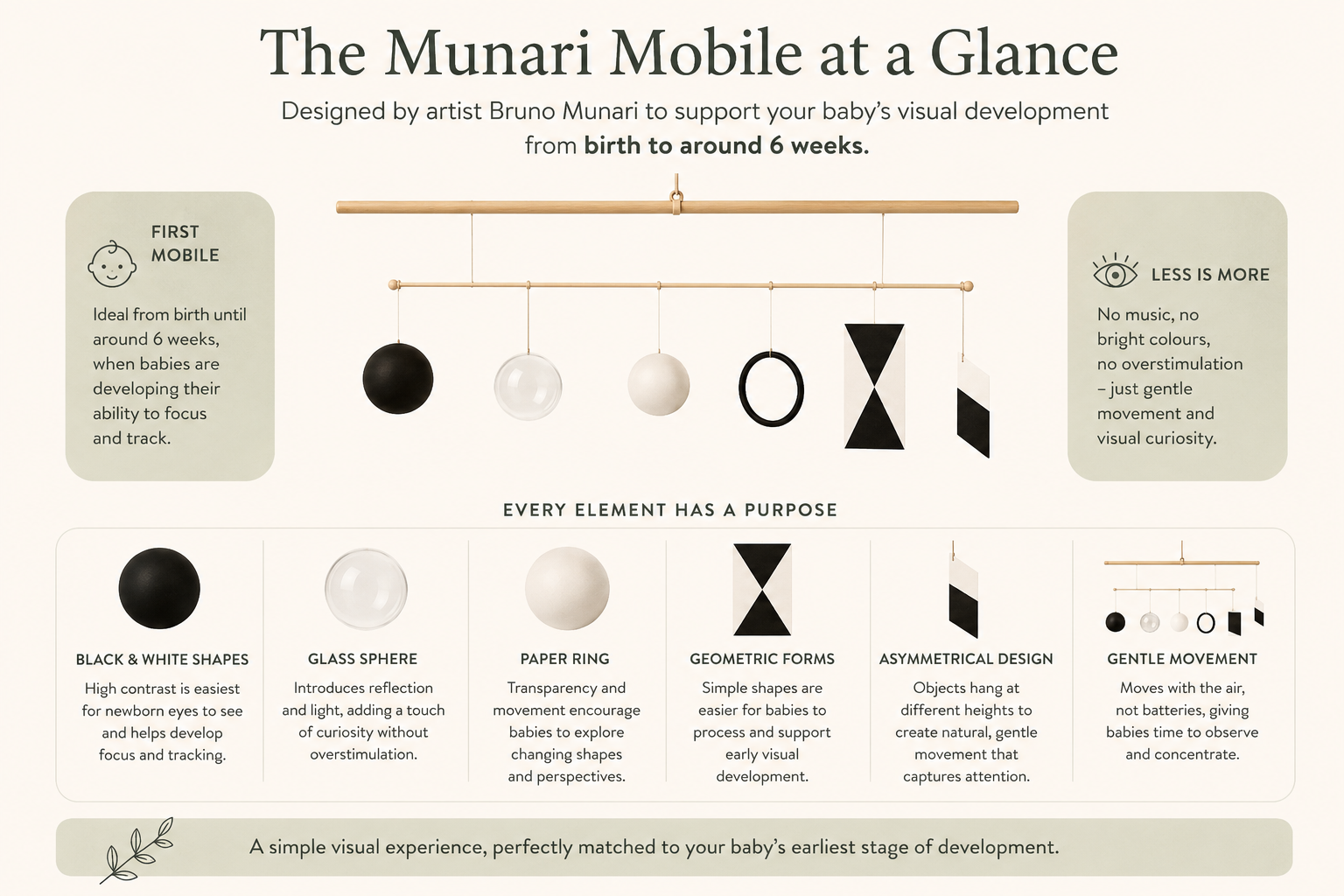
There are no soft animals, bright colours or gentle lullabies. Instead, you’ll find a handful of black-and-white geometric shapes, a clear glass sphere and a paper ring, all suspended at different heights from a simple wooden frame.
To many new parents, it can seem surprisingly plain.
Yet despite its unusual appearance, the Munari Mobile has become one of the best-known Montessori visual mobiles for newborns, and for good reason.
Every shape, colour and hanging point has been chosen deliberately to support the way a baby’s vision develops during the first few weeks of life.
Once you understand the thinking behind its design, the Munari Mobile begins to make much more sense.
Disclaimer: This post contains affiliate links. As an Amazon Associate I earn from qualifying purchases at no extra cost to you.
Who Invented the Munari Mobile?
The Munari Mobile is named after Bruno Munari, an Italian artist, designer and educator known for combining art, movement and learning through beautifully simple objects.
Although the mobile is now closely associated with Montessori nurseries around the world, it was originally inspired by Munari’s exploration of balance, geometry and visual perception.
Today, it is widely recognised as the first mobile in the Montessori visual mobile sequence, typically introduced from birth until around six weeks of age.
Why Does the Munari Mobile Look So Different?
Most baby mobiles are designed to entertain.
The Munari Mobile was designed to be observed.
Rather than surrounding babies with bright colours, music and constant movement, it offers just enough visual interest to encourage calm concentration without becoming overwhelming.
This difference reflects a central Montessori idea: babies learn best when they have time to observe and make discoveries for themselves.
Instead of trying to capture attention, the Munari Mobile quietly invites it.
Every Part Has a Purpose
One of the most fascinating things about the Munari Mobile is that almost nothing is decorative.
Every component contributes something different to your baby’s visual experience.
Together, they create a mobile that rewards slow, focused observation rather than constant stimulation.
The Black-and-White Shapes
Newborns see strong contrast much more easily than subtle colours.
The simple geometric shapes create clear outlines that are easier for developing eyes to distinguish and follow.
Rather than presenting many different colours at once, the Munari Mobile focuses attention on shape, movement and contrast.
The Glass Sphere
Perhaps the most unusual feature is the clear glass sphere.
Unlike the paper shapes, it reflects light and its surroundings, changing subtly throughout the day.
As your baby moves or the light changes, the reflections also change, creating gentle visual interest without flashing or spinning.
The Paper Ring
The suspended ring introduces something entirely different.
Unlike the solid shapes, it is transparent.
As it slowly rotates, babies experience changing outlines and shifting perspectives, encouraging longer periods of observation.
The Asymmetrical Layout
If you’ve looked closely, you’ll notice that nothing hangs evenly.
The objects sit at different heights and distances from one another.
This isn’t accidental.
An asymmetrical arrangement creates more natural, less predictable movement as air circulates around the mobile.
Instead of moving like a toy, it drifts gently, giving babies plenty of time to follow each object with their eyes.
Why Black and White?
People often assume newborns can only see in black and white.
That’s not entirely true.
Babies can detect some colour from birth, but their colour vision is still immature. Strong contrast is simply much easier for them to distinguish during the first few weeks.
That’s why the Munari Mobile relies primarily on bold black-and-white patterns rather than soft pastel colours.
As your baby’s vision develops, later Montessori mobiles gradually introduce colour, depth and more complex visual experiences.
When Should You Introduce a Munari Mobile?
The Munari Mobile is usually introduced from birth until around six weeks of age.
This is the period when babies spend much of their awake time quietly observing the world around them.
Short sessions during calm, alert moments are generally more valuable than leaving the mobile in place throughout the day.
As your baby’s vision develops, many families gradually move on to the Montessori Octahedron Mobile, which introduces colour while maintaining the same calm visual experience.
Is the Munari Mobile Really Worth It?
Not every family chooses to use Montessori mobiles, and babies certainly don’t need one to develop normally.
However, many parents appreciate the Munari Mobile because it offers something quite different from many modern baby products.
Rather than trying to entertain, it creates opportunities for quiet observation, gentle visual exploration and unhurried concentration.
For families following a Montessori-inspired approach, that simplicity is often exactly what makes it so appealing.
Can You Make Your Own Munari Mobile?
You certainly can, and many parents enjoy creating one themselves. However, because the Munari Mobile relies on careful balance, lightweight materials and precise positioning, it’s often more involved than it first appears.
If you’d rather spend time enjoying your newborn than gathering materials and measuring components, there are some beautifully made Montessori Munari Mobiles available to purchase.
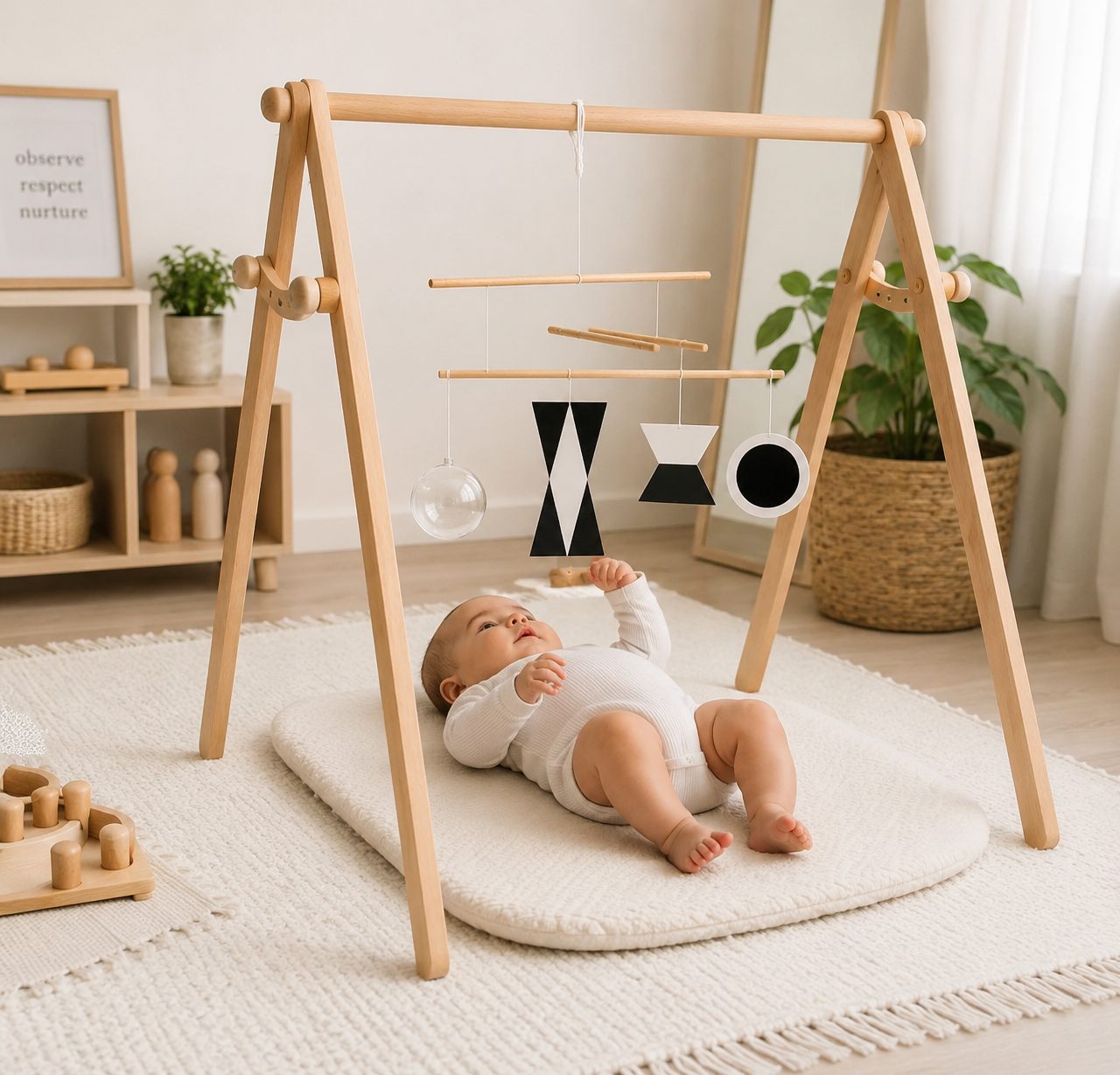
Whichever option you choose, we recommend hanging your Munari Mobile from a dedicated wooden floor mobile stand rather than above a cot or crib. This allows your baby to enjoy it during calm, supervised awake time while following Montessori principles, and keeps the sleep space free from visual stimulation. It’s also a worthwhile investment, as the same stand can be used with each of the Montessori visual mobiles—from the Munari through to the Octahedron, Gobbi and Dancers—without needing to buy a new frame each time.
Below, we’ve included the Munari Mobile we recommend for its simple design, quality materials and faithful interpretation of the original.
Final Thoughts
The Munari Mobile isn’t memorable because it looks beautiful.
It’s memorable because every part has a purpose.
The bold contrast, the transparent ring, the reflective glass sphere and the carefully balanced shapes all work together to create a calm visual experience that grows out of an understanding of how newborns see the world.
Whether you choose to introduce one at home or simply appreciate the thinking behind its design, the Munari Mobile is a wonderful reminder that sometimes the simplest objects can invite the deepest curiosity.