
Best Foldable Learning Towers That Don’t Take Over Your Kitchen
Many families love the idea of a learning tower — until they realise how much space some of them take up.
In smaller kitchens especially, large fixed towers can quickly start to feel like permanent furniture rather than something that supports daily routines.
That’s why foldable learning towers have become so popular.
They still allow toddlers to safely participate at counter height, but they’re much easier to store and fit into everyday family life without permanently taking over the kitchen.
And ultimately, that’s what matters most.
The goal is not simply saving space. It’s creating a practical way for toddlers to join everyday routines, contribute alongside you, and develop independence—even when kitchen space is limited.

Disclaimer: This post contains affiliate links. As an Amazon Associate I earn from qualifying purchases at no extra cost to you.
What Makes a Foldable Learning Tower Worth Buying?
Not all foldable learning towers work equally well once they’re part of everyday family life.
Some fold neatly but feel unstable in use. Others feel solid and secure but become heavy, awkward or inconvenient enough that they rarely get folded away in practice.
The best designs tend to disappear naturally into the rhythm of the home:
stable enough to use confidently every day, but practical enough that they do not permanently dominate the kitchen space around them.
And for many families — especially in smaller homes — that balance matters far more than having the most feature-heavy setup.
The goal is usually not creating a perfect Montessori kitchen.
It is creating a calmer, safer way for toddlers to participate in everyday routines without adding unnecessary friction to the home.
Features Worth Looking For
A Foldable Design That’s Actually Practical
Some learning towers technically fold but still remain bulky enough that nobody realistically wants to move or store them regularly.
Slimmer designs that fold relatively flat tend to work much better in everyday kitchens, especially in smaller UK homes where floor space matters day-to-day.
Adjustable Height
Adjustable platforms usually allow the tower to grow with your child over several years rather than becoming quickly outgrown.
That flexibility often makes the tower feel much more worthwhile long-term.
Stability Over Aesthetics
A foldable tower still needs to feel secure once opened.
Features like enclosed standing platforms, sturdy side rails, anti-tip feet and non-slip surfaces usually matter far more in real life than having the most aesthetically minimal design.
Especially once toddlers begin climbing independently.
Materials That Blend Naturally Into the Home
Wood and bamboo towers often feel visually calmer than brightly coloured plastic alternatives and tend to integrate more naturally into kitchens without looking overly toy-like.
Smooth finishes and rounded edges also make everyday use feel noticeably better over time.
Realistic Storage for Your Space
For many families, this is ultimately the deciding factor.
In smaller kitchens, lighter foldable designs often work much better than larger fixed towers that permanently occupy valuable floor space — especially if the tower needs to move regularly throughout the day.
Best Foldable Learning Towers UK
The best foldable learning towers tend to balance three things well:
safe everyday use, realistic storage and a design that fits naturally into family life without permanently taking over the kitchen.
These are the foldable learning towers that stand out most for smaller homes, compact kitchens and everyday practicality.
The Foldable Learning Tower We’d Recommend to Most Families
Our top pick for average-sized kitchens — folding down to just 20 cm when not in use.
If kitchen space is limited but you don’t need the most compact option available, this is probably the learning tower we’d buy.
At 20 cm when folded, it’s easy enough to tuck away between uses without sacrificing the reassuringly sturdy feel you want when your toddler is standing on it — a good balance for something you’ll potentially be getting out every day.
We also like that the standing platform adjusts as your child grows, so it’s unlikely to become redundant after just a few months.
FUNLIO Foldable Learning Tower
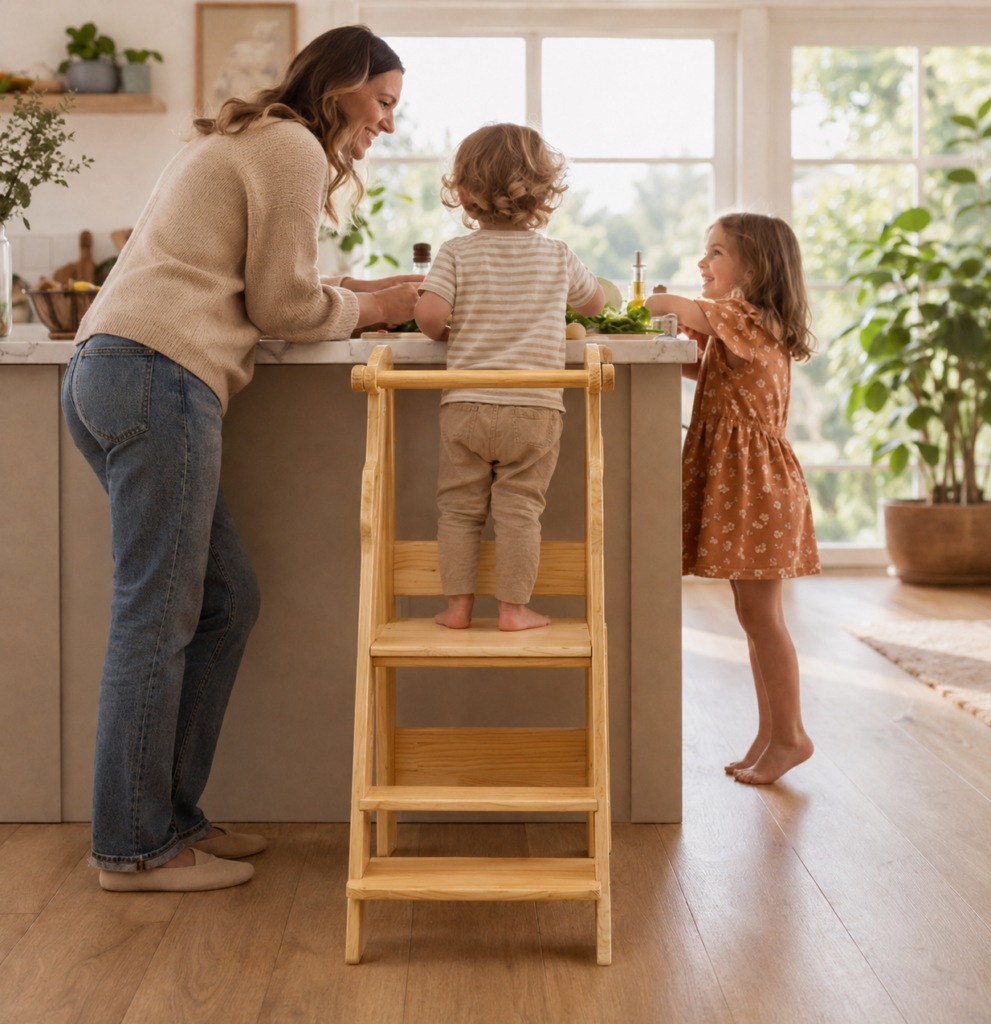
Best for: families who want a learning tower that folds away without feeling like a compromise.
✓ Folds flat for easy storage
✓ Adjustable platform height
✓ Enclosed standing area
✓ Ideal for smaller kitchens
Why we chose it
It solves the biggest problem with learning towers: where to keep them. When folded away it barely takes up any space, but once opened it feels stable enough that we’d happily use it every day.
The Foldable Learning Tower That Doesn’t Look Like Toddler Furniture
Our premium design pick for smaller kitchens — a folding learning tower that measures just 8 cm when folded.
If aesthetics matter just as much as practicality, this is the one we’d choose.
Rather than looking like another piece of children’s equipment, its simple birch plywood design feels much more like something that naturally belongs in the home. That’s a big advantage if your kitchen is open-plan or you simply don’t want toddler gear dominating the space. Even better, it folds down to an impressively slim 8 cm (around 11 cm including the protruding standing step), so it can be tucked away when you need the floor space back.
It’s designed to grow with your child too, with two adjustable platform heights (31 cm and 41 cm) and a recommended age range of 1–6 years. Add the rear safety bar, optional anti-tip feet and sturdy 50 kg weight capacity, and it feels like a particularly well-considered option for families who want something they can use for years rather than a short-lived toddler purchase.
Learning Tower Company Helper Tower
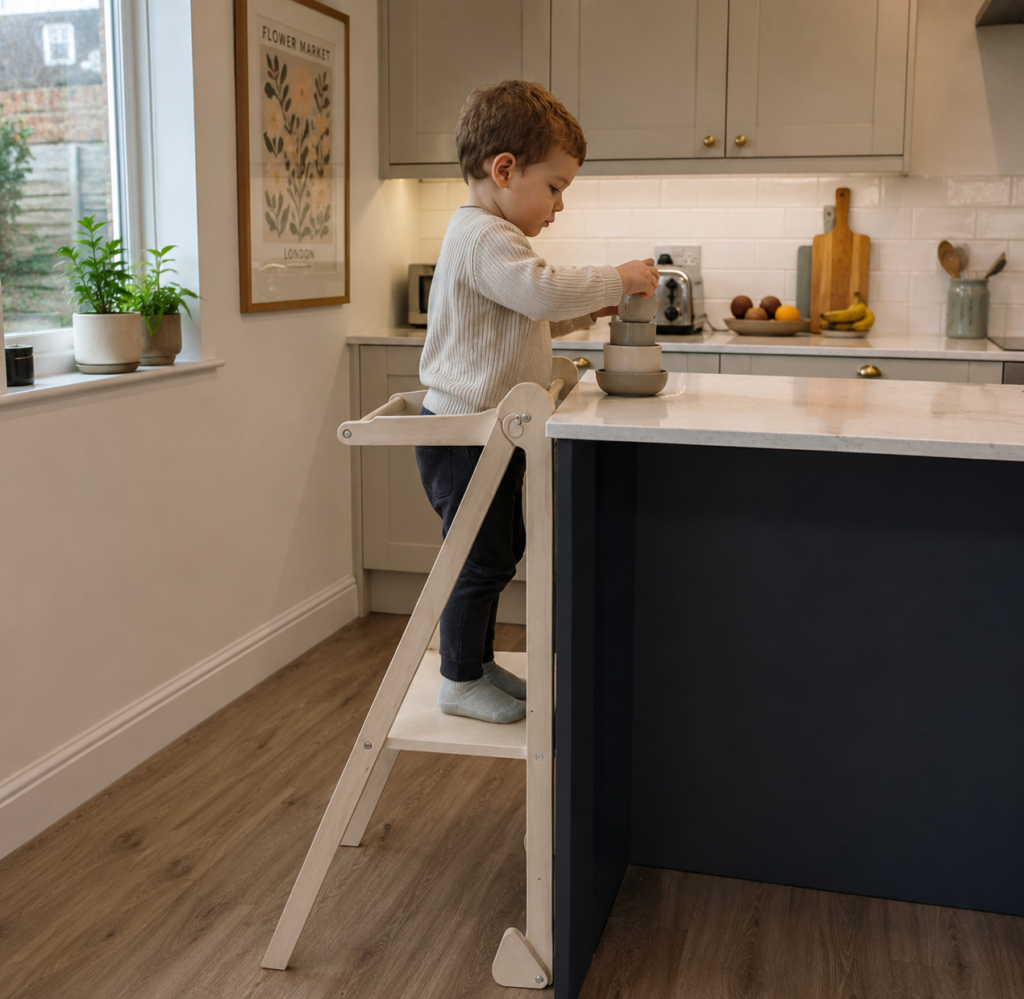
Best for: families who want a learning tower that’s as beautiful as it is practical.
✓ Clean, furniture-inspired design
✓ Folds away when not in use
✓ Ideal for modern, open-plan homes
Why we chose it
Most learning towers are designed purely for toddlers. This one feels like it was designed with the whole home in mind. It’s the tower we’d recommend to parents who want something they’ll be happy seeing every day.
The Best-Value Foldable Learning Tower
A practical, well-designed option that folds down to just 17 cm.
A good learning tower doesn’t have to be an investment piece. If you’re looking for something safe, practical and easy to put away, this is a particularly good-value option.
It folds to just 17 cm, making it easy to tuck away between uses, while its lighter design means it can be moved around the home without much effort. It may not have the refined finish of more premium models, but it gets the important things right — a thoughtful choice if you want the benefits of a learning tower without the premium price tag.
COSYLAND Foldable Learning Tower
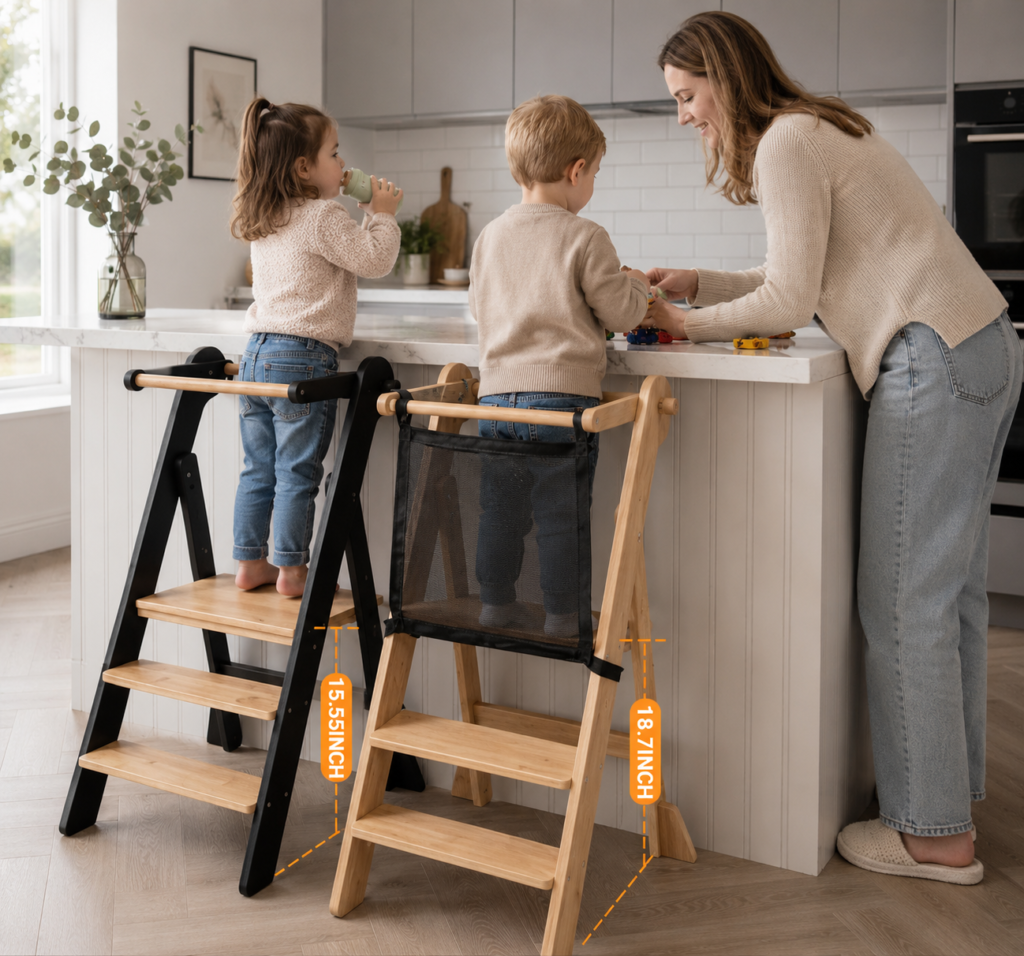
Best for: families looking for a practical first learning tower at a more affordable price.
✓ Budget-friendly
✓ Folds away for storage
✓ Lightweight and easy to move
✓ Simple, practical design
Why we chose it
Not every family needs the most expensive learning tower. If you’re looking for a straightforward option that encourages independence without the premium price tag, we’d be happy to recommend this one.
The Foldable Learning Tower We’d Choose for Small Kitchens
Our favourite space-saving pick — folding down to just 13 cm when not in use.
If your kitchen already feels full, this is the learning tower we’d recommend.
At just 13 cm when folded, it tucks away remarkably neatly after use, making it much easier to enjoy the benefits of a learning tower without permanently giving up valuable floor space. That’s especially useful in smaller kitchens, flats and open-plan homes where every bit of space matters.
It’s also lightweight enough to move around the house when needed, so it never feels like another bulky piece of toddler equipment that’s always in the way.
MamaToyz Foldable Learning Tower
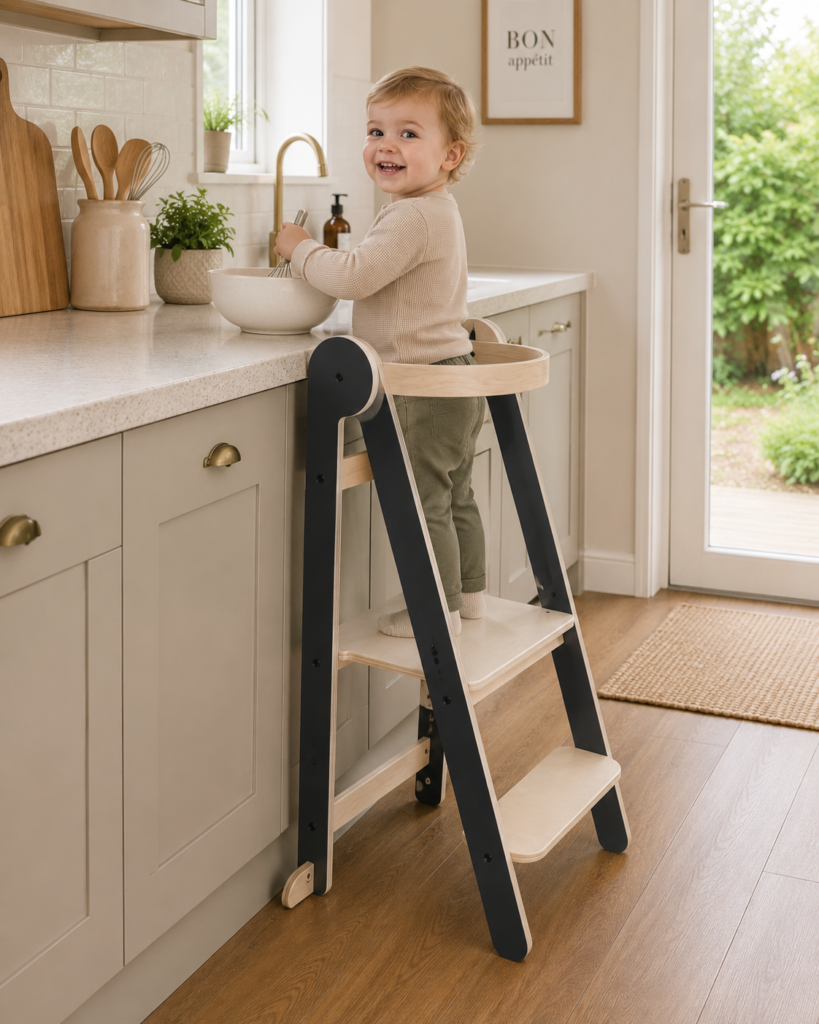
Best for: families with smaller kitchens who want a learning tower that’s easy to store between uses.
✓ Folds flat for compact storage
✓ Lightweight and easy to move
✓ Slim, space-saving design
✓ Ideal for smaller homes
Why we chose it
Some learning towers demand a permanent place in the kitchen. This one doesn’t. If space is your biggest concern, we think it’s one of the most practical options available.
Don’t Have Space for a Learning Tower? We’d Consider This Instead
Our compact alternative — folding down to just 17 cm when not in use.
If we’re being realistic, even a foldable learning tower isn’t the right fit for every home.
For smaller kitchens or flats, a sturdy wooden step stool can be a sensible alternative. It won’t offer the same level of support as a learning tower, but it still allows older toddlers to wash their hands, help prepare food or reach the worktop for short, supervised activities.
At just 17 cm when folded, this one is particularly easy to tuck away behind a cupboard or beside the fridge when you’re finished — a practical option if you simply don’t have the floor space for a full learning tower.
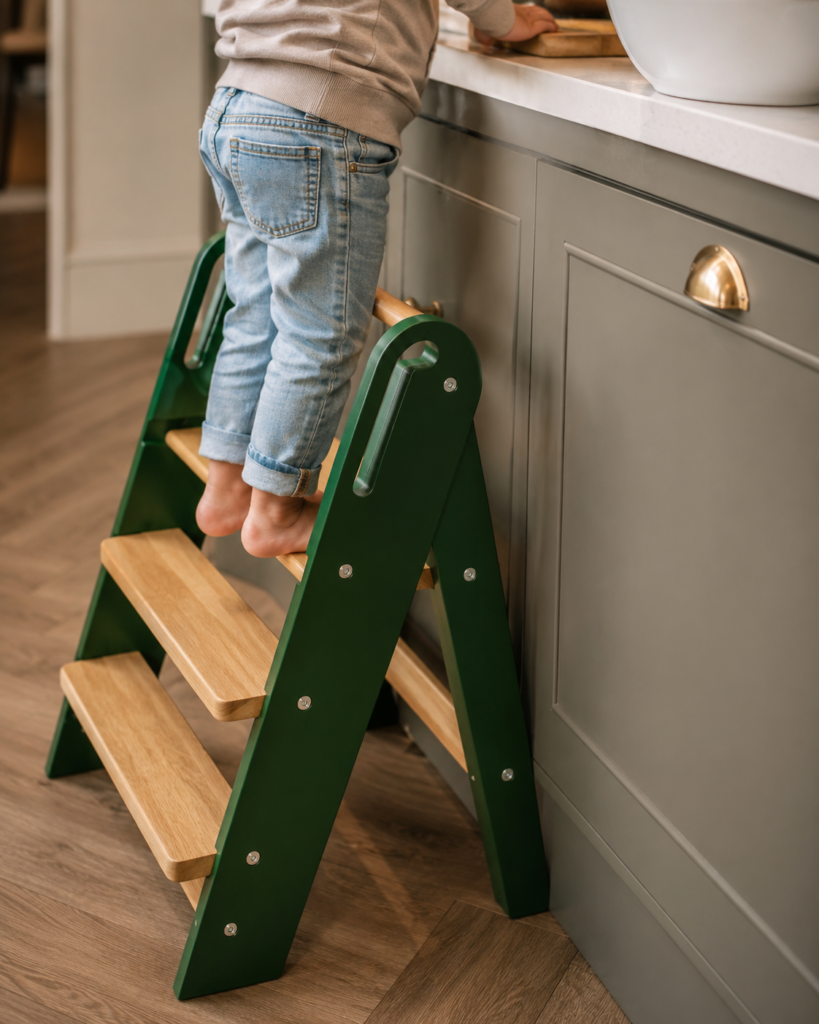
Best for: families who don’t have room for a full-size learning tower.
✓ Folds flat for storage
✓ Stable wooden construction
✓ Lightweight and easy to move
✓ Ideal for quick everyday tasks
Why we chose it
A learning tower isn’t an essential purchase for every family. If space is your biggest challenge, we’d rather recommend a good-quality folding step stool than encourage you to squeeze a bulky tower into a kitchen where it simply won’t work.
Are Foldable Learning Towers Safe?
Yes — provided the design still feels stable and secure once opened.
Some parents worry that foldable towers may feel less sturdy than fixed models, but well-designed versions are usually built to remain solid during normal daily use rather than simply prioritising compact storage.
Features like enclosed standing platforms, sturdy side rails, anti-tip feet and secure locking mechanisms tend to make the biggest difference in practice.
And as with any learning tower, toddlers should still be supervised during kitchen activities.
Are Foldable Towers Worth It?
For many families, absolutely — especially in smaller homes where space matters day-to-day.
In practice, foldability is often what determines whether the tower becomes part of everyday routines or eventually gets pushed aside because it feels too bulky to live with comfortably.
And interestingly, the easier a tower is to move, store and use consistently, the more naturally toddlers tend to participate in everyday kitchen routines over time.
What Age Are Foldable Learning Towers Suitable For?
Most foldable learning towers are designed for toddlers from around 18 months onwards, although some models advertise suitability from 12 months.
In reality, many families prefer waiting until their toddler is standing steadily, climbing more confidently and beginning to follow simple instructions more consistently before introducing one regularly.
Final Thoughts
If we were choosing today, we’d happily sacrifice a few extra features for a tower that’s genuinely easy to live with. A learning tower only supports everyday independence if it becomes part of your daily routine—and for many families, foldability is exactly what makes that possible.
Whether your toddler is helping stir pancake batter, washing strawberries or simply watching you cook dinner, the best learning tower is the one you’ll actually use.
Shopping on Amazon?
If you’re not already a Prime member, you can check whether you’re eligible for a free 30-day trial and enjoy Prime delivery on millions of eligible items.
Frequently Asked Questions About Folding Learning Towers
What is a folding learning tower?
A foldable learning tower is a toddler kitchen helper that can be folded away when not in use, making it a practical option for families with limited space.
You may also see them described as foldable kitchen helper towers, folding toddler towers, Montessori learning towers, or toddler kitchen stools. While the names vary, the goal is the same: helping toddlers safely participate in everyday routines at counter height without permanently taking up valuable kitchen space.
Are foldable learning towers safe for toddlers?
Yes, provided they are well-designed and used appropriately.
The safest foldable learning towers include features such as secure locking mechanisms, enclosed standing platforms, side rails, anti-tip feet, and non-slip steps. For most families, they provide a much safer alternative to standing on kitchen chairs or stools while helping with everyday tasks.
What age is a foldable learning tower suitable for?
Most learning towers are designed for children between roughly 18 months and 5 or 6 years old, although some manufacturers recommend them from 12 months.
In practice, many parents wait until their child can stand steadily, climb confidently, and follow simple instructions before introducing a learning tower. Adjustable-height models can often be used for several years as children grow.
Are foldable learning towers worth it for small kitchens?
For many families, this is exactly where foldable designs make the most sense.
Being able to fold the tower away after use can make it much easier to maintain floor space in smaller kitchens, flats, and open-plan homes. Many parents find they use the tower more often simply because it doesn’t feel like a permanent obstacle in the room.
What’s the difference between a learning tower and a step stool?
A standard step stool is designed to help a child reach a higher surface briefly.
A learning tower is designed to support longer periods of involvement and usually includes enclosed sides, a larger standing platform, and additional safety features that allow toddlers to participate more comfortably and securely in everyday kitchen activities.
Which foldable learning tower is best for small spaces?
Slim, fold-flat designs are often the most practical choice for compact homes.
When comparing options, it can be helpful to look not only at the folded dimensions but also at how easy the tower is to move, store, and unfold during everyday use. A tower that folds neatly but is awkward to set up may be used less often over time.
Do foldable learning towers feel less stable than fixed models?
Not necessarily.
Well-designed foldable learning towers are built to feel solid and secure once fully opened. Features such as reinforced frames, wide standing platforms, anti-tip feet, and reliable locking systems usually have a greater impact on stability than whether the tower folds or not.
Can you fold a learning tower away every day?
Yes. In fact, many parents specifically choose a foldable design because it allows them to store the tower between uses, reclaim floor space, and keep the kitchen feeling less cluttered.
Some models fold more easily than others, so it’s worth paying attention to the folding mechanism if you expect to use it daily.
What should I look for when buying a foldable learning tower?
The most important considerations are usually stability, safety, ease of use, and how well the tower fits your space.
Features such as secure locking mechanisms, enclosed safety rails, adjustable height settings, and a compact folded footprint are often more valuable in daily life than additional extras or gimmicks.
Are Montessori learning towers the same as helper towers?
Usually, yes.
Terms such as Montessori learning tower, kitchen helper tower, toddler standing tower, and toddler kitchen stool are often used interchangeably. While designs vary slightly, they all serve a similar purpose: helping young children participate more independently in everyday routines.
Can a foldable learning tower replace a kitchen chair for toddlers?
For many families, yes.
A learning tower generally provides a much safer and more stable alternative to dining chairs, stools, or improvised setups at counter height. It allows toddlers to observe and participate more independently while reducing climbing risks and the need for constant lifting.
You Might Also Find Helpful