
What to Do When Your Toddler Hits Another Child
It happens in seconds. One moment, your toddler is happily playing alongside another child. The next, someone is crying, another parent is looking in your direction, and you’re suddenly trying to work out what to say and do.
Few parenting moments feel quite as uncomfortable, particularly when they happen in public. You want to comfort the other child, address your toddler’s behaviour and reassure everyone involved — all while managing your own embarrassment or frustration.
If you’ve found yourself in this situation, you’re far from alone. Hitting is relatively common during the toddler years, when children’s emotional experiences are often bigger than their ability to communicate or manage them.
Understanding why it happens, and having a clear plan for how to respond, can make these moments considerably easier to navigate.

Is Hitting a Normal Phase in Toddlers?
For many children, hitting is a temporary developmental phase, particularly between the ages of one and three.
During these early years, children are still developing the skills they need to navigate social situations. They are learning how to communicate their needs, tolerate frustration, manage strong emotions and control physical impulses.
A toddler who desperately wants a toy may understand that another child has it but lack the patience, language or impulse control needed to wait for a turn.
Their physical response can happen before they have had the opportunity to consider an alternative.
Hitting may be developmentally common, but that doesn’t mean it should be ignored. Children need adults to intervene, establish clear boundaries and help them discover safer ways to express themselves.
Why Do Toddlers Hit Other Children?
Hitting can happen for several reasons, and the motivation is not always obvious. Understanding what happened immediately before an incident can help you respond more effectively.
Common triggers include:
- Frustration: Another child has a desired toy, interrupts their play or refuses to give them a turn.
- Overstimulation: Busy playgrounds, noisy playgroups and crowded environments can become overwhelming.
- Limited communication skills: A toddler may not yet have the words to express frustration, ask for help or request personal space.
- Immature impulse control: A child may act physically before considering what they are doing.
- Tiredness or hunger: Unmet physical needs can make emotional regulation more difficult.
- Excitement or experimentation: Some toddlers hit during enthusiastic play or while exploring how others respond to their actions.
Not every incident is driven by anger. Sometimes, hitting happens because a toddler becomes excited, struggles to judge the strength of their movements or simply doesn’t yet understand how their actions affect someone else.
Recognising the underlying reason doesn’t excuse the behaviour. It helps you identify what your child needs to learn instead.
What to Do Immediately When Your Toddler Hits Another Child
In the moment, your priorities are simple: prevent further harm, check on the child who has been hurt and help your toddler understand what they can do differently.
You don’t need an elaborate explanation or a perfectly delivered parenting script. A few calm, consistent steps are enough.
Short on time? Save this quick-response guide
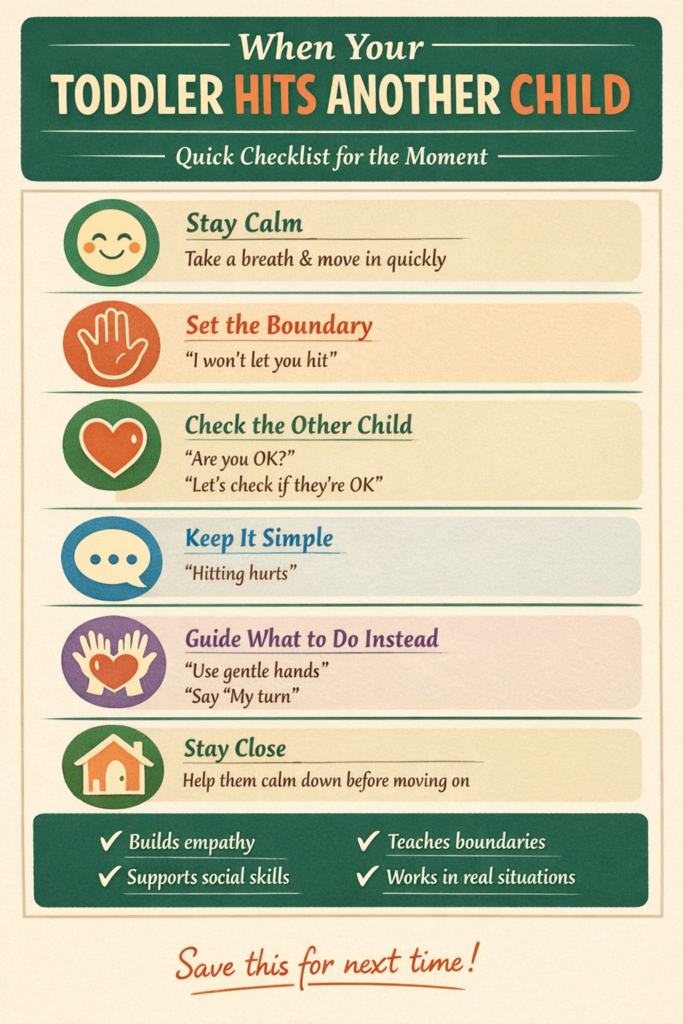
1. Move in quickly and calmly
Approach your toddler immediately. If they are about to hit again, gently block the movement or create enough physical space between the children to keep everyone safe.
Get close and use a calm, firm voice.
“I won’t let you hit.”
This phrase communicates a clear boundary without labelling your child as naughty or making threats.
You don’t need to raise your voice to demonstrate that you are taking the situation seriously. Your calmness does not weaken the boundary.
2. Check on the other child
Once you have prevented further hitting, turn your attention to the child who has been hurt.
“Are you OK? I’m sorry you got hurt.”
If appropriate, invite your toddler to notice what has happened.
“Look, she’s upset. Hitting hurt her.”
This step is important for two reasons. It ensures that the other child receives the care they need, and it gives your toddler an opportunity to begin understanding the impact of their actions.
If the other child needs space, respect that. Your toddler does not need to approach, touch or comfort them immediately.
Empathy develops gradually through repeated experiences of seeing how we respond to others.
3. State the boundary in simple language
Keep your explanation brief and concrete.
“Hitting hurts. I won’t let you hit.”
You can also acknowledge what your toddler was trying to communicate.
“You really wanted that toy. It’s OK to feel frustrated, but it’s not OK to hit.”
This distinction is particularly important. Your child is allowed to experience anger, frustration and disappointment. They are not allowed to hurt someone else because of those feelings.
When emotions are running high, a lengthy explanation about kindness or appropriate behaviour is unlikely to be effective. Save more detailed conversations for when your child is calm.
4. Show your toddler what to do instead
Simply telling a toddler not to hit leaves them without an alternative way to respond.
Try to identify what they were attempting to achieve and give them a more appropriate response.
For example:
- If they wanted a toy: “You can say, ‘My turn, please.’”
- If another child was too close: “You can say, ‘Space, please.’”
- If they were struggling with something: “You can ask me for help.”
- If they were angry: “You can tell me you’re angry.”
- If they became too physical during play: “Let’s slow down and use gentle hands.”
For younger toddlers who are not yet able to use these phrases, model the words on their behalf.
The aim is to gradually replace hitting with a safer, more effective way of communicating.
5. Stay close and help them reset
Rather than immediately sending your toddler away on their own, remain nearby and help them settle.
Depending on the situation, this might mean sitting together on a bench, moving to a quieter part of the playground or simply staying close while they regain their composure.
You might say:
“I’m going to stay with you for a little while. We’ll go back when you’re ready to play safely.”
This is not about rewarding the hitting with attention. It is about providing the support a young child may need to regain control and return to play safely.
If they are calm and able to continue playing without hurting others, there is no need to prolong the incident.
When frustration escalates into a meltdown, knowing what to say can help you respond with greater confidence. Rather than trying to reason with your toddler while they are overwhelmed, focus on short, reassuring phrases that acknowledge their feelings while maintaining clear boundaries. Our guide, 10 Calming Things to Say During a Toddler Meltdown, offers practical examples to help you support your child through these difficult moments.
What If Your Toddler Keeps Hitting?
Sometimes, despite a calm intervention, a toddler returns to play and hits again.
This can be particularly frustrating when you feel you have already explained the boundary clearly. However, understanding a rule and being able to follow it consistently are different developmental skills.
If the hitting continues, increase the level of support rather than the intensity of your reaction.
Stay within arm’s reach, supervise interactions more closely and intervene before another child is hurt.
If your toddler is unable to play safely, it may be necessary to take a break or end the activity altogether.
“You’re finding it hard to play safely right now. We’re going to take a break together.”
If the behaviour continues after a break:
“We’re going home now. We’ll try again another day.”
Leaving the playground is not necessarily a punishment. Sometimes, it is simply the most appropriate way to keep everyone safe when a child has reached the limits of what they can manage.
You can be compassionate about your toddler’s disappointment while remaining firm about the need to leave.
What to Do When Your Toddler Hits at the Playground or Nursery
Hitting can feel especially difficult in public because you are managing more than your child’s behaviour. You may also feel embarrassed, judged or worried about how another parent will respond.
It is natural to want to demonstrate that you are taking the situation seriously. However, raising your voice or demanding an immediate apology simply because other adults are watching is unlikely to make the experience more constructive.
What to say to the other parent
A brief, sincere acknowledgement is usually appropriate.
“I’m really sorry that happened. Is your little one OK? I’ll stay close to mine and make sure it doesn’t happen again.”
If their child is injured or particularly distressed, give them the time and space they need.
You don’t need to defend your toddler’s behaviour or offer an extensive explanation of child development. Acknowledging what happened and taking practical steps to prevent further harm demonstrates that you are handling the situation responsibly.
What if nursery reports that your toddler has been hitting?
If your child’s nursery reports repeated incidents, try to approach the conversation collaboratively.
Useful questions to ask include:
- What usually happens immediately before the hitting?
- Does it tend to happen during particular activities or transitions?
- Is it associated with sharing toys or waiting for a turn?
- Does it happen more frequently when my child is tired?
- What approaches have helped them settle?
Understanding these patterns can help you and the nursery develop a consistent response.
If possible, agree on a few simple phrases that both you and the nursery staff can use. Familiar language and predictable boundaries may help your child understand what is expected across different environments.
Should You Make Your Toddler Apologise After Hitting?
It is understandable to want your child to say sorry after hurting someone. Apologising is an important social skill, but a meaningful apology requires a level of understanding that toddlers are still developing.
A forced apology may teach a child to repeat the expected word without necessarily understanding why it matters.
Instead, model an apology yourself.
“I’m sorry you got hurt.”
Once your toddler is calm, you can offer them an opportunity to help repair the situation.
They might offer to fetch a tissue, return a toy or say sorry if they feel ready to do so.
However, avoid insisting that the other child accepts a hug or physical gesture of affection. They may not want further interaction, and their boundaries matter too.
The long-term goal is to help your toddler understand the value of making amends, rather than simply learning to say the right word after doing something wrong.
What to Say When Your Toddler Hits
Having a few familiar phrases ready can make it easier to respond calmly, particularly when an incident catches you off guard.
| Situation | What to say |
|---|---|
| Your toddler is about to hit | “I won’t let you hit.” |
| They have hurt another child | “Hitting hurts. Let’s make sure they’re OK.” |
| They want another child’s toy | “You want a turn. Let’s ask.” |
| They are angry | “It’s OK to feel angry. It’s not OK to hit.” |
| They need personal space | “You can say, ‘Please move back.’” |
| They are overwhelmed | “Let’s find somewhere quieter together.” |
| They continue hitting | “I’m going to help you take a break.” |
| They choose a safer response | “You asked for help instead of hitting. That was helpful.” |
You don’t need to memorise every phrase. Choose a few that feel natural to you and use them consistently.
Short, clear language is often more effective than an explanation your toddler is not yet ready to process.
What Not to Do When Your Toddler Hits
Even when we understand toddler development, being caught off guard can make it difficult to respond as calmly as we would like.
Where possible, try to avoid the following approaches.
Shouting or intimidating your child. A loud or threatening response may interrupt the behaviour, but it doesn’t necessarily teach your toddler how to manage the situation differently next time.
Labelling your child. Describing a toddler as naughty, mean or aggressive risks confusing their behaviour with their identity. Address what they did rather than who they are.
Forcing an immediate apology. Model empathy and encourage meaningful repair when your child is ready.
Ignoring the behaviour. Although hitting can be developmentally common, it still requires immediate intervention to protect others.
Giving lengthy lectures. A toddler who is upset or overstimulated is unlikely to benefit from an extended explanation.
Hitting back to demonstrate how it feels. This sends a contradictory message about whether physical force is an acceptable response to frustration.
Gentle parenting does not mean allowing harmful behaviour. It means setting clear, effective boundaries without unnecessary fear or shame.
How to Reduce Toddler Hitting Over Time
Responding appropriately after an incident is important, but some of the most valuable learning happens before the next one.
1. Stay close during challenging situations
If your toddler tends to hit during busy playgroups, playground visits or interactions involving favourite toys, stay close enough to intervene early.
Watch for signs of growing frustration, such as reaching repeatedly for a toy, becoming physically tense or raising their voice.
You might be able to step in before the situation escalates.
“You really want that truck. Let’s ask when it will be your turn.”
Over time, these supported interactions give your toddler opportunities to practise alternatives to hitting.
2. Build a small vocabulary for difficult moments
Toddlers don’t need complicated emotional language to begin communicating more effectively.
Simple words and phrases such as help, stop, my turn, space and I’m angry can give them useful alternatives to physical reactions.
Practise these during everyday interactions, rather than introducing them only after something has gone wrong.
If your child is not yet speaking confidently, gestures and simple signs can also help them communicate their needs.
3. Practise gentle interactions through play
Calm moments are ideal opportunities to teach social and emotional skills.
Use dolls, soft toys or pretend play to explore familiar situations.
For example, two teddy bears might want the same toy. You can demonstrate how one teddy asks for a turn, waits or seeks help from an adult.
You can also model gentle touch when caring for dolls, handling delicate objects or interacting with pets under supervision.
These playful experiences allow children to practise new responses without the emotional pressure of a real disagreement.
4. Notice patterns and adjust expectations
If hitting happens frequently, spend a few days observing when it is most likely to occur.
You may discover that your toddler struggles towards the end of a long play session, shortly before lunch or in particularly crowded environments.
Sometimes, relatively small adjustments can help:
- Offering a snack before an outing.
- Choosing quieter times to visit the playground.
- Keeping playdates shorter.
- Providing advance notice before transitions.
- Allowing time for rest after nursery.
- Staying nearby when children are playing with particularly desirable toys.
These adjustments are not about avoiding every challenging situation. They help create conditions in which your toddler has a better chance of practising new skills successfully.
5. Recognise progress when it happens
It is easy to focus on the moments when your toddler hits and overlook the occasions when they manage a difficult situation differently.
Notice when they ask for help, wait for a turn, move away from another child or express frustration using words.
Offer specific, natural feedback.
“You were frustrated, and you came to ask me for help.”
This helps your toddler recognise what they did differently without making them dependent on rewards or excessive praise.
The Montessori Perspective: Gentle Guidance and Clear Limits
The Montessori approach places considerable importance on respect for the child, independence and the development of social responsibility.
Respecting a child’s feelings, however, does not mean permitting behaviour that harms others.
The principle of freedom within limits is particularly relevant here. Children are free to explore, express themselves and engage with others within boundaries that protect everyone’s safety and wellbeing.
Montessori grace and courtesy activities also offer opportunities to practise everyday social skills, including asking for a turn, respecting personal space, offering help and responding when someone is hurt.
Rather than expecting children to instinctively know how to navigate these situations, adults demonstrate the behaviour and provide repeated opportunities to practise it.
We can respect a toddler’s feelings while firmly preventing them from hurting someone else. The two are entirely compatible.
If Your Toddler Is Also Hitting You at Home
Some children hit other children during social interactions, while others direct their frustration towards parents or caregivers.
The underlying developmental challenges may be similar, but the situations and appropriate responses can differ.
For practical examples of how to respond when your child hits you, including how to protect your own physical boundaries while remaining connected, read our guide to what to do when your toddler hits you.
When Should You Seek Additional Support?
Although occasional hitting is common during toddlerhood, persistent or increasingly intense physical aggression may warrant additional support.
Consider speaking to your health visitor, GP or nursery staff if:
- Your child frequently hurts other children despite consistent support.
- The hitting is becoming more intense or regularly causes injuries.
- Your child finds it particularly difficult to settle after becoming upset.
- The behaviour is significantly affecting their ability to participate in everyday activities.
- You have concerns about their communication, emotional development or wider wellbeing.
- You feel unable to manage the behaviour safely.
Seeking advice does not mean something is necessarily wrong with your child. It can help you better understand their needs and identify strategies suited to their individual development.
Final Thoughts
When your toddler hits another child, you may feel an immediate pressure to correct the behaviour, reassure the other parent and demonstrate that you are handling the situation well.
But you don’t need to turn every incident into a major lesson.
Move in quickly. Keep everyone safe. Acknowledge what happened, hold the boundary and show your child a more appropriate way to respond.
Some days, your toddler will manage frustration beautifully. On others, they may need considerably more support. Progress is rarely linear, particularly during the early years.
With patient guidance, consistent boundaries and repeated opportunities to practise, children can gradually develop the skills they need to navigate social situations more successfully.
The goal is not simply to stop your toddler from hitting. It is to help them learn what to do with their feelings instead.