
10 Calming Things to Say During a Toddler Meltdown
If you’ve ever found yourself saying “calm down” while your toddler somehow gets louder, you’ll know how difficult it can be to find the right words in the middle of a meltdown.
Toddlers are still learning to manage big feelings, frustration and disappointment, and when they become overwhelmed, long explanations usually aren’t very helpful. Often, fewer words are better.
The aim isn’t to find a magic phrase that instantly stops the crying. It’s to keep your response calm and simple, acknowledge what your child is feeling and hold any boundary that still needs to be held.
Here are 10 phrases you can try — and when each one can be useful.

Disclaimer: This article contains affiliate links. If you purchase through these links, we may earn a small commission at no extra cost to you. As an Amazon Associate, we earn from qualifying purchases.
Why Toddlers Have Meltdowns in the First Place
Toddlers are dealing with big emotions while the skills they need to manage them — including language, impulse control, attention and emotional regulation — are still developing.
Add hunger, tiredness, frustration, sensory overload or an unexpected transition, and sometimes there is simply more going on than they can manage calmly.
That’s also why a lengthy explanation in the middle of a meltdown often gets you nowhere. When a child is already overwhelmed, keeping your language short and your response predictable is usually more useful than trying to reason everything through there and then.
Once things have settled, there is plenty of time to talk about what happened.
10 Things to Say During a Toddler Meltdown
1. “I’m here. You’re safe.”
Sometimes you don’t need to say very much at all.
If your toddler is overwhelmed, a short, reassuring phrase lets them know that you’re nearby without adding more language for them to process.
You don’t have to fix the feeling or explain why something happened. Stay close, keep everyone safe and give them time.
2. “I see you’re really upset.”
Putting simple words to what you see can help children gradually build the language they need to talk about their feelings.
You don’t need to guess exactly what they’re feeling, either. If you’re not sure whether it’s anger, disappointment or frustration, “I can see this is really hard” works just as well.
The point isn’t to talk them out of the feeling. It’s simply to acknowledge it.
3. “It’s hard when things don’t go how you want.”
Validation doesn’t mean agreeing to whatever your toddler wants.
You can understand why they’re upset and still keep the answer the same.
Perhaps they wanted another biscuit, didn’t want to leave the park or desperately wanted to press the button themselves. Acknowledging the disappointment can help you connect without abandoning the boundary.
You might say:
“You really wanted another biscuit. It’s hard when the answer is no.”
The answer is still no.
4. “I won’t let you hit.”
Big feelings are allowed. Hurting someone isn’t.
If your toddler is hitting, kicking, biting or throwing something that could hurt someone, you don’t need a lengthy explanation in the middle of the meltdown.
Keep the boundary short and clear:
“I won’t let you hit.”
Then physically prevent the behaviour if necessary while staying as calm as you can.
There will be time to talk about what happened afterwards.
“I won’t let you hit” sets a clear boundary, but the phrase on its own isn’t the whole response. If hitting is happening regularly, it helps to look at what’s driving the behaviour, what to do physically in the moment and what happens afterwards. We cover that in more detail in How to Respond When Your Toddler Hits You.
If throwing is becoming a regular pattern in your home, you might also find our guide to Toddler Throwing Things? A Calm Step-by-Step Response helpful.
5. “Let’s take a big breath together.”
Some toddlers won’t want to take a breath when they’re already very upset — and that’s okay.
Rather than repeatedly telling them to calm down, you can model a slow breath yourself and invite them to join you.
Keep it low-pressure. They may copy you, or they may simply need you to stay nearby while the feeling passes.
6. “You wanted the blue cup.”
Sometimes the simplest response is to reflect back what happened.
“You wanted the blue cup.”
“You wanted to do it yourself.”
“You didn’t want to leave the park.”
You’re not necessarily offering to change the situation. You’re showing your child that you understand what they were trying to communicate.
For a toddler who doesn’t yet have all the words to explain what’s wrong, that can be particularly useful.
7. “We can try again.”
Toddlers are learning an extraordinary number of new skills, and sometimes the thing that tips them over the edge is simply not being able to do something yet.
Putting on a shoe. Opening a snack. Building a tower. Pouring their own water.
If frustration is behind the meltdown, “We can try again” offers another possibility without immediately taking over and doing it for them.
Sometimes they’ll want another go. Sometimes they’ll have had enough. Both are okay.
8. “I’m going to sit right here with you.”
You don’t always have to fix the feeling.
Sometimes staying nearby, keeping everyone safe and giving your child time is enough.
If they want a cuddle, you can offer one. If they don’t want to be touched, you can give them some space while remaining close.
“I’m going to sit right here with you” communicates that you’re available without demanding anything from them.
9. “When you feel calmer, we’ll figure it out.”
Trying to solve the original problem while your toddler is extremely upset can quickly turn into more explaining, negotiating and frustration for everyone.
It’s okay to wait.
Once things have settled, you can decide whether there is actually a problem to solve, talk briefly about what happened or simply carry on with the day.
Not every meltdown needs a post-match analysis.
10. “Feelings are okay. Hurting isn’t.”
This is another useful phrase when a meltdown becomes physical.
Your toddler is allowed to be angry that you turned the television off. They’re allowed to cry because it’s time to leave. They’re allowed to be disappointed that they can’t have something they want.
The boundary around hitting, biting, kicking or hurting someone doesn’t change.
“You can be angry. I won’t let you hit.”
That may be all you need to say in the moment.
What Not to Say During a Toddler Meltdown
Most parents have said at least one of these at some point:
- “Calm down.”
- “You’re fine.”
- “Stop crying.”
- “It’s not a big deal.”
- “Big boys/girls don’t cry.”
The problem is that these phrases don’t give an overwhelmed toddler much useful information. Something that seems completely insignificant to us can feel enormous to a three-year-old.
That doesn’t mean you have to agree that receiving the wrong-coloured cup is a catastrophe.
You can acknowledge the disappointment without pretending the situation is different:
“You really wanted the blue one. You’re upset. Today we’re using this cup.”
Feeling acknowledged and getting what you want are two different things.
A Simple Three-Step Response
If remembering 10 different phrases feels impossible while someone is screaming beside you, forget the scripts and keep it simpler.
1. Keep your voice calm
You don’t have to whisper or perform exaggerated calmness. Just try not to add your own escalating voice to an already difficult moment.
2. Keep your words short
A toddler who is already overwhelmed probably isn’t going to absorb a five-minute explanation about why they couldn’t have another biscuit.
Say what needs to be said and leave the rest until later.
3. Acknowledge the feeling and hold the boundary
These can happen at exactly the same time:
“You really want another one. We’re not having another one today.”
“You don’t want to leave. It’s time to go.”
“You’re very angry. I won’t let you hit.”
Understanding a feeling doesn’t require you to change the limit.
What If None of These Phrases Work?
That’s completely possible.
Sometimes a toddler who is already overwhelmed doesn’t need another phrase at all. They may need fewer words, some space, physical comfort if they want it, or simply time.
These aren’t scripts you have to perform perfectly. Think of them as alternatives to lengthy explanations, threats or repeatedly saying “calm down”.
And if the meltdown involves hitting, kicking or throwing, safety comes first. You can calmly stop the behaviour while keeping your language very simple:
“I won’t let you hit.”
You can talk about what happened once everyone is calmer.
Common Toddler Meltdown Triggers
Sometimes the most useful question isn’t “What should I say during the meltdown?” but:
“What keeps happening just before it?”
Patterns can be surprisingly revealing.
Hunger and tiredness
A hungry or exhausted toddler generally has less capacity for dealing with frustration. If meltdowns reliably happen before dinner or towards bedtime, the timing itself may be giving you useful information.
Overstimulation
A busy day, lots of noise, unfamiliar people or simply having to cope with one thing after another can leave some children needing considerably less from us afterwards.
This can be particularly noticeable after childcare. If your child seems perfectly happy at nursery and then falls apart once they get home, read Toddler Meltdown After Nursery: What’s Really Going On?.
Transitions
Stopping one enjoyable thing and moving on to something else can be difficult for young children.
Giving a little warning can sometimes make the transition easier:
“Two more minutes, then we’re getting out of the bath.”
Some toddlers also find it easier when they can actually see time passing. We use a Time Timer – Visual Timer for this — it makes an abstract “five more minutes” much more concrete.
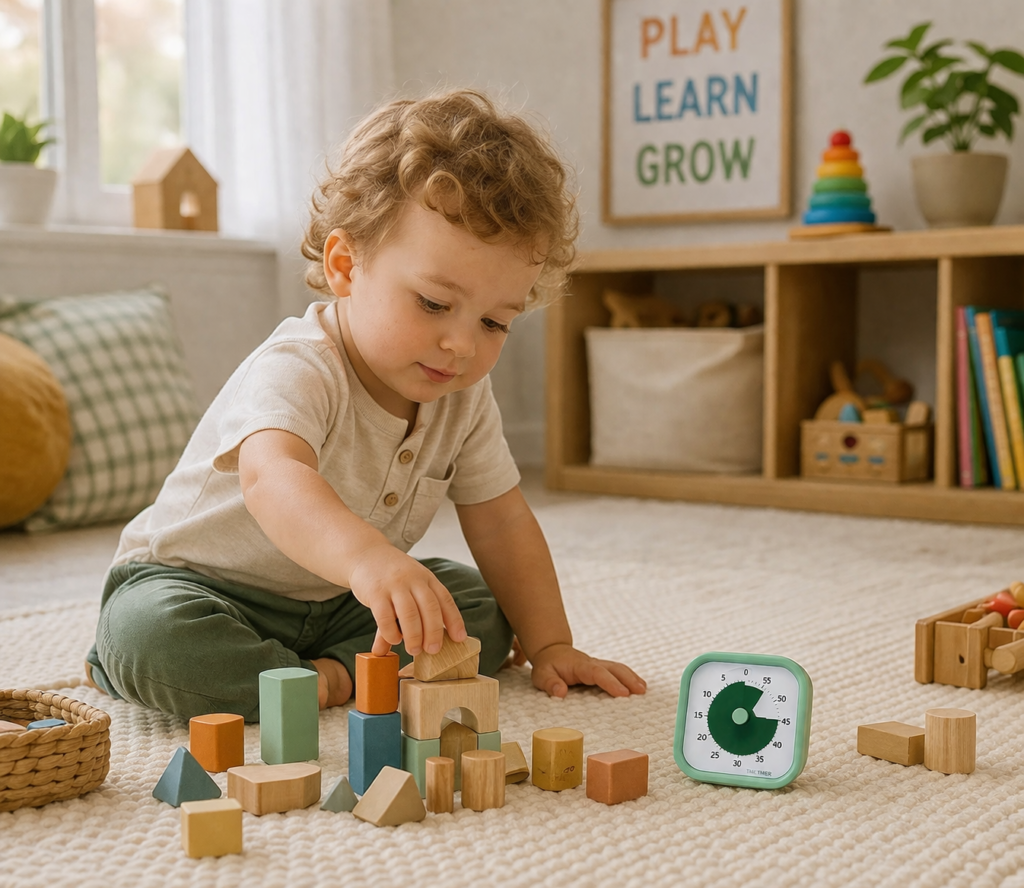
You can also read our guide to when and how to use visual timers with toddlers.
Frustration
Sometimes the trigger is simply wanting to do something their current skills won’t quite allow.
Before stepping in immediately, see whether breaking the task into one smaller step helps. They may need help — or they may simply need another attempt.
Final Thoughts
You don’t need to remember all 10 phrases the next time your toddler melts down.
Pick one or two that feel natural to you. Keep your words short, hold the boundary if there is one, and don’t worry if your child doesn’t immediately calm down.
Sometimes the most useful thing you can communicate is simply:
I see that this is hard. I’m here. And I won’t let you hurt yourself or anyone else.
The conversation can come later.
Frequently Asked Questions
What should I say when my toddler is having a meltdown?
Keep your words short and simple. Phrases such as “I’m here”, “I can see you’re really upset” or “I won’t let you hit” can acknowledge what your toddler is feeling without adding a lengthy explanation while they’re already overwhelmed.
Should I ignore my toddler during a meltdown?
You don’t necessarily need to talk, distract or try to stop the meltdown, but that doesn’t mean you have to withdraw completely. You can stay nearby, keep your child safe and offer comfort if they want it. Some toddlers want closeness; others need a little more space.
Should you talk to a toddler during a tantrum?
You can, but less is often more. If your toddler is very upset, they may struggle to take in a long explanation or lots of questions. Keep anything you need to say brief and save the bigger conversation for when things have settled.
What if my toddler hits me during a meltdown?
Stop the hitting and keep the boundary clear: “I won’t let you hit.” You can acknowledge the anger without allowing the behaviour. If hitting happens regularly, our How to Respond When Your Toddler Hits You guide looks more closely at what may be driving it and what to do before, during and after.
You Might Also Find Helpful