
Why Your Toddler Won’t Go to Sleep (And How to Make Bedtime Easier Tonight)
If your toddler won’t go to sleep or keeps waking up, you’re not alone.
Bedtime can quickly turn into delays, call-backs, extra hugs, and repeated trips out of the room. It can feel like your toddler is fighting sleep — even when they are clearly exhausted.
But when a toddler won’t go to sleep, the issue usually isn’t sleep itself. It’s what’s happening in the body and environment before bedtime.
Many parents look for ways to fix bedtime, but sleep is shaped by the entire day — movement, light, connection, stimulation, and routine.
We spent a long time assuming bedtime resistance was a bedtime problem. Looking back, the biggest improvements usually came from things we changed earlier in the day rather than anything we did after pyjamas were already on.

Disclaimer: This post contains affiliate links. As an Amazon Associate I earn from qualifying purchases at no extra cost to you.
Sleep isn’t just about what happens at bedtime.
If you’re not sure what that looks like in practice, a simple daily rhythm can make a big difference. This guide shows how everyday routines support calmer evenings:
→ Montessori Practical Life for Babies & Toddlers: Simple Daily Routines
When you optimise those inputs, bedtime resistance often decreases without power struggles.
This isn’t about sleep training.
It’s about making rest easier than resistance.
Why Toddlers Resist Sleep
Between 18–36 months, several things are happening developmentally:
- independence is increasing
- imagination is expanding
- separation awareness is stronger
- physical energy peaks
- language is exploding
Sleep means stopping.
And stopping can feel like loss of control.
So instead of asking, “How do I make them sleep?”
it helps to ask, “What makes sleep feel harder for their nervous system?”
1. Movement before rest
Toddlers regulate through their bodies.
If the body hasn’t had enough heavy movement, it will seek stimulation at bedtime.
Look at the late afternoon and early evening:
Did they climb?
Carry?
Push?
Hang?
Jump?
Outdoor play before dinner often reduces bedtime resistance more than longer bedtime routines.
Sleep improves when the body feels used.
If your toddler seems “wired” at night, it may be under-movement — not defiance.
2. Light is stronger than you think
Light directly affects melatonin production.
Bright overhead lighting in the evening tells the brain: stay alert.
Sleep optimisation often begins 60–90 minutes before bedtime by dimming lights earlier than feels necessary.
Switch to:
- warm light
- softer lamps
- slower speech
- quieter activities
If your toddler resists sleep in the dark or becomes unsettled at night, a soft, dimmable night light can help create a calmer transition.
Being able to gradually shift the room from brighter warm light during books to a very soft amber glow during wind-down supports the body’s natural sleep signals without overstimulation.
It’s worth remembering that not every toddler needs a night light. Some children sleep perfectly well in complete darkness, while others seem to feel more secure with a small amount of light during bedtime or night waking.
If you’re unsure whether a night light might help, we’ve put together a guide that explores when toddlers may benefit from one, what features are worth looking for, and a few simple low-stimulation options that work well for sleep:
→ Best Night Lights for Toddlers Who Won’t Sleep
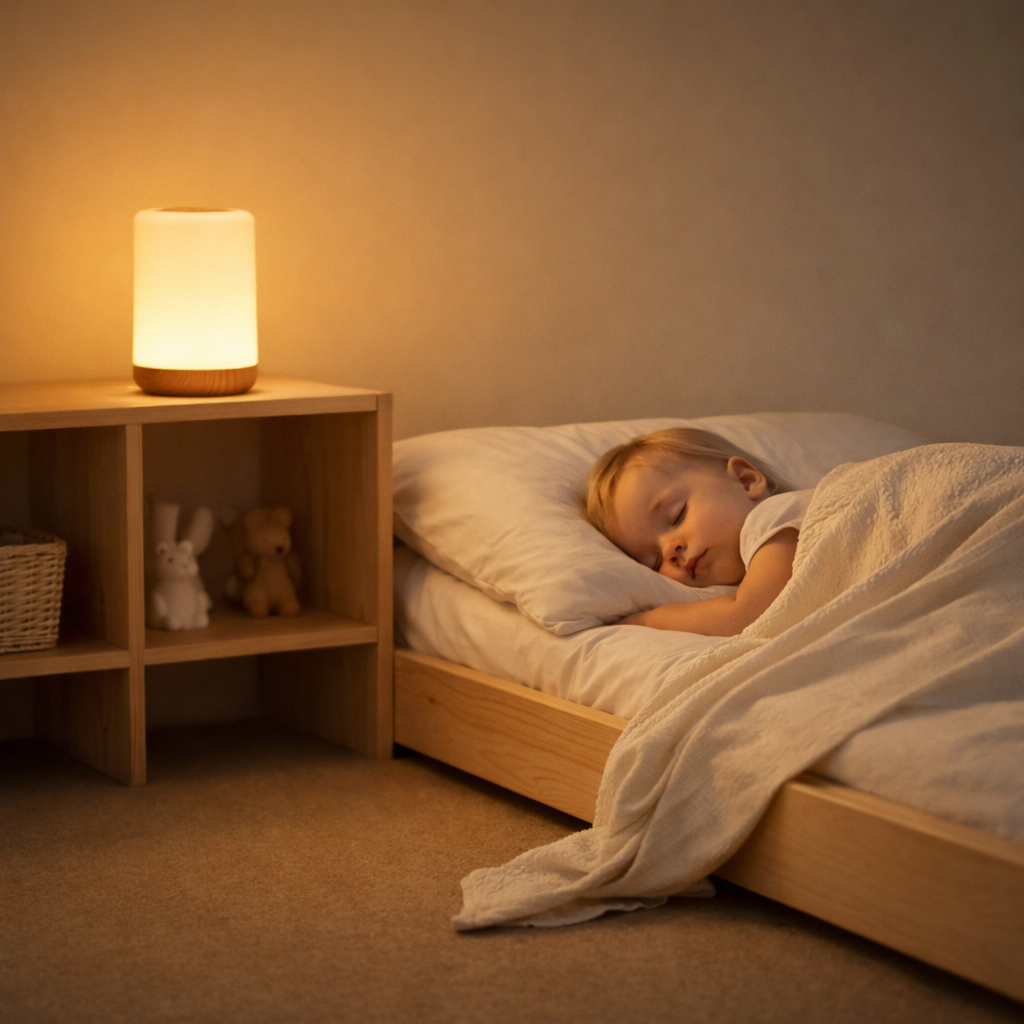
View this dimmable LED night light on Amazon
3. The bedtime routine should regulate, not excite

Bath time can be calming — or activating — depending on how it’s approached.
Warm water naturally lowers cortisol, but the sensory experience still matters. We noticed that our daughter settled more easily when bath time felt predictable and comfortable rather than exciting.
For children with sensitive skin, dryness or irritation can sometimes create subtle discomfort that becomes more noticeable at bedtime. Using a gentle, fragrance-free wash can help minimise one potential source of irritation before sleep.
Keep bath lighting dim.
Slow your movements.
Lower your voice.
The routine should feel predictable, not stimulating.
Books can play a surprisingly powerful role in a calming bedtime routine.
At this age, toddlers often respond well to familiar stories with gentle repetition and predictable rhythms. Reading the same books night after night may feel repetitive for adults, but that familiarity is often exactly what helps children relax.
Some bedtime favourites in our house included I Love You to the Moon and Back and Goodnight Moon both of which have a calm, reassuring feel that naturally supports winding down before sleep. Pairing a cosy story with a calm Montessori bedroom setup helps make bedtime feel familiar, predictable and secure.
4. Watch the overtired window
An overtired toddler rarely looks sleepy.
They look:
Silly
Hyper
Clingy
Defiant
Chaotic
When cortisol rises, the body fights rest.
If bedtime has become a battle, experiment with moving it earlier by 15–30 minutes for a week.
Optimisation sometimes means less effort — not more.
5. Some Toddlers Need More Time to Wind Down
Not all bedtime resistance is caused by overtiredness.
Some toddlers simply need more time to transition from the stimulation of the day into a state that feels calm enough for sleep.
This is especially common in highly active, curious children who move quickly from one activity to the next and struggle when the pace suddenly changes.
In those situations, bedtime often works best when the transition begins earlier than expected.
Rather than moving directly from active play to pyjamas and bed, try creating a gentler wind-down period before the bedtime routine begins.
This might include:
– quieter play
– reading together
– dimming lights throughout the house
– listening to calm music
– reducing screens and stimulating activities
The goal isn’t to make your toddler sleepy.
It’s to help their nervous system gradually shift from activity into rest.
Many parents find that when this transition becomes more gradual, bedtime starts to feel less like a battle and more like a natural continuation of the evening.
6. Simplify the sleep environment
The bedroom should not compete with sleep.
Too many toys, bright colours, busy shelves, or stimulating artwork keep the brain alert. This is one reason many Montessori-inspired bedrooms prioritise fewer visible toys, open space and simple furniture.
A calmer space supports faster settling:
Neutral tones
Minimal visible toys
Consistent temperature
Predictable layout
Many families notice improvement when bedrooms are simplified rather than decorated further.
Sleep often improves when the environment feels calm, predictable and free from unnecessary distractions.
7. Keep the response predictable
When toddlers get up repeatedly, the adult response often determines whether the cycle escalates.
The nervous system relaxes with predictability.
Use one calm, repeatable phrase:
“I won’t let you leave the room. It’s time for sleep.”
Walk them back.
No new language.
No added emotion.
No negotiation.
Security builds through repetition.
8. Optimise connection before separation
Bedtime resistance sometimes increases when toddlers feel disconnected during the day.
A short, undistracted connection ritual before bed can reduce multiple call-backs.
Try:
5 minutes of full attention
No phone
No instructions
Just presence
Fill the connection need before expecting separation.
9. Accept developmental waves
Sleep isn’t linear at this age.
Language leaps
Growth spurts
Separation phases
Toilet learning
New fears
All affect sleep temporarily.
Optimisation isn’t about eliminating every wake-up.
It’s about reducing unnecessary friction so developmental changes don’t become full battles.
10. Create a Calmer Sleep Environment
If your toddler’s room feels busy or overstimulating, simplifying the environment can sometimes reduce bedtime resistance more effectively than changing the bedtime routine itself.
We found that calmer bedrooms with fewer visible toys, predictable layouts and child-friendly furniture often supported easier transitions into sleep.
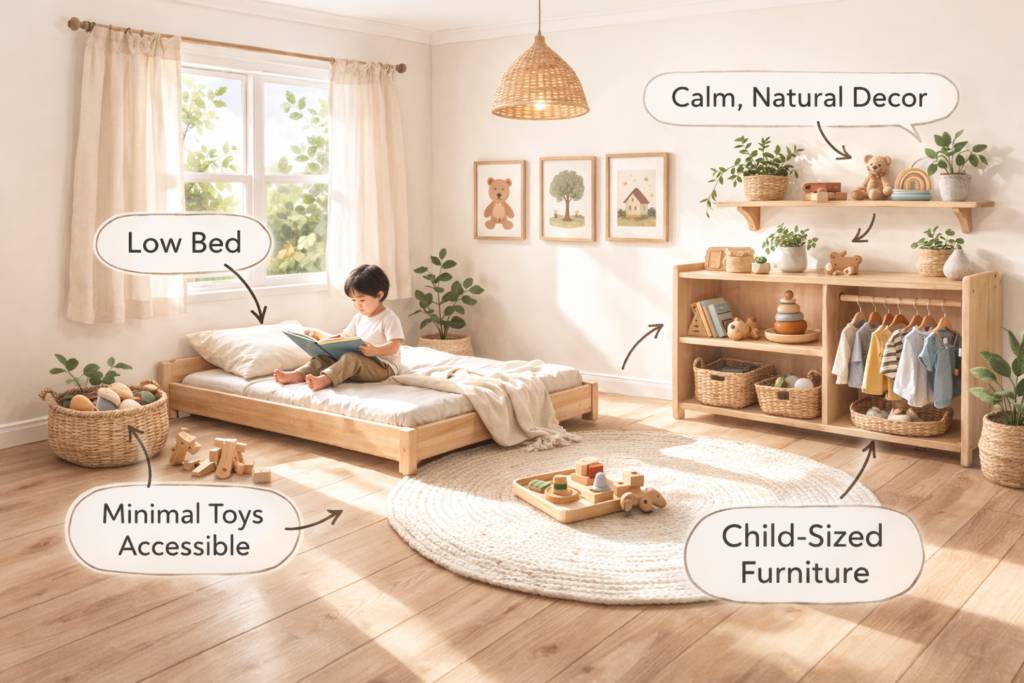
→ Montessori Bedroom Setup for Toddlers (Full Guide for 1–3 Years)
Final Thoughts
If your toddler won’t go to sleep, it’s easy to assume the problem begins at bedtime.
In reality, bedtime is often where the effects of the entire day become visible.
Movement, light, stimulation, connection and routine all influence how easily a toddler can settle into sleep.
Rather than searching for a perfect bedtime strategy, it can be more helpful to make small adjustments throughout the day and observe what changes.
Sometimes the biggest improvements come from the simplest shifts.
A little more movement.
A calmer environment.
A gentler transition into rest.
Over time, those small changes often make bedtime feel easier for everyone.
FAQs
Yes. This article is perfect for FAQs because parents search very specific sleep questions.
I’d focus on questions that:
- Match real searches.
- Reinforce the article’s message.
- Create semantic relevance around toddler sleep.
I’d add 8–10 FAQs like these:
Why won’t my toddler go to sleep even when they’re tired?
Toddlers who are overtired often appear more energetic rather than sleepy. When cortisol levels rise, children can become hyperactive, clingy or resistant to bedtime. In many cases, moving bedtime slightly earlier and reducing stimulation before bed can help.
Why does my toddler suddenly fight bedtime?
Sudden bedtime resistance is often linked to developmental changes such as language growth, separation anxiety, increased independence or changes in routine. These phases are common and usually temporary, although maintaining a predictable bedtime routine can help.
How can I make bedtime easier for my toddler?
Many families find that bedtime becomes easier when they focus on the entire day rather than the bedtime routine alone. Physical movement, outdoor play, reduced evening stimulation, consistent routines and connection before bed can all support better sleep.
What time should a toddler go to bed?
There is no single bedtime that works for every child. However, many toddlers sleep best when bedtime occurs before they become overtired. Watching for patterns and adjusting bedtime by 15–30 minutes can often be more helpful than following a strict schedule.
Why is my toddler hyper before bed?
A hyper toddler is not always an under-tired toddler. Overtiredness can cause children to appear silly, energetic, defiant or unusually active as stress hormones increase. Lack of physical movement during the day can also contribute to bedtime hyperactivity.
Can too many toys in a bedroom affect sleep?
For some children, a busy bedroom can make it harder to settle. Visible toys, bright colours and stimulating decorations may encourage play rather than rest. A simpler sleep environment often helps create a calmer transition to bedtime.
Do night lights help toddlers sleep?
Some toddlers feel more comfortable with a soft night light, particularly during phases of separation anxiety or fear of the dark. Warm, low-brightness night lights tend to work best because they provide reassurance without creating additional stimulation.
How much physical activity does a toddler need before bed?
Most toddlers benefit from plenty of movement throughout the day, including climbing, running, carrying, pushing and outdoor play. Physical activity helps support regulation and can make it easier for the body to transition into rest later in the evening.
Is bedtime resistance a sign of a sleep problem?
Not necessarily. Bedtime resistance is a normal part of toddler development and is often related to independence, separation awareness, overtiredness or environmental factors rather than a medical sleep problem.
What is the Montessori approach to toddler sleep?
Montessori-inspired sleep environments typically focus on simplicity, predictability and independence. Rather than relying on complex sleep aids, the emphasis is on creating a calm environment that supports a child’s natural ability to rest.
You Might Also Find Helpful