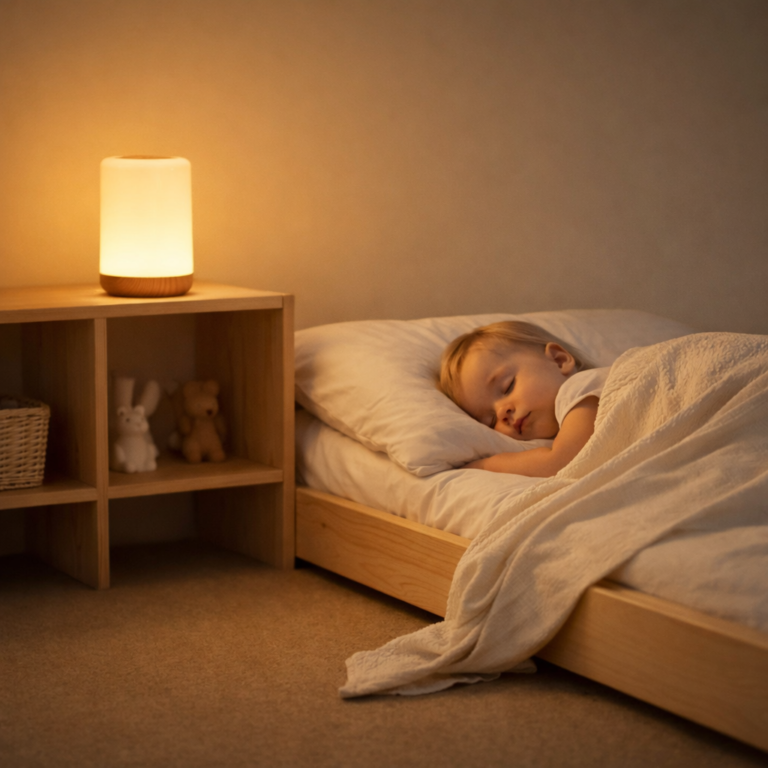
How to Build a Bedtime Routine That Fits Your Baby
If you’ve searched for bedtime routines before, you’ve probably noticed something.
Almost every article recommends exactly the same sequence.
Bath.
Pyjamas.
Story.
Cuddle.
Bed.
It sounds wonderfully simple.
Until you try it with your own child.
Because babies—and later toddlers—have an extraordinary ability to ignore the script.
For some children, a warm bath is wonderfully calming.
For others, it has exactly the opposite effect.
Our daughter fell firmly into the second camp.
Bath time didn’t make her sleepy.
It made her positively delighted.
She’d race around the bedroom in her nappy, jump enthusiastically across the bed and treat the entire evening like the highlight of her day.
The calmer we tried to make bath time…
…the more energetic she became.
At first, we assumed we were doing something wrong.
Surely bedtime was supposed to begin with a bath?
Eventually, we stopped trying to copy someone else’s routine.
Instead, we started paying closer attention to our own daughter.
That’s when we realised we’d been asking the wrong question.
Instead of:
“Should bath time be part of bedtime?”
the better question was:
“What actually helps our daughter feel ready for sleep?”
It wasn’t the bath that mattered.
It was the predictable sequence around it.
Children don’t usually become sleepy because of the bath itself.
They become sleepy because the same familiar sequence happens in roughly the same order every evening.
Those repeated bedtime cues quietly tell the brain:
“Daytime is finishing.”
“Sleep is coming next.”
Once we understood that, everything became easier.
We simply removed the bath from bedtime altogether.
Instead, our evenings gradually settled into a rhythm that suited our daughter.
We’d share a few slices of apple, brush her teeth, and spend a little time doing something quiet—usually Play-Doh or cutting strips of paper with children’s scissors.
We’d spend a little time doing something quiet—usually Play-Doh or cutting strips of paper with children’s scissors.
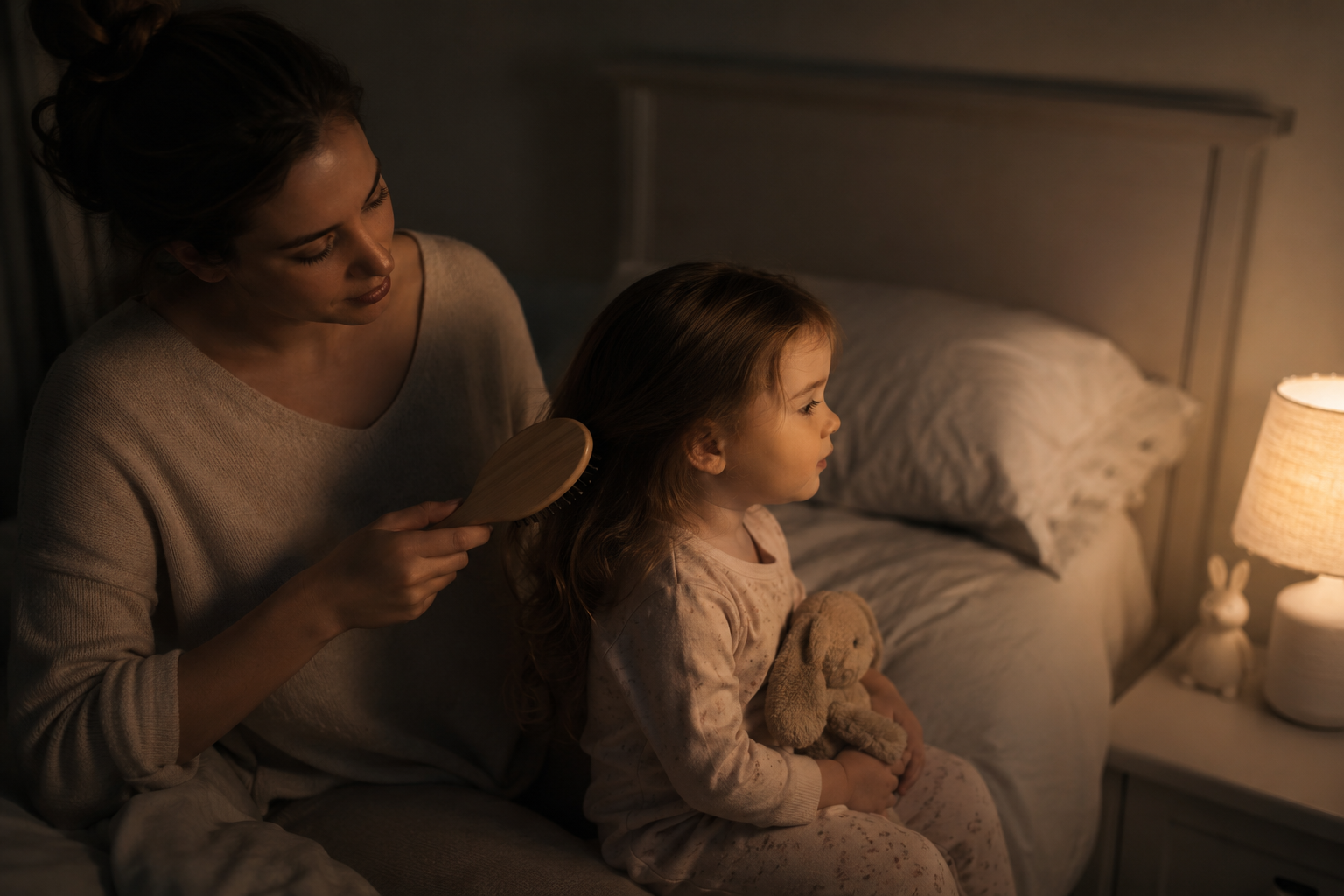
Then I’d brush her hair for a few minutes with a soft bamboo brush. It wasn’t something we’d planned, but she found it incredibly relaxing and it naturally became one of the cues that bedtime was approaching.
After that we’d read a book together.
Lights down.
Sleep.
It isn’t the routine you’ll find in most parenting books.
But it’s the routine our daughter came to recognise.
And that’s what mattered most.
How to Build a Bedtime Routine That Fits Your Family
Before deciding what to include, spend a few evenings simply paying attention.
Every child has activities that naturally help them slow down…
…and others that seem to do exactly the opposite.
Our daughter taught us this very quickly.
Bath time made her wonderfully energetic.
Brushing her hair quietly with a bamboo brush had the opposite effect.
It wasn’t something we’d planned.
It was something we noticed.
That’s often how the best bedtime routines are discovered.
Not by copying someone else’s…
…but by observing your own child.
Step 1: Notice What Calms Your Child
Instead of asking,
“What should our bedtime routine look like?”
try asking,
“When does my child naturally begin to slow down?”
Some babies become wonderfully calm after a warm bath.
Others seem happiest reading books.
Some enjoy gentle rocking.
Others love a bedtime feed.
Some toddlers relax while colouring.
Others enjoy puzzles.
Play-Doh.
Hair brushing.
Listening to quiet music.
Before deciding what your routine should include, spend a few evenings simply observing your child. The activities that naturally help them slow down are often the very ones worth building your routine around.
The activity itself matters less than how your child responds to it.
Step 2: Build Around Three or Four Predictable Cues
Think of your routine as a story with the same ending every evening.
Each activity naturally leads to the next until bedtime becomes the expected conclusion.
For example:
Snack
↓
Quiet play
↓
Hair brushing
↓
Story
↓
Bed
Or perhaps:
Bath
↓
Pyjamas
↓
Feed
↓
Book
↓
Bed
The exact sequence will look different for every family.
That’s perfectly normal.
Most bedtime routines don’t need to be long. Even 20–30 minutes of familiar, predictable activities can become a powerful cue that sleep is approaching.
Step 3: Keep the Order More Consistent Than the Clock
This is where many parents feel they have to be exact.
7:00 bath.
7:10 pyjamas.
7:20 story.
7:30 asleep.
Real life rarely works like that.
Children don’t know what time it is.
They recognise patterns.
Whether bedtime begins at 6:45 or 7:15 matters far less than the familiar sequence that follows.
Over time, that predictability becomes the cue itself.
Step 4: Don’t Be Afraid to Change It
Your baby’s routine at six months probably won’t be the same routine they need at two years old.
As children grow…
…their needs change.
That’s exactly what happened for us.
Our routine today looks completely different from the one we imagined we’d have.
And that’s okay.
The goal isn’t to preserve the same routine forever.
It’s to keep creating one that helps your child feel safe, relaxed and ready for sleep.
Common Mistakes When Establishing a Bedtime Routine
When we first started thinking about bedtime routines, we assumed success depended on finding the perfect sequence.
Looking back, we think it was much more about consistency than perfection.
Here are a few things we’d approach differently today.
Trying to copy another family’s routine
It’s easy to assume that if bath, book and bed works beautifully for another family, it should work for yours too.
But children don’t all relax in the same way.
Some babies become wonderfully calm after a bath.
Others become energised, chatty and ready for another hour of play.
Rather than trying to recreate someone else’s evening, pay attention to the activities that genuinely help your child slow down.
Including too many stimulating activities
The final part of the day should gradually become calmer.
If an activity leaves your child excited, giggling or racing around the room, it may simply belong earlier in the evening instead.
That doesn’t make it a bad activity.
It just means it isn’t serving as a helpful bedtime cue.
Some toddlers even seem to become more energetic just before bed, leaving parents wondering whether they’re tired at all. In many cases, that burst of energy is actually a sign of overtiredness rather than a lack of sleep.
→ 18-Month-Old Hyper Before Bed? The Surprising Reason
Changing the routine too quickly
It’s tempting to abandon a new routine after a couple of evenings if bedtime doesn’t immediately become easier.
But routines aren’t magic.
They work because they become familiar.
Give your child time to recognise the sequence before deciding whether it’s working.
If you’re also thinking about your child’s sleep environment, remember that bedtime routines and sleep products play different roles. A calm, predictable routine lays the foundation, while carefully chosen products can simply support it.
→ Best Low-Stimulation Night Lights for Toddlers
Focusing too much on the clock
Many bedtime guides suggest a very precise timetable.
7:00 bath.
7:15 pyjamas.
7:25 story.
Real life rarely unfolds so neatly.
Children are far more likely to notice the order of events than the exact time they happen.
A familiar sequence repeated consistently often matters much more than starting at precisely 7:00 every evening.
Forgetting that routines grow with your child
The routine that works for a six-month-old probably won’t be the same one that works at two years old.
As children develop, their interests, energy levels and needs naturally change.
Your bedtime routine can change with them.
The goal isn’t to preserve the same routine forever.
It’s to keep creating one that helps your child feel calm, secure and ready for sleep.
Doing too much
Many parents feel they need to create an elaborate bedtime routine with multiple calming activities.
In reality, simpler routines are often easier to repeat consistently.
A routine only works if it still feels manageable on busy evenings.
What Makes a Good Bedtime Routine?
A good bedtime routine isn’t defined by the activities themselves.
It’s defined by consistency.
A successful bedtime routine isn’t the one that looks the same in every home. It’s the one your child learns to recognise.
The individual steps may look different from family to family, but the familiar sequence is what helps children recognise that sleep is approaching.
Final Thoughts
There’s no universal bedtime routine.
No single sequence that works for every baby or every toddler.
The best routine is the one your child begins to recognise.
It might include a bath.
It might not.
It might involve a bedtime feed, gentle hair brushing, a favourite story or a quiet few minutes of Play-Doh before the lights go down.
What matters isn’t the individual activities.
It’s the familiar rhythm they create together.
Because after enough evenings, your child no longer needs to wonder what comes next.
They begin to recognise the rhythm.
And that quiet sense of predictability is often what helps bedtime feel less like a daily battle…
…and more like the gentle end to the day you’ve been hoping for.
Frequently Asked Questions
How do I establish a bedtime routine for my baby?
Start by observing what naturally helps your baby feel calm. Rather than copying another family’s routine, build a simple sequence of two to four calming activities and repeat them in the same order each evening. Over time, those familiar bedtime cues help signal that it’s time for sleep.
What is the best bedtime routine for babies?
There isn’t one bedtime routine that works for every baby. While many families include a bath, feed and story, others find different activities work better. The most effective bedtime routine is one that your baby finds calming and that you can repeat consistently.
Do babies need a bath every night before bed?
No. A bath isn’t essential if it doesn’t suit your baby. Some babies find bath time relaxing, while others become more alert and playful afterwards. If that’s the case, there’s nothing wrong with choosing another calming activity instead.
How long should a baby’s bedtime routine be?
Most bedtime routines last around 20 to 30 minutes, but there’s no perfect length. The routine only needs to be long enough for your baby to recognise the familiar sequence before sleep.
What if my bedtime routine stops working?
It’s completely normal for bedtime routines to change as babies grow. Developmental milestones, teething, illness and changing sleep needs can all affect bedtime. Rather than starting from scratch, adjust the routine gradually while keeping the overall order as consistent as possible.
At what age should I start a bedtime routine?
Many families begin introducing a simple bedtime routine from around 6 to 8 weeks, although newborn routines are naturally less predictable. As your baby grows, repeating the same calming sequence each evening can help establish familiar bedtime cues.
Does the exact bedtime matter?
Consistency is usually more important than an exact clock time. Babies and toddlers respond well to predictable patterns, so following the same sequence of events each evening often matters more than starting at precisely the same minute every night.
Can toddlers have a different bedtime routine from babies?
Yes. As children grow, their bedtime routines naturally evolve. A toddler’s routine might include quiet play, brushing their hair, reading together or another calming activity before bed. The activities can change over time—the familiar order is what helps children know that sleep is approaching.
You Might Also Find Helpful