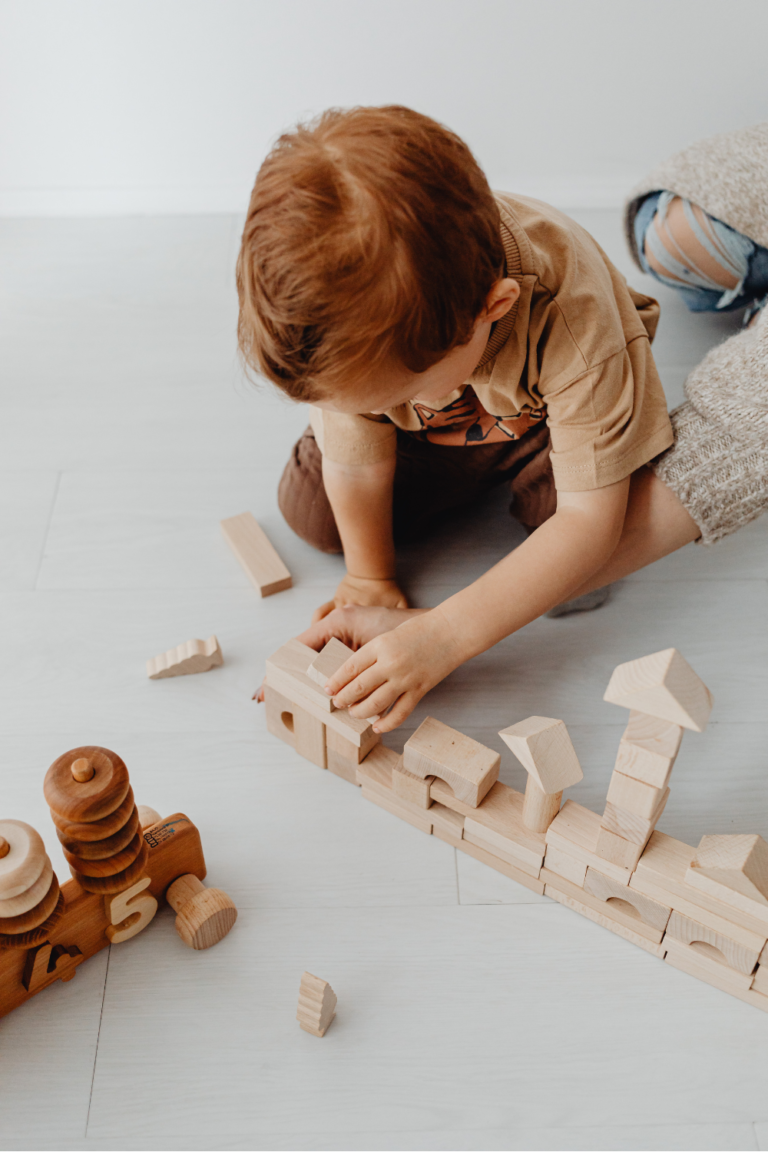
Do You Actually Need to Entertain a 1 Year Old All Day?
There’s a slightly strange point somewhere around your baby’s first birthday when the days can suddenly feel very long.
Your baby is no longer quite content to lie on a mat while you get on with things. They’re crawling, cruising or walking, opening cupboards, following you into every room and developing increasingly strong opinions about where you should be and what you should be doing.
And yet they’re still too little for many of the activities suggested for toddlers.
It’s easy to start wondering what you’re supposed to do with them all day.
Do you need sensory activities ready for the morning? Should you be sitting on the floor playing with them? Taking them to classes? Teaching colours? Setting up invitations to play?
Or is it actually okay to unload the dishwasher while your one-year-old wanders around the kitchen carrying a wooden spoon?
The more I’ve thought about this, the more I think we sometimes start with the wrong question.
Instead of asking “How do I entertain my one-year-old all day?”, it might be more useful to ask:
“What does my one-year-old actually need from their day?”
Because those are two very different things.
A One-Year-Old Doesn’t Need an Entertainment Schedule
One of the easiest traps to fall into as a parent is thinking that an awake child needs to be doing an activity.
There are certainly days when having something up your sleeve is useful. A rainy afternoon can feel approximately six hours longer when you’re sharing it with a restless one-year-old.
But childhood doesn’t need to be organised into a succession of activities.
At this age, almost everything is still interesting.
Imagine being dropped onto another planet where you don’t recognise half the objects, don’t understand the language properly and have no idea why everyone keeps disappearing through certain doors. You’d probably spend quite a lot of time simply watching too.
That’s roughly the position a one-year-old is in. A washing machine spinning, a bus pulling up, water disappearing down the plughole or watching you crack an egg are all still relatively new experiences. Opening a drawer is interesting. Following you upstairs is interesting. Taking three wooden spoons out of a pot and putting them back again can apparently be interesting for considerably longer than the expensive toy sitting beside them.
They don’t need us to make the world interesting yet. It already is.
And that means you don’t necessarily need to create another one for them.
Let Them Into Your Day Instead
This was the shift that made the most sense to me: rather than trying to construct a separate toddler day alongside adult life, bring your child into the life that is already happening.
If you’re making breakfast, let them watch.
If you’re putting washing away, give them a sock to carry.
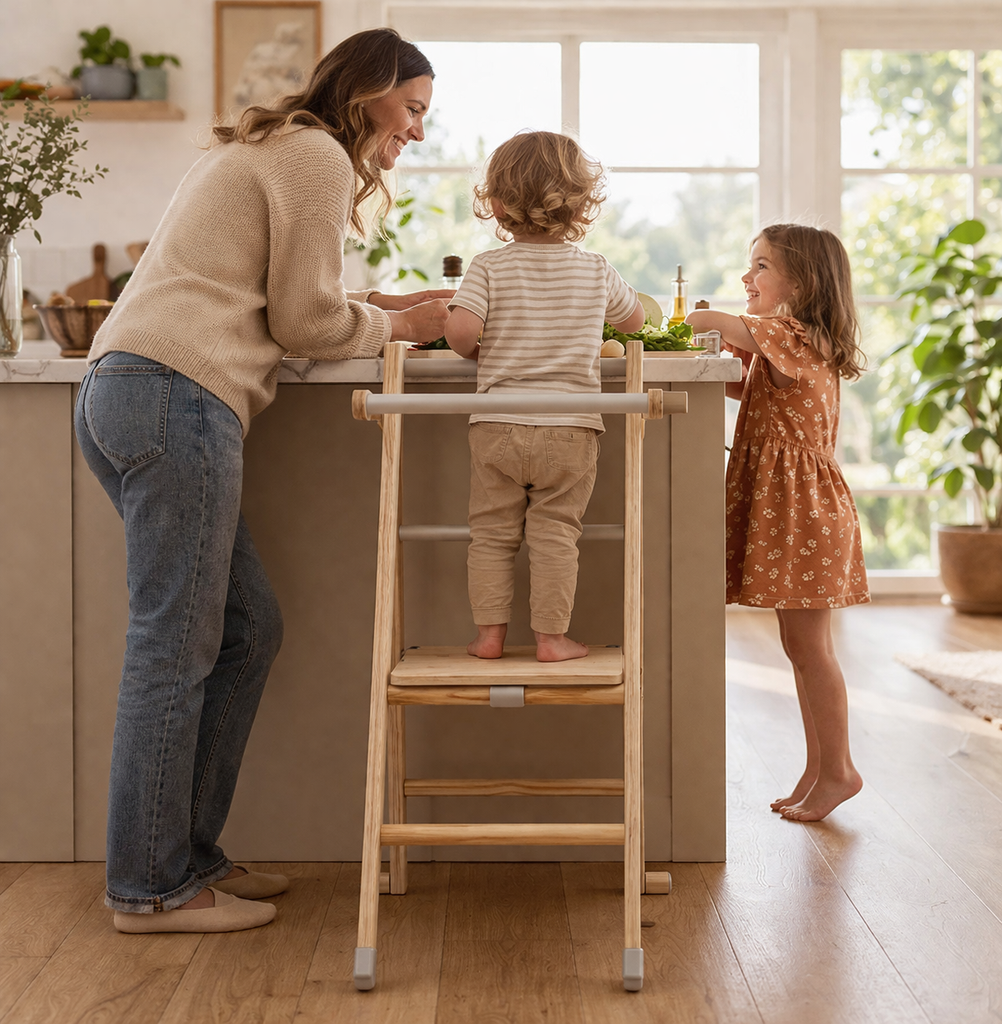
If you’re cooking, they can stand safely nearby and see what you’re doing.
A learning tower can make this much easier once they’re developmentally ready for one, giving them a safe place to watch — and eventually join in. We’ve compared our favourite space-saving options in our guide to the Best Foldable Learning Towers That Don’t Take Over Your Kitchen.
If you’re in the garden, let them potter beside you.
If you’re tidying toys, invite them to put something back in the basket.
None of this needs to become an elaborate learning opportunity. You don’t have to narrate every action, turn folding laundry into a colour lesson or congratulate them for successfully transporting a tea towel across the kitchen.
They’re simply participating.
At one, that participation might mostly consist of watching, carrying things, taking things out, putting things in and occasionally making the job take twice as long.
That’s okay.
They’re beginning to discover that they have a place within family life rather than existing in a separate children’s world that adults continually have to animate for them.
Watching You Is Doing Something
This one is easy to underestimate.
When we see a one-year-old standing quietly watching us make lunch, we can feel as though we ought to give them something to do.
But observing is something to do.
They are watching how you hold the jug. Where the plate comes from. What happens when you open the fridge. How you wipe the table. What you do when something spills.
Eventually, the child who has watched you wipe the table dozens of times reaches for the cloth themselves.
That’s one of the lovely things about this stage. Participation often begins long before a child is actually capable of helping.
So you don’t need to rush in and fill every quiet moment.
Sometimes they’re learning simply by being there.
Give Them Real Things to Do
As your one-year-old becomes more capable, there are little ways to move them from watching to participating.
Not because you need another activity to fill twenty minutes, but because young children often genuinely want to be involved in whatever you’re doing.
They might:
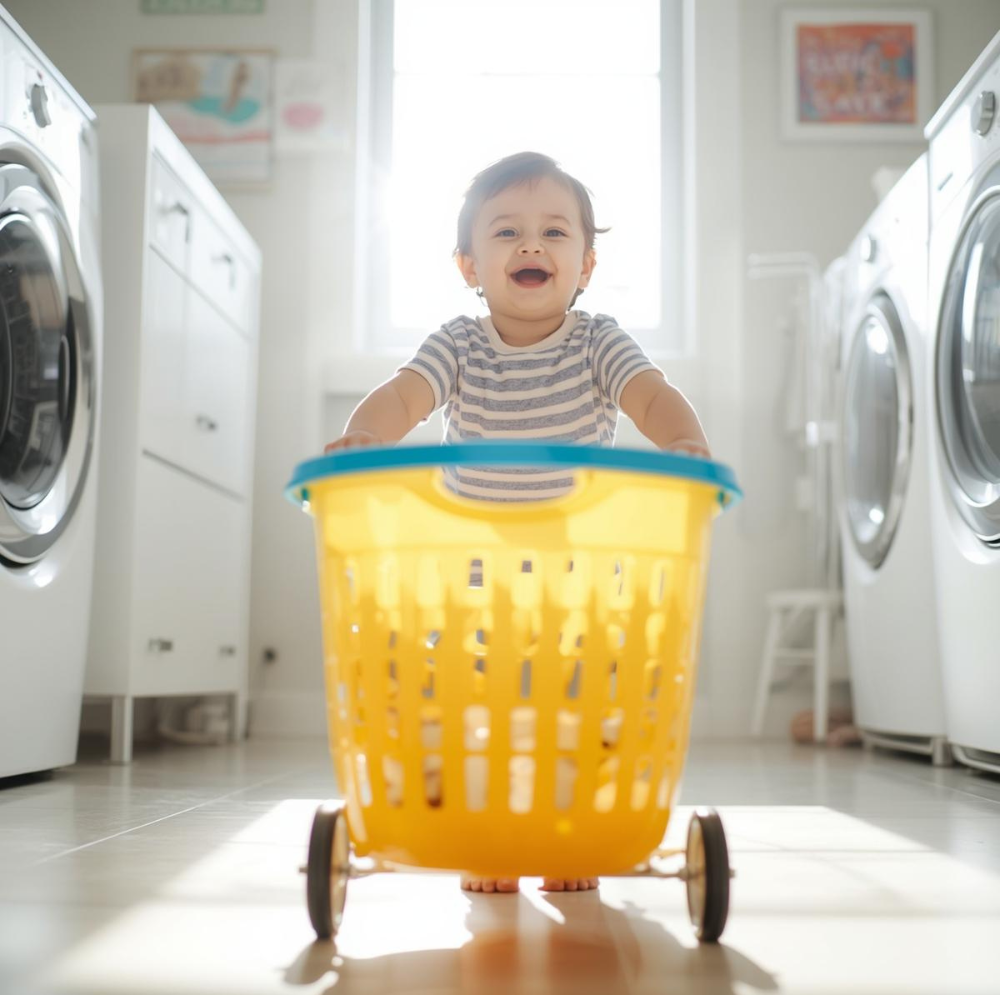
- carry clothes to the washing machine,
- put a spoon on the table,
- wipe a small spill with a cloth,
- drop toys into a basket,
- put fruit into a bowl,
- carry their shoes to the door,
- water a plant with help,
- put something into the bin,
- or stand beside you while you prepare food
Will they do these things efficiently?
Absolutely not.
A one-year-old’s contribution to laundry may involve putting one sock into the machine and then removing four.
But efficiency isn’t really the point.
They’re discovering something much more interesting: I can do things here too.
This idea of letting children take part in ordinary household life is something we explore more in Montessori Practical Life for Babies & Toddlers — although you certainly don’t need a Montessori home to start handing over the odd sock or cloth.
You Don’t Have to Play With Them Every Time They Play
Playing with your child is lovely. Sit on the floor. Build the tower. Roll the ball backwards and forwards. Read the same book for the seventh time.
But you don’t have to join every game.
There’s a subtle difference between being available and being the entertainment.
You can be nearby while your child explores.
You might be drinking your coffee while they stack cups on the floor. You might be making dinner while they investigate a kitchen drawer you’ve made safe for them. You might be folding clothes while they move objects between two baskets for reasons known only to themselves.
You don’t need to show them the “right” way to play with everything either.
Give them enough time and children frequently find uses for objects that wouldn’t have occurred to us.
Sometimes the most useful thing an adult can do is simply not interrupt.
Make Independent Exploration Possible
Of course, telling a one-year-old to “go and play” while placing them in a room full of things they can’t touch isn’t particularly realistic.
This is where the environment matters.
If there is somewhere in your home where they can move relatively freely, reach a few carefully chosen toys or books and explore without hearing no, don’t touch that and come away from there every thirty seconds, independent play becomes much easier.
It doesn’t need to be a beautiful dedicated playroom.
A low basket with a handful of toys, a small bookshelf, a safe kitchen cupboard they are allowed to investigate or simply a child-friendly corner of the room can be enough.
And fewer things can sometimes work better than more.
When everything is available at once, toys easily become background clutter. Putting out a smaller selection and changing it occasionally can make the things they already own interesting again.
Our simple guide to toy rotation explains how we do this without turning it into another complicated system to maintain.
Outside Counts — Even When Nothing Is Planned
Not every trip outside needs a destination.
A one-year-old doesn’t necessarily need the zoo, soft play or a carefully researched toddler class to have an interesting morning.
Walking slowly down the road can take quite some time when you’re one.
There are leaves to pick up, dogs to watch, buses to point at, puddles to investigate and inexplicably fascinating drains.
A trip to the shop can be part of the day. So can posting a letter, walking to get coffee or sitting in the garden. For longer walks or errands, a baby or toddler carrier can make it easier to simply bring them along with whatever you were already planning to do.
Adult life and a child’s need to explore don’t always have to compete.
Often they can happen at the same time.
And Yes, Sometimes Set Up Something Fun
None of this means activities are bad.
Sometimes it’s lovely to get the paints out, fill a bowl with water, make play dough, build a blanket den or set something interesting on the table.
The difference is that activities become something you occasionally offer rather than something you’re responsible for continually producing.
You don’t need six of them before lunch.
For a one-year-old, something incredibly simple can be enough: water and a cup, chunky crayons and paper, a cardboard box, a few containers to fill and empty, or music to dance to.
And if you spend longer preparing the activity than they spend doing it, congratulations: you have had the authentic one-year-old activity experience.
What Does a One-Year-Old Actually Need From Their Day?
Probably much less novelty than the internet can make it seem.
They need opportunities to move their bodies. They need conversation, affection and connection with the people who care for them. They need food, sleep and time outside. They need interesting things to explore and plenty of opportunities to practise emerging skills.
They need to hear language, look at books, touch things, carry things, climb things, repeat things and occasionally become deeply invested in an object you had not realised was remotely interesting.
And increasingly, they need opportunities to do things for themselves.
What they don’t necessarily need is an adult orchestrating every waking minute.
So What Does a Day With a One-Year-Old Actually Look Like?
This is perhaps where social media has done parents no favours.
A perfectly good day might look remarkably ordinary from the outside.
You have breakfast together. Your child potters around while you clear up. You get dressed and go for a walk. They investigate some leaves while you wonder how it can possibly take fifteen minutes to travel fifty metres.
You come home. They play while you make lunch, wandering over occasionally to involve you in something extremely important. You eat. They nap.
In the afternoon you read some books, perhaps go to the shop, put some washing away together and spend a while in the garden. At some point you sit down and properly play together. At another point you need to make dinner, so they occupy themselves nearby.
There might be a toddler group or swimming lesson in there. There might be a beautifully prepared activity.
There also might not be.
The rhythm matters more than filling every gap.
Boredom Doesn’t Mean You’re Doing Something Wrong
When a child starts fussing or wandering around aimlessly, our instinct can be to produce something.
A toy. A snack. A new activity. A screen. Ourselves.
And sometimes that’s exactly what they need.
But not every moment of uncertainty needs fixing immediately.
There is value in having a little space between one thing and the next — enough time for a child to notice something, investigate it and decide what to do.
Independent play doesn’t appear because we finally discover the perfect toy that keeps a child occupied for forty-five minutes.
It’s something children gradually learn when they’re given safe opportunities to explore without an adult continually directing what happens next.
At one, those stretches may be very short.
Five absorbed minutes still count.
You Are Part of Their Day, Not Their Entertainment Department
Perhaps this is the part worth remembering on those particularly long afternoons.
Your one-year-old absolutely needs you.
They need your attention, your comfort, your conversation, your boundaries and plenty of moments when you’re completely present with them.
But needing you isn’t the same as needing you to entertain them continuously.
There will be years ahead for complicated crafts, days out, elaborate games and activities that require actual instructions.
At one, the ordinary world still has plenty to offer.
Let them watch. Let them follow. Let them help badly. Let them explore. Let them occasionally wonder what to do next.
You don’t have to create childhood for them.
They’re already in it.
Frequently Asked Questions
Do I need to entertain my 1-year-old all day?
No. One-year-olds need plenty of interaction and connection, but that doesn’t mean you need to provide constant entertainment. Everyday life gives them an enormous amount to observe and explore. Letting them watch what you’re doing, join in with simple household tasks, play independently nearby and come along on ordinary outings can all be part of their day.
What can I do with my 1-year-old all day?
You don’t necessarily need to fill the day with activities. Meals, getting dressed, a walk, errands, books, playing at home, helping with simple household jobs, time outside and naps can provide plenty of rhythm to the day. A toddler group, swimming lesson or planned activity can be lovely too, but it doesn’t have to happen every day.
Is it okay to let my 1-year-old play independently?
Yes. Independent play at this age may only last a few minutes, and that’s completely reasonable. Providing a safe space with a small number of accessible toys or everyday objects gives them opportunities to explore without an adult directing every moment of their play.
Is it okay for a 1-year-old to be bored?
You don’t need to immediately fill every quiet or restless moment with entertainment. A little unstructured time gives children the opportunity to notice what’s around them and decide what to explore next. Sometimes what looks like “nothing to do” to an adult is the beginning of a child finding something interesting for themselves.
You Might Also Find Helpful