
Montessori Toy Rotation: The Simple System That Keeps Toddlers Engaged
If your toddler constantly dumps toys on the floor, gets bored quickly, or jumps from one activity to another, the problem may not be the toys themselves — it may simply be too many choices at once.
Montessori toy rotation is a simple way to reduce overwhelm, help toddlers focus, and encourage longer, more meaningful play.
Instead of filling the room with dozens of toys, the Montessori approach focuses on fewer, more meaningful activities that support learning and independence.
Here’s how Montessori toy rotation works and how you can easily start using it at home.
Disclaimer: This post contains affiliate links. As an Amazon Associate I earn from qualifying purchases at no extra cost to you.
What Is Montessori Toy Rotation?
Montessori toy rotation means keeping only a small number of toys available at a time, while everything else is simply stored away and brought out later. The toys aren’t being removed permanently or donated—they’re still part of your child’s collection, just not all visible at once.
Keeping just a small selection on display creates a calmer, less overwhelming environment that’s easier for toddlers to navigate and choose from independently.
Toy rotation doesn’t just reduce clutter. It also gives children repeated opportunities to build concentration, independence, decision-making and a sense of responsibility for their environment.
This simple approach is widely used in Montessori homes because it encourages deeper, more focused play without constantly introducing something new.
If you’re interested in encouraging longer independent play sessions, you may also enjoy our guide on independent play for toddlers → How to Create an Environment That Encourages Independent Play
Why Toy Rotation Works
Toddlers often play best when they can focus on a small number of activities. When too many toys are available, it’s easy for them to move quickly from one thing to another without becoming deeply engaged.
By keeping the play space simple, toy rotation encourages longer concentration, more independent play and a calmer, more organised environment.
One of the biggest surprises for us was discovering that boredom wasn’t always a sign our daughter needed more toys. In many cases, she actually played for longer when there were fewer options available. Once we reduced the number of toys on display, she began returning to the same activities repeatedly instead of constantly searching for something new.
It was a useful reminder that toddlers often benefit from simplicity more than constant novelty. We also realised we didn’t need to keep buying new toys to hold her interest. Simply rotating the ones she already owned often made familiar favourites feel exciting again, just because they’d been out of sight for a little while.
If your toddler struggles to stay engaged with toys, you may also find this helpful → Why Won’t My Toddler Play Alone and What Actually Helps
Our Toy Rotation Reset
When we first tried toy rotation, we didn’t buy anything new or completely reorganise the playroom. We simply gathered every toy into one place, chose a small selection covering different types of play and packed the rest away. We kept the remaining toys in simple storage boxes in a cupboard where they were easy for us to reach but out of sight for our daughter. Nothing was thrown away or donated—we simply swapped a few activities between the shelf and storage every week or two.
Almost immediately, the room felt calmer and our daughter seemed less overwhelmed by choice.
The biggest improvement came from moving those activities onto a low shelf. When toys were stored in baskets, play often turned into searching and emptying everything out. Once each activity had its own place on an open shelf, she began choosing toys independently, returning to familiar activities more often and, over time, even putting them back herself.
Looking back, the biggest benefit wasn’t a tidier room. It was seeing how much more capable she became when she could access and choose activities independently.
We chose a more substantial shelf because we wanted something that would grow with our daughter rather than replacing furniture every couple of years. Even now, as her interests have changed, it continues to work just as well for books, puzzles, craft activities and more advanced toys.
The shelf itself isn’t the important part. What matters is creating a calm, organised space where your child can clearly see what’s available. Open shelving simply makes that easier.
If you’re looking for inspiration, the shelf below illustrates the general approach.
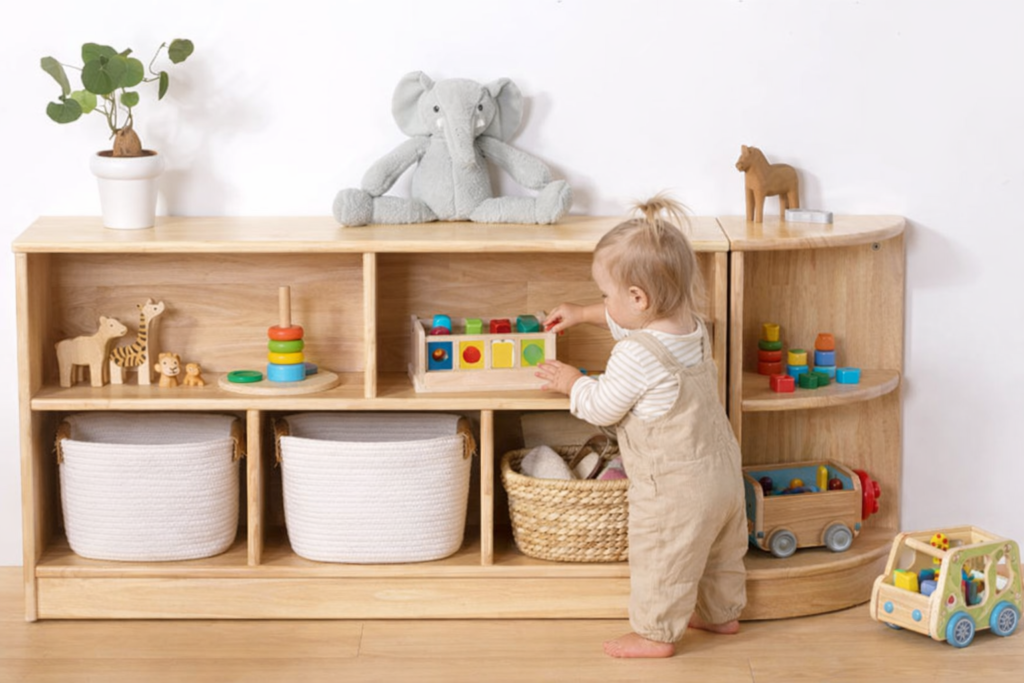
If you’d prefer a more budget-friendly option, a simple bookcase or storage unit can work just as well. The key is to keep toys within your child’s reach, clearly visible and limited to a small number of carefully chosen activities.
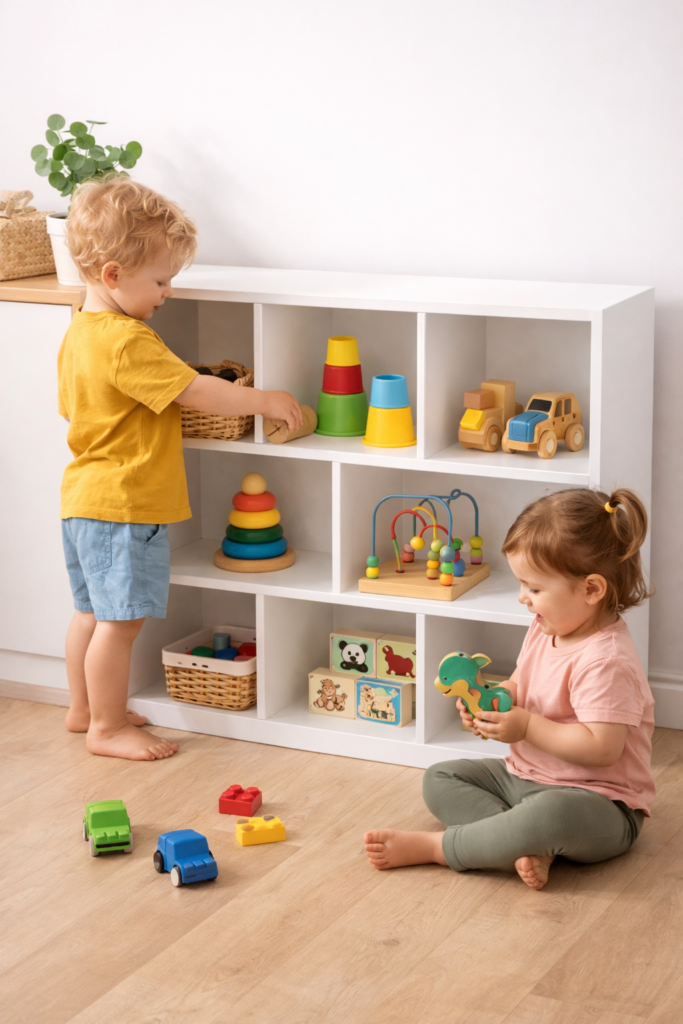
View Montessori-style storage unit
Once your shelves are set up, the final step is simply to refresh them every week or two. Rather than replacing everything at once, swap just two or three activities to keep the environment familiar while introducing a little novelty.
How Many Toys Should Be Out?
In Montessori environments, less is usually better.
For most toddlers, around 6–10 carefully chosen activities is a good starting point. Think of the shelf as a small selection from your child’s collection, not a reflection of everything they own.
That doesn’t mean 6–10 toys in total. It simply means 6–10 activities on display, with everything else stored somewhere convenient until it’s their turn to come back. Rather than offering multiple toys that do the same thing, aim for a balanced mix of activities such as a simple puzzle, a shape sorter, a stacking toy, a practical life activity, a few books and perhaps one or two open-ended toys.
Giving each activity its own space on a low shelf makes it easier for toddlers to see what’s available, make independent choices and return items when they’ve finished.
If you’re setting up a toddler play area, you might also find our guide to Montessori toys for 1 year old toddlers helpful.
Building a Balanced Toy Shelf
A well-balanced toy shelf doesn’t need lots of activities. In fact, a small selection that encourages different types of play is often far more engaging than several toys that all serve the same purpose.
For example, you might include a simple puzzle or shape sorter to encourage problem-solving, a stacking toy or peg board to develop fine motor skills, a practical life activity such as pouring or transferring, a few favourite books and perhaps one open-ended toy that invites imaginative play. Together, these activities give toddlers opportunities to explore, repeat and gradually master a range of new skills without the environment feeling overwhelming.
If you’re looking for specific toy recommendations, our guide to educational toys for 1-year-olds by developmental milestone explores activities that support fine motor skills, problem-solving, movement, coordination and early independence.
A Simple Toy Rotation Example
If you’re wondering what this might look like in practice, here’s one simple example. You don’t need these exact toys—the goal is simply to offer a balanced selection and swap a few activities every week or two.
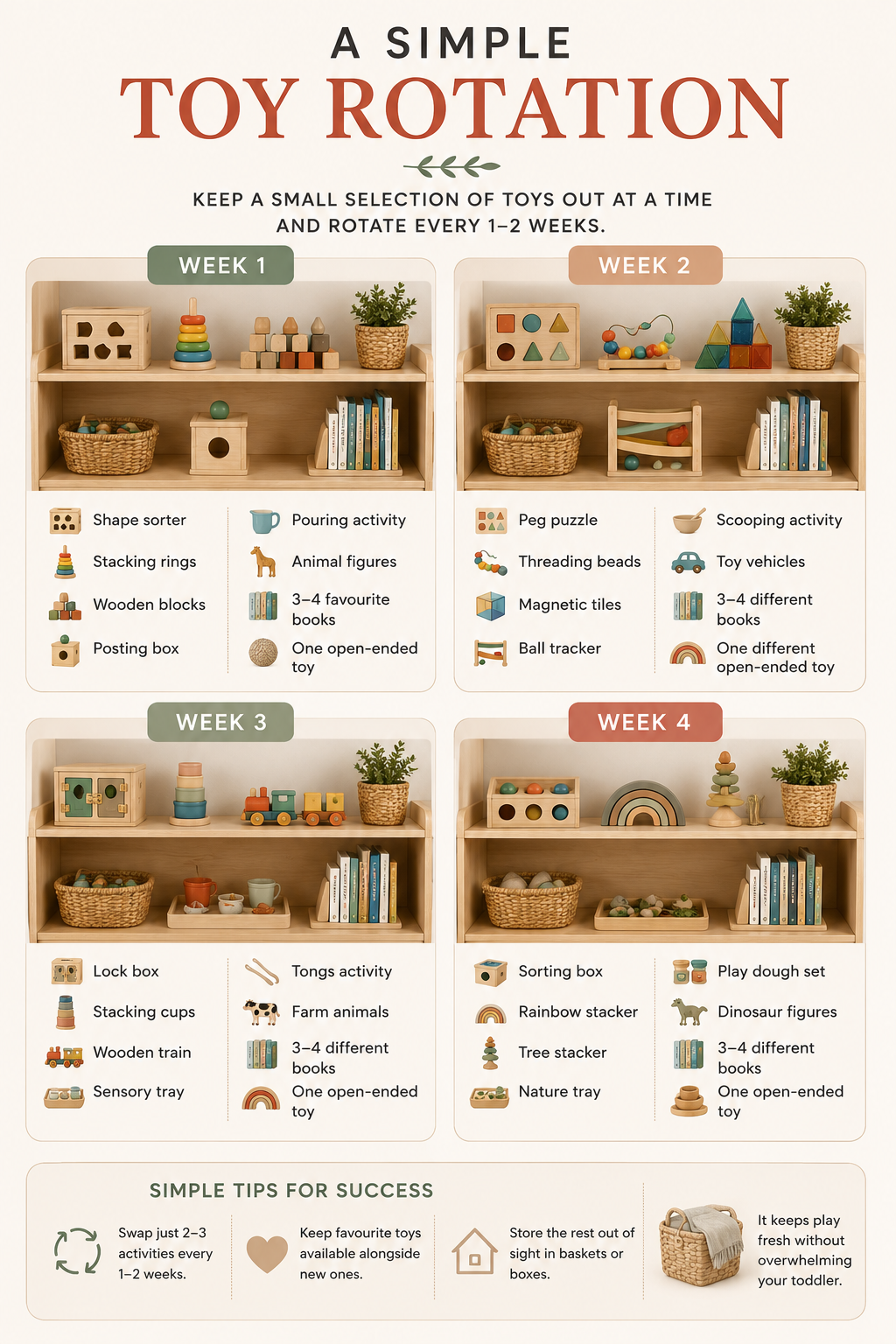
Remember, this isn’t a strict schedule. If your toddler is still deeply engaged with a particular activity, there’s no need to rotate it just because a new week has begun. Let your child’s interests guide the timing as much as the calendar.
How Often Should You Rotate Toys?
Most Montessori families rotate toys every one to two weeks, but there isn’t a fixed schedule. Some parents rotate based on time, while others simply watch their child.
If a toy hasn’t been chosen for a while, your toddler seems less interested, or the shelf is starting to feel cluttered, it may be time to swap a few activities. Small, gradual changes are usually more effective than replacing everything at once.
Signs Your Toy Rotation Is Working
As toy rotation becomes part of your routine, you may notice your toddler playing with activities for longer, returning to familiar toys more often and becoming increasingly confident choosing independently. Many families also find that a calmer, more organised play space leads to fewer toy-related battles.
Common Toy Rotation Mistakes
Toy rotation doesn’t need to be complicated, but a few common mistakes can make it less effective.
One of the biggest is changing every toy at once. While it can be tempting to completely refresh the shelf, small changes usually work better. Replacing just two or three activities keeps the environment familiar while still making it feel new.
Another common mistake is leaving too many toys out.
Some parents also feel they need to get rid of toys to make rotation work. In reality, most families simply keep the rest in a cupboard, storage box or another room until they’re ready to swap them back in.
When every shelf is full, toddlers often spend more time deciding what to play with than actually playing. A smaller, carefully chosen selection usually encourages deeper concentration and more independent exploration.
Finally, try not to rotate toys too frequently. Children often return to the same activity again and again as they refine a new skill, and what looks repetitive to us is often an important part of learning. If a toy is still being chosen regularly, there’s no need to swap it out just because a week has passed.
A Simple Rule to Remember
Maria Montessori observed that children often show deep concentration when they are given meaningful work in an environment that supports independence. Toy rotation follows the same principle. Rather than constantly introducing new entertainment, it creates space for children to return to familiar activities, practise skills repeatedly and develop confidence through mastery.
A helpful Montessori principle is:
Fewer toys on display often lead to deeper play.
Toy rotation isn’t about buying more toys.
It’s about creating a thoughtful environment where children can focus, explore, and develop independence.
Many parents find that once they reduce the number of toys, they also reduce stress — for both themselves and their child.
Final Thoughts
Toy rotation isn’t about owning fewer toys or constantly buying new ones. It’s about helping your child rediscover the toys they already have by making them easier to see, easier to choose and more enjoyable to come back to.
If you’re building a calm and child-friendly home environment, you may also enjoy our guides to:
→ Creating a Montessori calm corner for toddlers
→ Montessori daily routines for toddlers
These simple changes can help support independence, emotional regulation, and deeper learning at home.
Frequently Asked Questions About Montessori Toy Rotation
What is Montessori toy rotation?
Montessori toy rotation is the practice of offering a small number of carefully chosen activities at a time while storing the rest away. Rather than surrounding children with dozens of options, the goal is to create a calm and orderly environment where they can focus more deeply on what is available.
Many parents find that toys feel interesting again when they return to the shelf after a short break, often reducing the feeling that children constantly need something new.
How many toys should toddlers have available?
There is no perfect number, but many Montessori-inspired homes display around 6–10 activities at a time.
The goal is not to restrict play but to make choices manageable. When children can easily see everything available, they are often more likely to choose an activity independently and stay engaged with it for longer.
How often should you rotate toys?
Most families rotate toys every one to two weeks, although there is no strict schedule.
Some parents rotate based on time, while others simply watch their child. If a toy has not been chosen for a while or the shelf starts to feel repetitive, it may be a good time to swap a few activities. Small changes are usually more effective than completely replacing everything at once.
Does toy rotation actually help toddlers play longer?
Many parents notice that it does.
When fewer toys are available, children often spend more time exploring each activity instead of moving rapidly between options. This doesn’t mean every child will suddenly play independently for long periods, but a simpler environment can make focused play feel easier and less overwhelming.
Do I need special Montessori toys for toy rotation?
No. Toy rotation works with almost any toys you already own.
The Montessori principle is not about buying specific products. It is about offering a thoughtful selection of activities that support exploration, concentration and independence. Books, puzzles, stacking toys, practical life activities and even everyday household objects can all be part of a successful toy rotation.
Should I rotate books too?
Many Montessori families rotate books alongside toys. Offering a small selection of books at a time can make them feel more inviting and easier for toddlers to choose independently. Favourite books can stay available for longer, especially if your child regularly returns to them.