
Educational Toys for 1 Year Olds by Developmental Milestones
The first year brings an incredible amount of change.
Around their first birthday, many babies are becoming more mobile, more curious and more determined to explore the world around them. Some are pulling to stand, some are taking their first steps, and others are happily perfecting crawling, cruising or climbing.
At the same time, they’re developing new ways of thinking and learning. They begin experimenting with cause and effect, searching for hidden objects, placing things into containers and solving simple problems through trial and error.
It’s important to remember that children reach milestones at their own pace. Development is rarely a straight line, and there is often a wide range of what is considered completely normal.
Rather than trying to accelerate development, the best educational toys simply support the skills that are already beginning to emerge. They provide opportunities to practise, experiment and explore through play.
In this guide, we’ve organised our recommendations around common developmental milestones that often emerge around the first birthday, including posting and sorting, object permanence, developing a pincer grip, pulling up, cruising, first steps, and movement and coordination. Many are Montessori-inspired, open-ended and designed to remain engaging long after a particular milestone has passed.
Disclaimer: This post contains affiliate links. I may earn a small commission at no extra cost to you. As an Amazon Associate I earn from qualifying purchases.
Find Toys by Developmental Milestone
One of the easiest ways to end up with a house full of unused toys is to buy products based on age recommendations alone.
A toy labelled “12+ months” isn’t necessarily relevant to what your child is interested in right now.
Instead, we prefer to think about toys in terms of the skills and milestones that are beginning to emerge.
The toys below aren’t designed to accelerate development. They simply provide opportunities to practise skills that many one-year-olds are naturally working on already.
The guide is organised around the following developmental milestones:
- Putting things into containers and taking them out again
- Object permanence and early problem-solving
- Developing a pincer grip
- Pulling up, cruising and taking first steps
- Movement, coordination and following moving objects
Milestone: Putting Things In and Taking Things Out
If there is one activity that seems almost universally appealing around the first birthday, it’s moving objects from one place to another.
Containers become fascinating.
So do boxes, baskets, cups and drawers.
What looks repetitive to adults is often serious developmental work for a toddler.
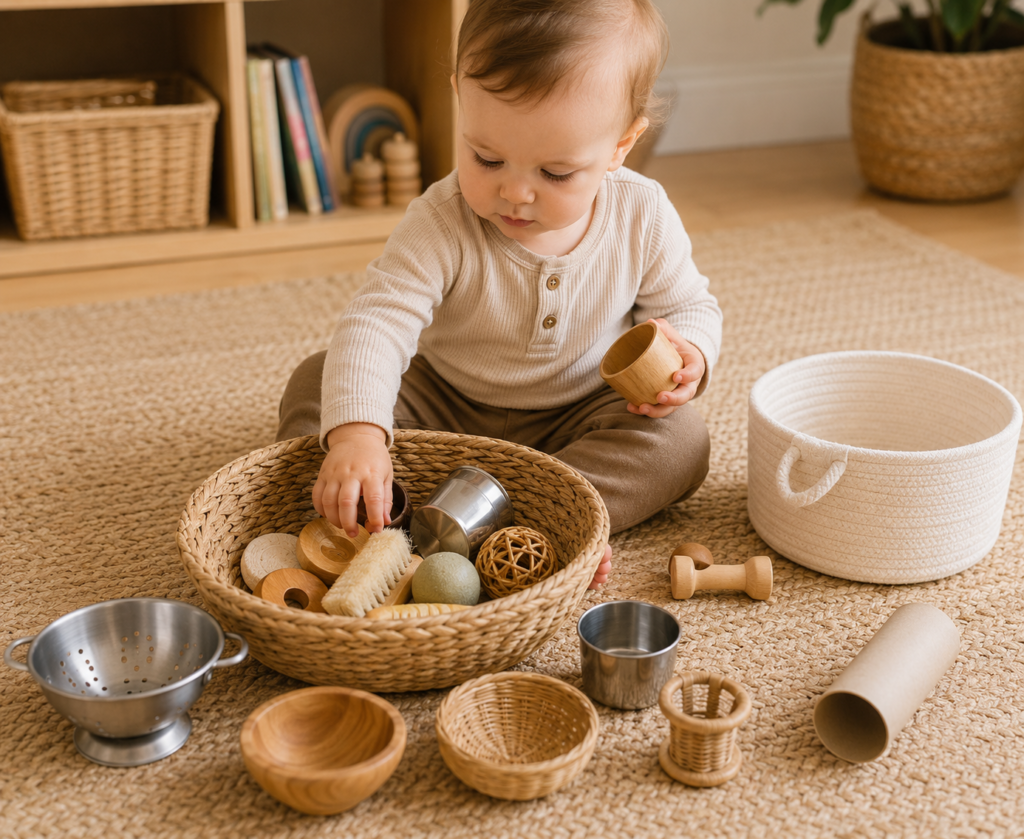
Treasure Basket and Containers
One of our favourite reminders that educational toys don’t always need to be expensive.
A small basket filled with safe household objects often attracts more attention than many purpose-built toys.
At this age, filling, emptying, carrying and sorting can easily become the activity itself.
Targets: Sensory exploration, tactile discrimination, containment and posting, fine motor grasp variety, bilateral coordination, wrist rotation, problem-solving, and vocabulary building
Posting Box
A Montessori posting box allows children to insert large wooden discs, balls or shapes through a slot before retrieving them again.
It sounds remarkably simple because it is.
Targets: Pincer grasp, three-jaw chuck grasp, spatial orientation, wrist alignment, hand-eye coordination, size discrimination, object permanence, and problem-solving
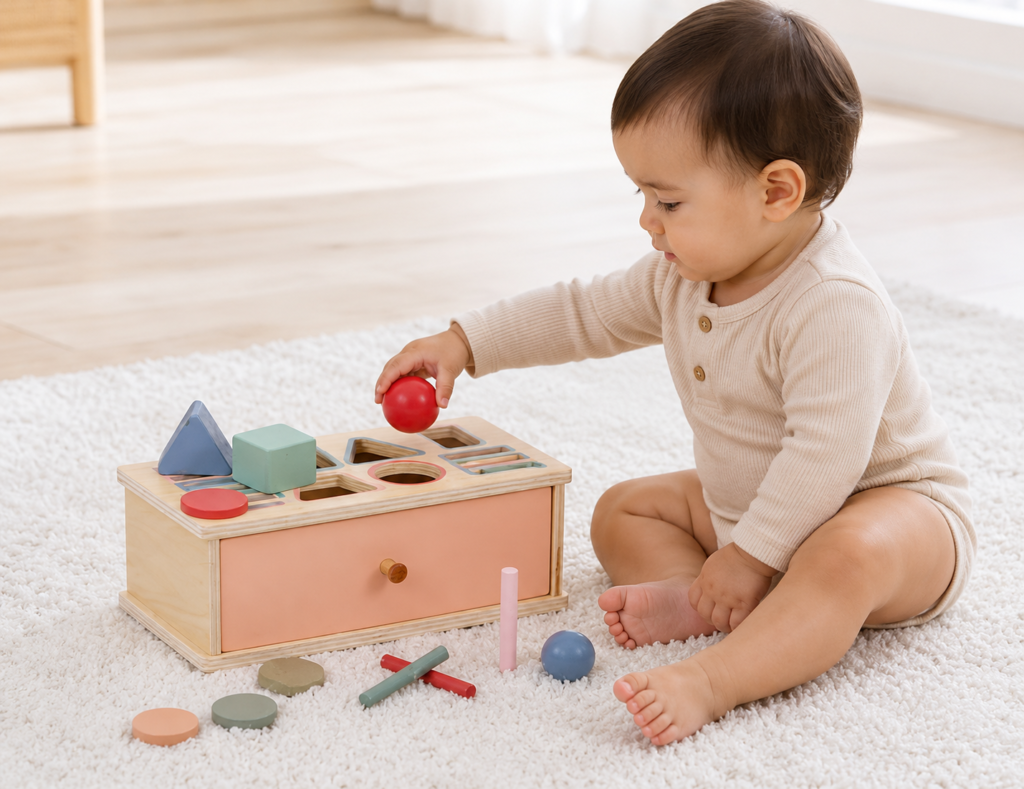
Yet it supports hand-eye coordination, concentration, problem-solving and the satisfaction of repeating a successful action over and over.
Many children return to this activity long after the novelty should have worn off.
Montessori Colour Sorting Cups & Balls Set
One of those rare toys that seems to evolve alongside your child.
What begins as simple posting, filling and emptying soon becomes colour matching, scooping, sorting, stacking and imaginative play. With twelve wooden cups, matching balls, a bowl, spoon and storage tray, there are countless ways to revisit the same set as new skills begin to emerge.
Targets: Colour recognition, visual matching, classification, pincer grasp, palmar grasp, hand-eye coordination, spatial awareness, bilateral coordination, and early scooping/transferring mechanics
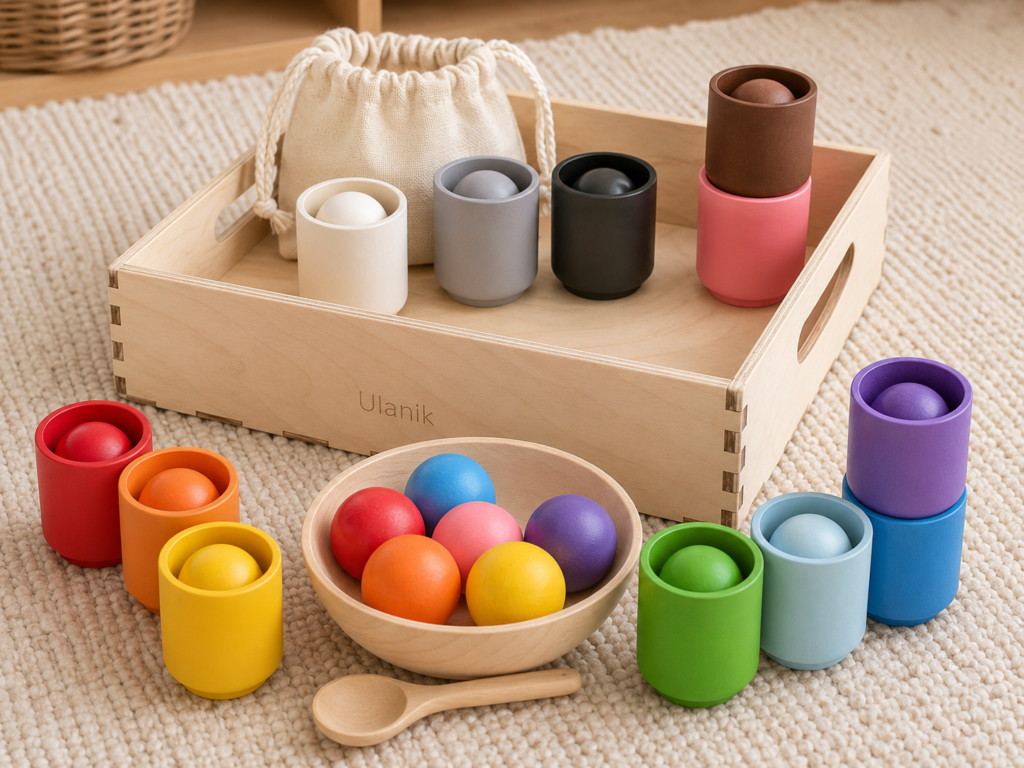
Although it’s one of the more expensive recommendations in this guide, we think it’s also one of the best long-term investments. Rather than outgrowing it after a few weeks, many children continue discovering new ways to use it well into the toddler years.
Our daughter is almost three now, and it’s still one of the toys she returns to regularly. What started as simple colour matching has gradually become stacking towers, counting games, pretend magic tricks where the balls “disappear” beneath the cups, and simple memory games where we hide a coloured ball and take turns remembering which cup it’s under. It’s one of those rare toys that seems to grow alongside your child rather than being quickly left behind.
Milestone: Object Permanence
Around this age, many babies become increasingly interested in things that disappear and reappear.
Hide a toy under a cloth and suddenly you’ve created a challenge worth solving.
Object Permanence Box
This is one of the most recognisable Montessori materials for a reason.
The child places a ball into a hole and watches it reappear.
Targets: Object permanence, visual tracking, hand-eye coordination, palmar-to-pincer grasp transition, cause and effect, focus and concentration, and gross motor reach
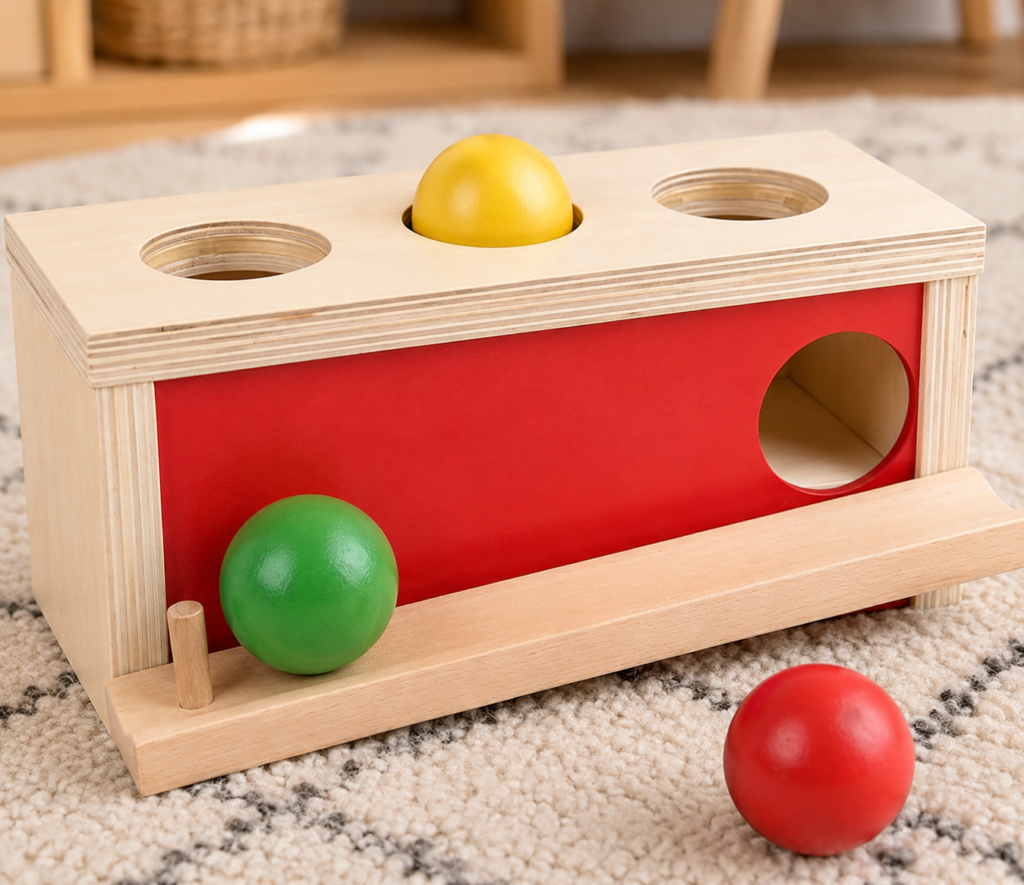
The sequence is simple, predictable and deeply satisfying.
More importantly, it helps children understand that objects continue to exist even when they can no longer see them.
Milestone: Developing a Pincer Grip
The pincer grip — picking up objects using the thumb and forefinger — becomes increasingly important during the second year.
Many everyday activities eventually depend on it, from feeding to drawing and dressing.
Bunny Pop Up Toy
One of the most engaging ways we’ve found to encourage the pincer grip.
Targets: Cause and effect, hand-eye coordination, palmar-to-pincer grasp transition, wrist and finger strength, spatial tracking, colour matching, and bilateral coordination
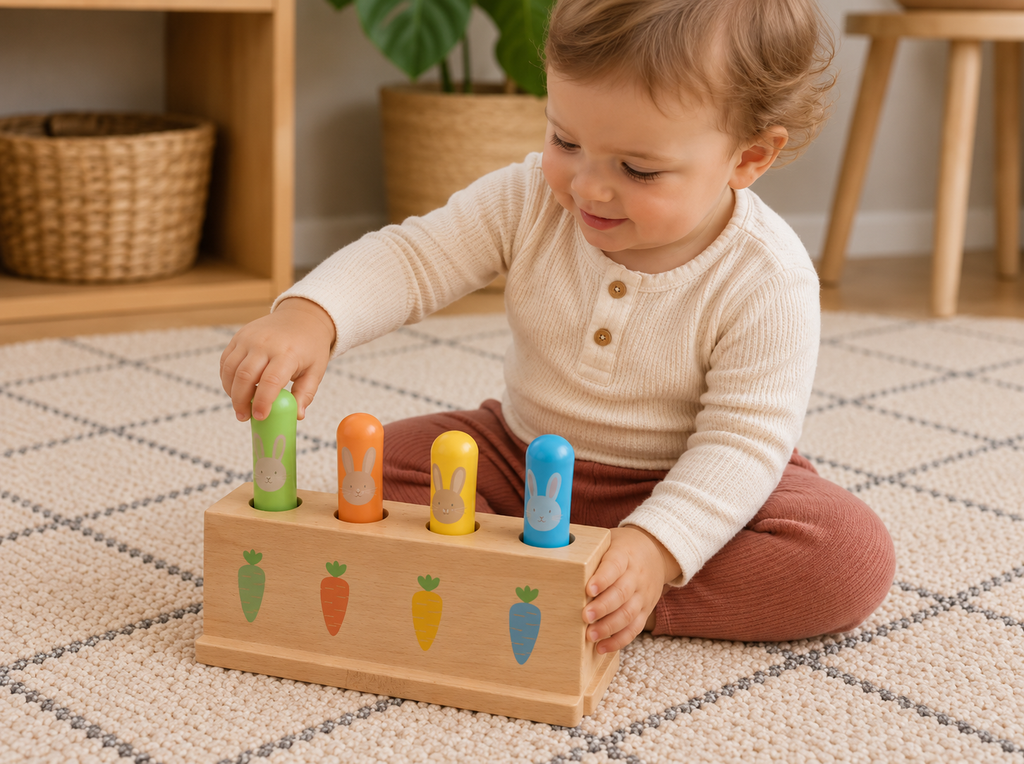
Children press the little bunnies down one by one, then eagerly wait to see which one pops back up next. The simple cause-and-effect action naturally encourages repetition, giving little fingers plenty of opportunities to practise precise movements without the activity ever feeling like work.
It’s one of those deceptively simple toys that many toddlers happily return to again and again, building fine motor skills through play rather than repetition alone.
Carrot Harvest Activity Cube
We don’t usually recommend multi-activity toys. Many try to do too much at once and end up doing very little particularly well.
This is one of the few exceptions.
Targets: Spatial awareness, size discrimination, object permanence, finger isolation, motor planning, crossing the midline, cause and effect, wrist strength, bilateral coordination, and tactile discrimination
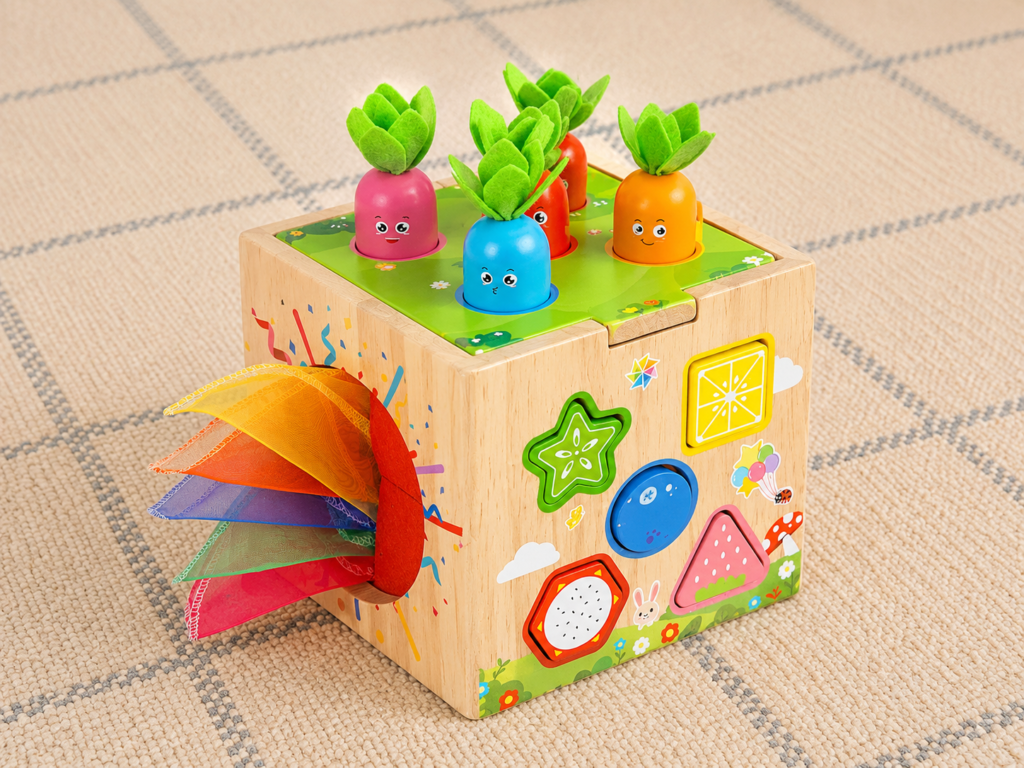
The carrot harvest game first caught our attention, but the cube also includes a shape sorter, animal sliding maze, teaching clock and a sensory tissue box with soft scarves for pulling and exploring. Each activity feels purposeful rather than overwhelming, offering something new as your child’s skills develop.
The carrot game is especially engaging, encouraging grasping, pulling and matching while introducing simple problem-solving as children work out which carrot fits where. Our daughter spent far longer rearranging the carrots than we ever expected.
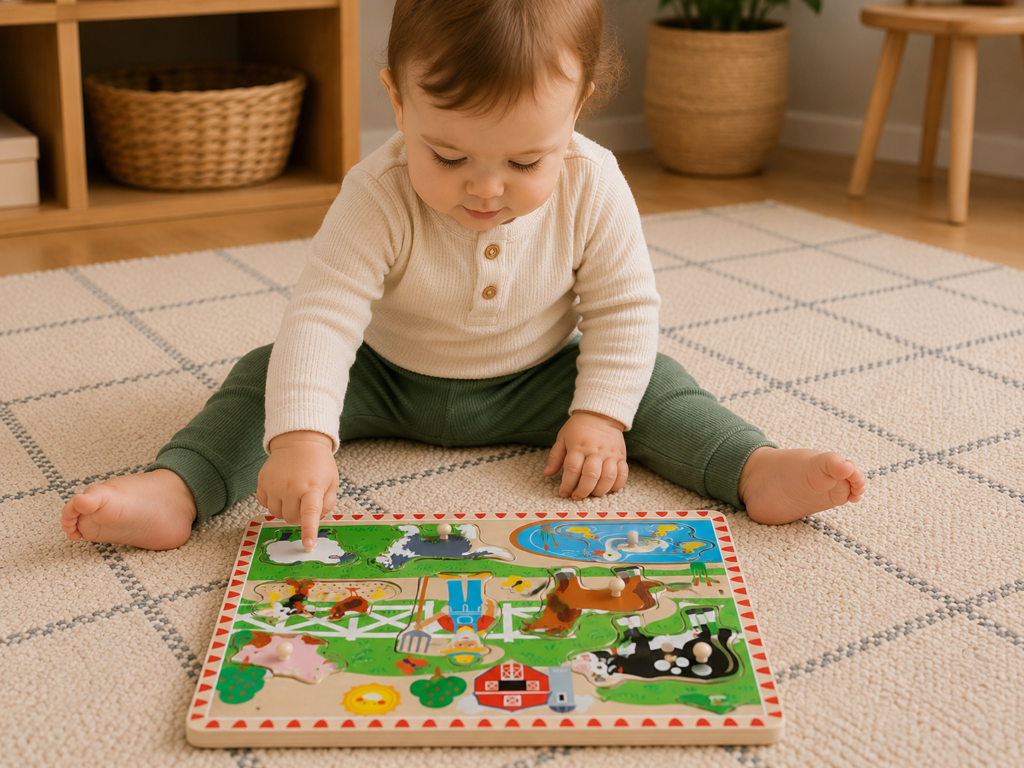
Wooden Knob Puzzle
One of the simplest first puzzles we’ve found. Matching animals to their outlines introduces the idea that each piece belongs in a particular place, while the chunky wooden knobs are easy for little hands to grasp, making it an approachable introduction to puzzles around the first birthday.
Targets: Pincer grasp refinement, three-jaw chuck grasp, spatial orientation, geometric shape discrimination, hand-eye coordination, muscular isolation, and visual problem-solving
Milestone: Movement, Coordination & Following Objects
Many one-year-olds are still highly motivated by movement.
Sometimes the most effective toy is simply something worth following.
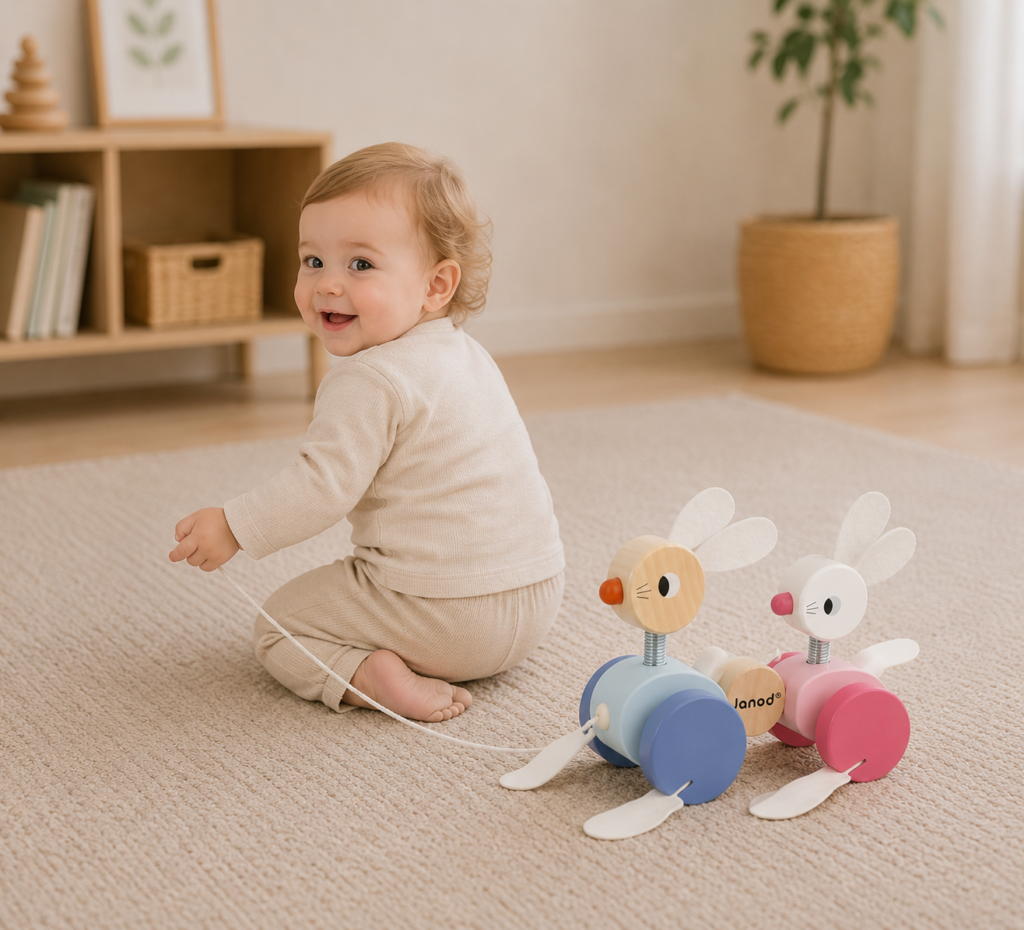
Pull Along Toy
Pull-along toys have been around for generations, and for good reason. As toddlers become more confident walkers, they naturally enjoy taking favourite toys with them, turning every journey across the living room into a little adventure.
This beautifully made wooden bunny is one of the few toys that’s genuinely stood the test of time in our house. Our daughter is almost three and still reaches for it several times a week. Watching the bunnies wobble along behind her never seems to lose its charm, and the way their little feet flap as they roll still makes us laugh every. single. time.
Targets: Backward tracking, spatial awareness, multi-tasking coordination, balance control, gait stabilization, cause and effect, and grip strength
Milestone: Pulling Up, Cruising and Taking First Steps
Not every developmental toy needs to be played with while sitting on the floor.
As mobility increases, many children become interested in standing, climbing and exploring from a new perspective.
Pikler Triangle
If there is one larger Montessori investment that grows with a child, this is probably it.
Targets: Gross motor strength, spatial orientation, vestibular processing, proprioceptive input, balance control, motor planning, risk assessment, and self-confidence
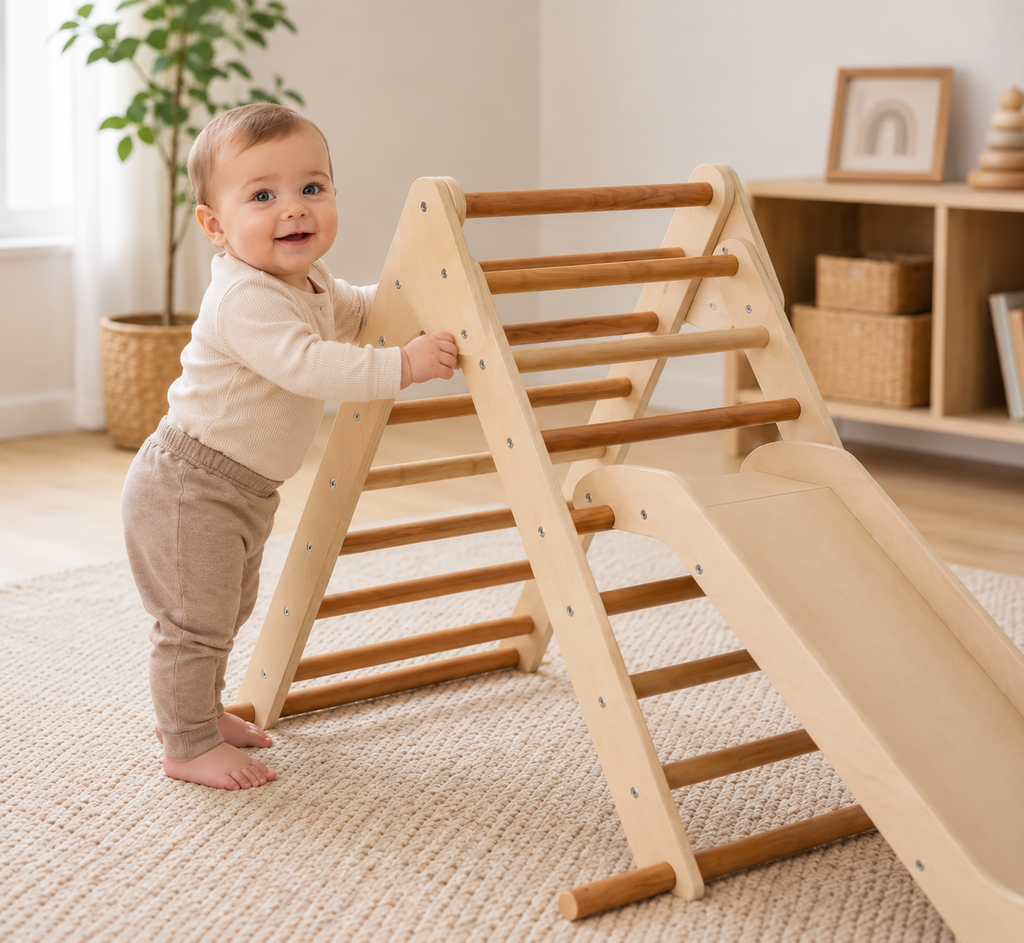
While many parents initially buy it for climbing toddlers, even younger children often begin by pulling up, cruising around it and exploring its structure.
Heavy Wooden Walker Wagon
As babies begin pulling up, cruising and taking their first independent steps, they often look for sturdy objects to hold onto as they move around.
Targets: Gross motor strength, core stability, balance control, spatial awareness, posture refinement, bilateral coordination, motor planning, and independent navigation
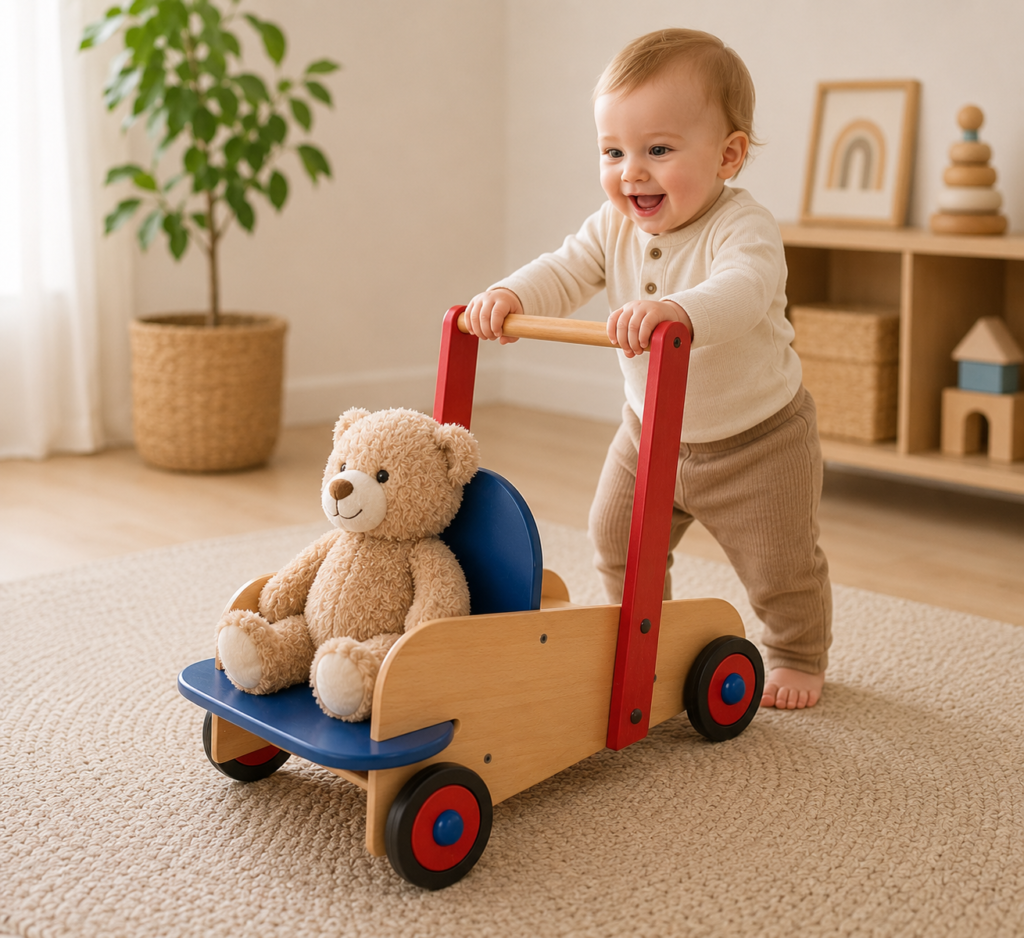
A well-built wooden push wagon can provide a stable surface to practise standing and pushing at their own pace, while also doubling as a favourite way to transport toys, books and treasured finds around the house.
We particularly like heavier wooden models, as they’re generally more stable than lightweight plastic alternatives and less likely to race away from little feet. Long after those first steps have become confident walking, many toddlers continue using them for imaginative play, making them one of the few early mobility toys that can remain useful for years.
A Quick Note on Educational Toys
The best educational toys rarely look particularly educational.
They don’t quiz children, flash lights or claim to teach ten skills at once.
More often, they provide a simple challenge that a child chooses to repeat voluntarily.
That’s one of the reasons Montessori toys have remained popular for so long. They respect the idea that children learn most effectively when they’re actively involved in the process.
In many cases, the most valuable toy is simply the one that continues to be used long after the box has been recycled.
While educational toys can encourage movement, concentration and problem-solving, it’s equally important to give young children opportunities to slow down and recharge. If you’re creating a calming space at home, our guide to creating a Montessori-inspired calm corner shares simple ideas for supporting independent quiet time and emotional regulation.
Shopping on Amazon?
If you’re not already a Prime member, you can check whether you’re eligible for a free 30-day trial and enjoy Prime delivery on millions of eligible items.
Frequently Asked Questions
What are the best educational toys for a 1 year old?
The best educational toys are those that match your child’s current stage of development rather than simply their age. Around the first birthday, many babies enjoy posting toys, object permanence boxes, treasure baskets, simple puzzles and toys that encourage pulling up, cruising and early walking. Open-ended toys that can be used in different ways often remain engaging for much longer than single-purpose toys.
Are Montessori toys good for 1 year olds?
Yes. Many Montessori toys are ideal for one-year-olds because they encourage children to learn through hands-on exploration rather than lights, sounds or buttons. Simple materials such as posting boxes, object permanence boxes and wooden sorting toys allow babies to repeat movements, solve problems and build confidence at their own pace.
How many toys should a 1 year old have?
Most one-year-olds benefit more from a small selection of thoughtfully chosen toys than a room full of options. Rotating a handful of toys every week or two often keeps play fresh while reducing overstimulation. A few high-quality, open-ended toys usually provide far more learning opportunities than dozens of battery-powered alternatives.
What developmental milestones should educational toys support at 12 months?
Around 12 months, many babies begin developing skills such as putting objects into containers, understanding object permanence, refining their pincer grip, pulling up to stand, cruising, taking first steps and improving coordination. Educational toys don’t speed up these milestones, but they can provide enjoyable opportunities to practise the skills that are already beginning to emerge.
What toys do children still play with after their first birthday?
Some of the longest-lasting toys are those that grow alongside the child. Open-ended toys such as wooden pull-along toys, Pikler triangles, colour sorting sets, activity cubes and simple wooden puzzles often remain favourites well into the toddler years because children continue finding new ways to use them as their abilities develop.