A Simple Montessori Toddler Daily Routine for Calm Days
When toddlers know what comes next, the day often feels calmer for everyone.
Young children thrive on predictability. Not because they need rigid schedules, but because familiar rhythms help the world feel safer, more manageable, and easier to understand.
This is one reason Montessori places so much value on daily routines. Rather than rushing from one activity to the next, Montessori encourages a gentler rhythm built around connection, movement, independence, rest, and meaningful participation in everyday family life.
Instead of constantly entertaining toddlers or filling every moment with planned activities, the focus is on creating a predictable flow to the day. Children know what to expect, have opportunities to contribute, and are given the time and space to concentrate deeply on what they are doing.
The routine in this guide is not intended to be a strict schedule. Instead, think of it as a simple framework that can be adapted to your child’s age, temperament, and sleep needs.
For most toddlers between 12 months and 3 years, this kind of predictable daily rhythm often helps create calmer, more connected days at home.
Why Toddlers Thrive With Predictable Routines
Toddlers experience the world very differently from adults.
Transitions can feel abrupt. Waiting can feel overwhelming. And constantly changing expectations can quickly lead to frustration.
A predictable daily rhythm helps reduce that uncertainty.
When toddlers begin to recognise what usually happens next, they often feel:
- calmer
- more cooperative
- more independent
- emotionally secure.
This is one reason Montessori homes often feel peaceful.
The environment, routines, and pace of the day work together to support the child rather than constantly pulling them from one thing to the next.
Research also suggests that consistent family routines may help reduce stress and behavioural difficulties over time by making daily life feel more predictable and easier for children to anticipate.
If you’re navigating big emotions during this stage, our easy-read guide to toddler behaviour may also help.
Importantly, Montessori routines are not about creating a perfectly structured day.
They are about creating enough consistency for toddlers to feel grounded while still allowing flexibility for real life.
Many parents also include small calming spaces in their home, such as a Montessori calm corner, where children can pause and regulate their emotions during overwhelming moments.
Toddlers are still developing the ability to regulate emotions, manage transitions, and understand what comes next throughout the day.
Predictable routines reduce uncertainty by helping children anticipate what is happening next. Over time, this can make daily life feel safer, calmer, and easier to navigate emotionally.
Research also suggests that consistent family routines are associated with positive child development outcomes including emotional regulation, behaviour, sleep, self-control, and overall wellbeing.
A 2023 systematic review by researchers Saliha B. Selman and Janean E. Dilworth-Bart reviewed 170 studies and found that predictable routines were consistently associated with healthier developmental outcomes in children.
Source: “Routines and Child Development: A Systematic Review” — Selman & Dilworth-Bart (2023)
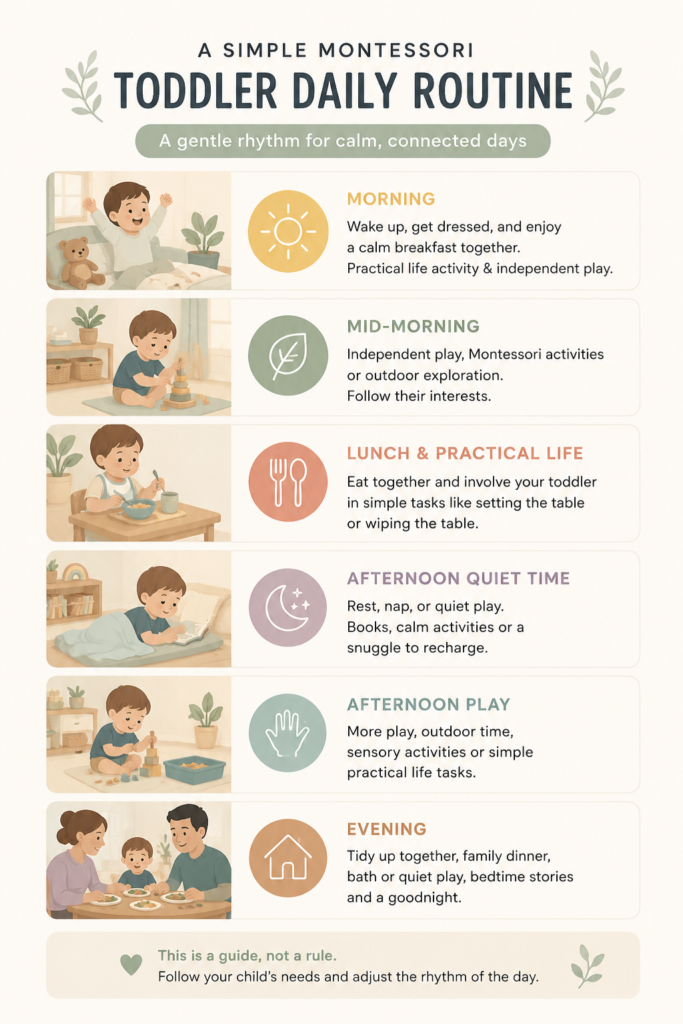
A Simple Montessori Toddler Daily Routine
Montessori routines do not need to be rigid or overly scheduled.
The goal is simply to create a predictable flow to the day that balances:
- movement
- play
- practical life
- connection
- rest.
Here is a simple rhythm many Montessori families naturally follow.
Morning Routine
Mornings often set the tone for the entire day.
A slower, calmer start usually helps toddlers feel more regulated and cooperative throughout the morning.
A simple Montessori morning often begins slowly. After waking and getting dressed, toddlers join the family for breakfast before moving naturally into practical life activities and independent play.
Rather than rushing immediately into activities, Montessori mornings often allow toddlers time to participate in everyday routines.
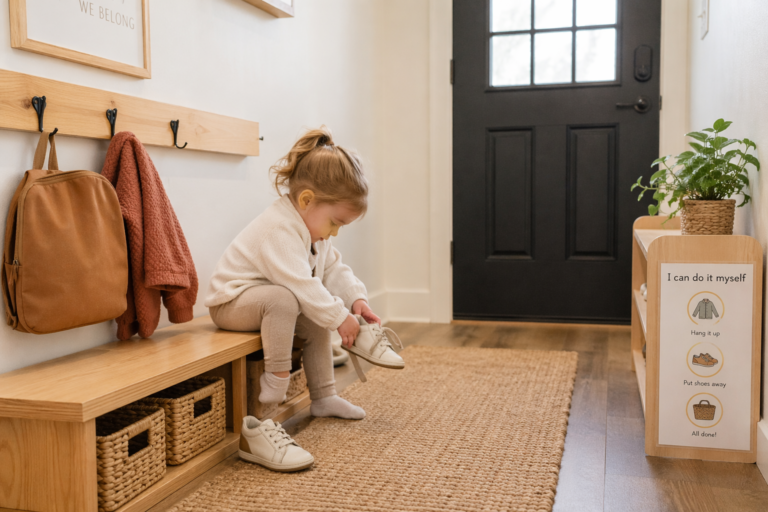
These small moments of participation are often referred to as practical life activities in Montessori. Simple tasks like carrying a cup, wiping a spill, or helping with laundry help toddlers build independence naturally throughout the day.
→ Montessori Practical Life for Babies & Toddlers
This might be as simple as carrying a cup to the breakfast table, helping wipe a spill, placing clothes in the laundry basket, or putting shoes by the door before leaving the house.
These small moments build independence naturally because toddlers feel involved rather than constantly directed.
After breakfast, many toddlers move naturally into independent play.
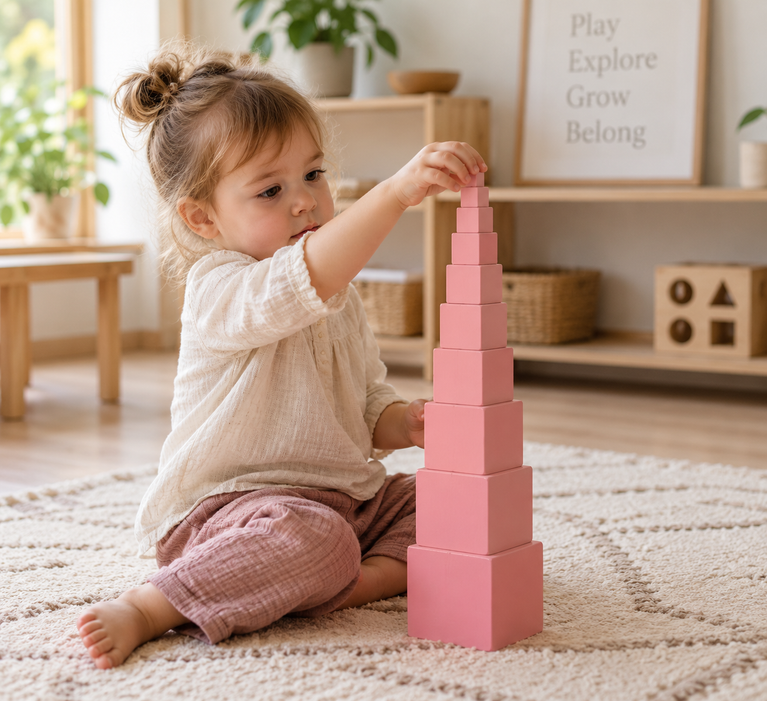
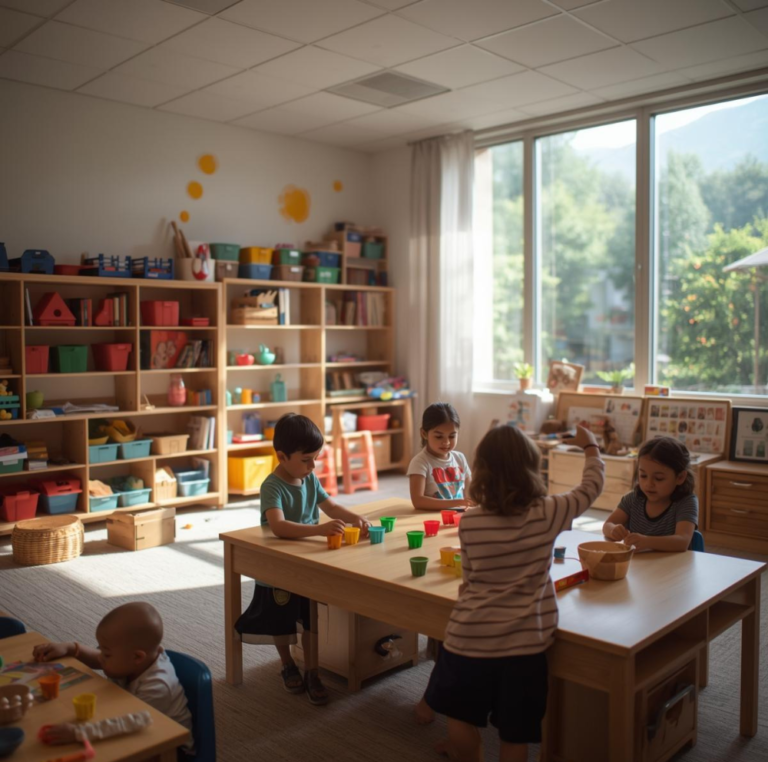
Montessori homes often use low toy shelves with only a few carefully chosen toys available at once. This helps reduce overwhelm while encouraging deeper concentration.
Simple activities like stacking, posting, puzzles, object permanence toys, and practical life trays often hold attention far longer than overstimulating toys with lights and sounds.
If you’re looking for age-appropriate ideas, our guide to Best Montessori Toys for 1 Year Olds shares some simple options that encourage concentration and independent play.
Mid-Morning Play and Exploration
Mid-morning is often when toddlers have the most physical energy, which is why many Montessori families use this part of the day for movement, outdoor play, and exploration.
Montessori places a strong emphasis on movement because young children learn through using their bodies. Climbing, carrying, walking, balancing, and exploring all support both learning and emotional regulation.
This doesn’t need to involve elaborate activities or carefully planned outings. For a toddler, a simple walk around the neighbourhood, time in the garden, or an opportunity to move freely outdoors can be enough.
Many everyday experiences become meaningful opportunities for exploration at this age. A toddler might stop to collect leaves, watch birds, carry sticks, pour water, or simply notice different textures under their feet.
Time outside also helps many children regulate emotionally, burn energy, and concentrate more deeply later in the day.
One of the simplest Montessori ideas is that children don’t always need constant activities or entertainment. Often, they benefit most from having time and space to explore the world around them at their own pace.
Lunch and Practical Life
Mealtimes are one of the easiest places to incorporate Montessori principles into everyday life because they naturally create opportunities for participation.
Rather than simply serving food and managing the routine for them, toddlers are encouraged to take part in small, meaningful ways. That might mean carrying napkins to the table, placing spoons beside plates, helping wipe a spill, carrying their plate to the counter, or pouring a small amount of water with support.
The goal is not perfect behaviour or perfect table manners.
It is participation.
These small responsibilities help toddlers feel capable, trusted, and genuinely included in family life. Over time, familiar routines around meals often become some of the most repeated practical life experiences of the day.
One of the reasons Montessori places such value on everyday tasks is that children learn through doing. What appears ordinary to an adult can feel deeply meaningful to a toddler who is eager to contribute.
Afternoon Quiet Time
Many toddlers still nap during this stage, while others benefit more from a period of rest and reduced stimulation.
In Montessori homes, quiet time is often viewed as just as important as active play. After a busy morning of movement, exploration, and participation, children benefit from an opportunity to slow down and recharge.
For some families, this looks like an afternoon nap. For others, it might mean reading together, listening to soft music, spending time in a calm corner, or enjoying a period of quiet independent play.
The goal is not necessarily sleep.
It is creating a calmer rhythm in the middle of the day that allows toddlers to pause, regulate, and reset before the afternoon continues.
Many Montessori families also create simple calming spaces with a few books, floor cushions, comfort objects, and minimal distractions. These quiet environments help children develop the ability to rest and regulate without constant stimulation.
For some toddlers, this slower period can also reduce late-afternoon overwhelm and make the rest of the day feel noticeably calmer.
Afternoon Play and Activities
After a period of rest, many toddlers naturally return to movement, exploration, and play.
This part of the day does not need to be heavily planned. In fact, Montessori routines often work best when children have enough time to return to activities at their own pace.
A toddler might spend time outdoors, work on a puzzle, build with blocks, explore a practical life activity, or help with small household tasks alongside a parent. What matters less is the specific activity and more the opportunity to engage deeply with it.
If you’re looking for simple screen-free activities, you might also enjoy our guide to Educational Games for Toddlers That Parents Actually Enjoy Too.
One thing Montessori environments often do differently is avoid offering too many choices at once. When only a small number of activities are available, toddlers are often able to focus for longer periods and move more calmly between them.
This is one reason many Montessori families rotate toys every few weeks rather than keeping everything available all the time.
If you’d like to learn more, our guide to Montessori Toy Rotation for Toddlers explains how a simpler toy setup can encourage longer concentration and more independent play.
Evening Routine
Evenings tend to work best when they feel calm, predictable, and noticeably slower than the rest of the day.
For many families, the evening naturally follows a familiar rhythm. Toys are tidied away, the family gathers for dinner, and the pace of the day gradually begins to slow. This might be followed by a bath, some quiet play, bedtime stories, and eventually sleep.
These repeated routines help toddlers recognise that the day is coming to an end and allow both their bodies and minds to prepare for rest.
One of the reasons bedtime routines are so effective is that they become highly predictable. Over time, toddlers begin to anticipate what comes next, which can make transitions to sleep feel smoother and less stressful for everyone.
Many Montessori homes also create simple sleep environments with floor beds, accessible spaces, and minimal distractions. The goal is not to create a perfect Montessori bedroom, but to support independence while keeping the environment calm and restful.
If you’re considering a Montessori-inspired sleep space, you might also enjoy our guides to Montessori Bedroom Setup for Babies and Bedroom Setup for 12-18 months old Toddlers.
Flexibility Matters More Than Perfection
No Montessori routine works perfectly every day.
Some days toddlers feel energetic and curious. Other days they need more comfort, connection, or rest.
The goal is not to follow a rigid schedule.
It is to create a predictable rhythm that supports your child while still leaving room for real life.
When a routine is working well, many parents notice that transitions become easier, independent play lasts longer, and the day generally feels calmer. Over time, toddlers begin anticipating what comes next, which can reduce frustration and help family life flow more smoothly.
Final Thoughts
A Montessori toddler routine does not need to be complicated.
In fact, the most effective routines are often the simplest.
Rather than filling the day with activities, Montessori encourages us to create a gentle rhythm built around connection, movement, participation, rest, and play.
When toddlers know what to expect, they often feel more secure, more confident, and more able to participate in everyday family life.
And while every day will look slightly different, those familiar rhythms can help create calmer, more connected days for everyone.
You Might Also Find Helpful