Simple Montessori Feeding Tools for Toddlers Learning to Eat Independently
Many parents are surprised when their toddler suddenly insists on feeding themselves. At around 18–24 months, toddlers often push away help, grab the spoon, and make a spectacular mess of the kitchen table.
While it can feel chaotic, this stage is actually an important part of development.
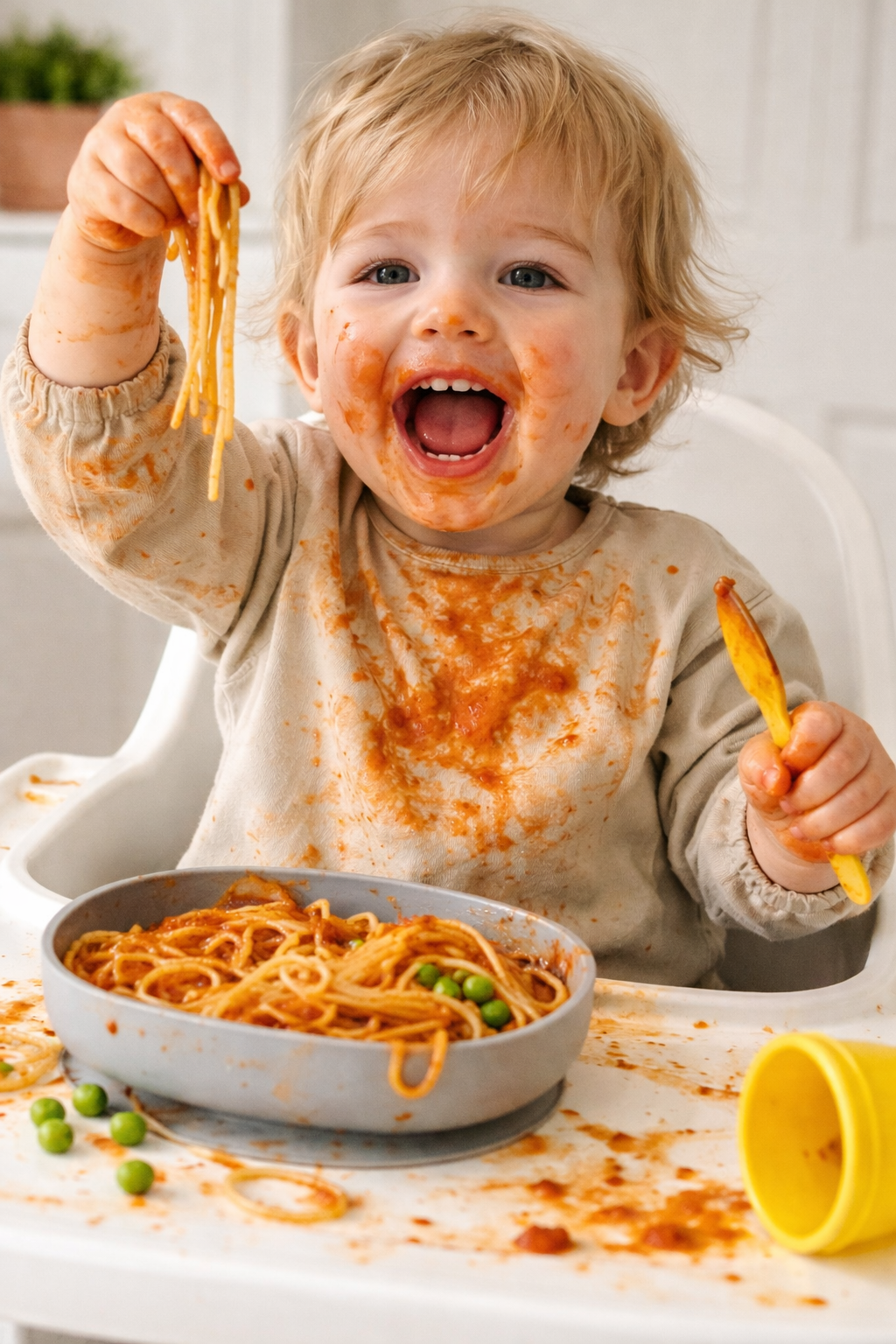
In Montessori education, independent eating is encouraged from an early age because it supports a child’s growing desire for autonomy, coordination, and confidence. When toddlers are given the right tools and environment, mealtimes can become a powerful opportunity for learning rather than a daily struggle.
Understanding why toddlers want to feed themselves can help parents create calmer, more supportive mealtime routines — just like understanding why toddlers sometimes ignore instructions during this stage of development.
Why Toddlers Want to Feed Themselves
Between 18 and 24 months, toddlers enter a developmental phase where independence becomes very important.
Maria Montessori described this stage as a period where children are driven by a natural urge to “help me do it myself.”
At this age, toddlers are developing:
- fine motor coordination
- hand-eye coordination
- problem-solving skills
- early self-confidence
Feeding themselves allows toddlers to practice all of these abilities at once.
When adults constantly intervene — for example by feeding them quickly with a spoon — toddlers may become frustrated. This is often when parents begin to see behaviours like throwing food, refusing meals, or grabbing utensils.
From a developmental perspective, these behaviours are not misbehaviour. They are signs that the child wants more participation and control during mealtimes.
Montessori environments support this by giving toddlers tools that make independence possible — similar to how Montessori play activities encourage independent exploration.
Why Toddler-Sized Cutlery Matters
One of the most helpful adjustments parents can make is using cutlery designed for toddler hands.
Standard adult utensils are often too large and heavy for toddlers, which makes it difficult for them to successfully scoop or spear food.
Toddler cutlery is designed with:
- shorter handles
- lighter weight
- rounded edges
- easier grip shapes
These features allow toddlers to develop coordination gradually without becoming overwhelmed.
Disclaimer: This post contains affiliate links. I may earn a small commission at no extra cost to you. As an Amazon Associate I earn from qualifying purchases.
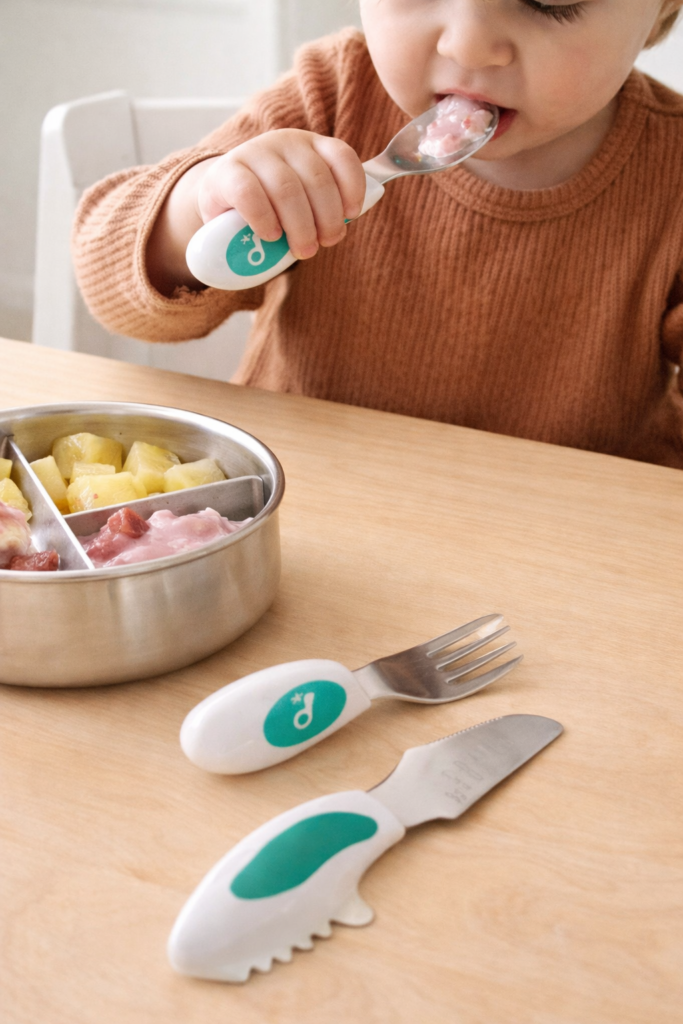
Many parents — including us — find that switching to toddler-sized forks and spoons dramatically improves mealtime independence. Montessori-inspired sets are typically made from stainless steel and sized appropriately for small hands, allowing toddlers to practice eating in a way that feels natural. We have been using this set from year one up until 2.5 years old and counting!
When children experience small successes like successfully scooping yogurt or spearing a piece of fruit, their confidence grows quickly.
Why Montessori Often Uses Stainless Steel Plates
Another common Montessori recommendation is using stainless steel plates and bowls rather than plastic ones.
This might seem like a small detail, but it can make a meaningful difference for toddlers.
Real materials like stainless steel provide:
- better sensory feedback
- realistic weight and texture
- durability for everyday use
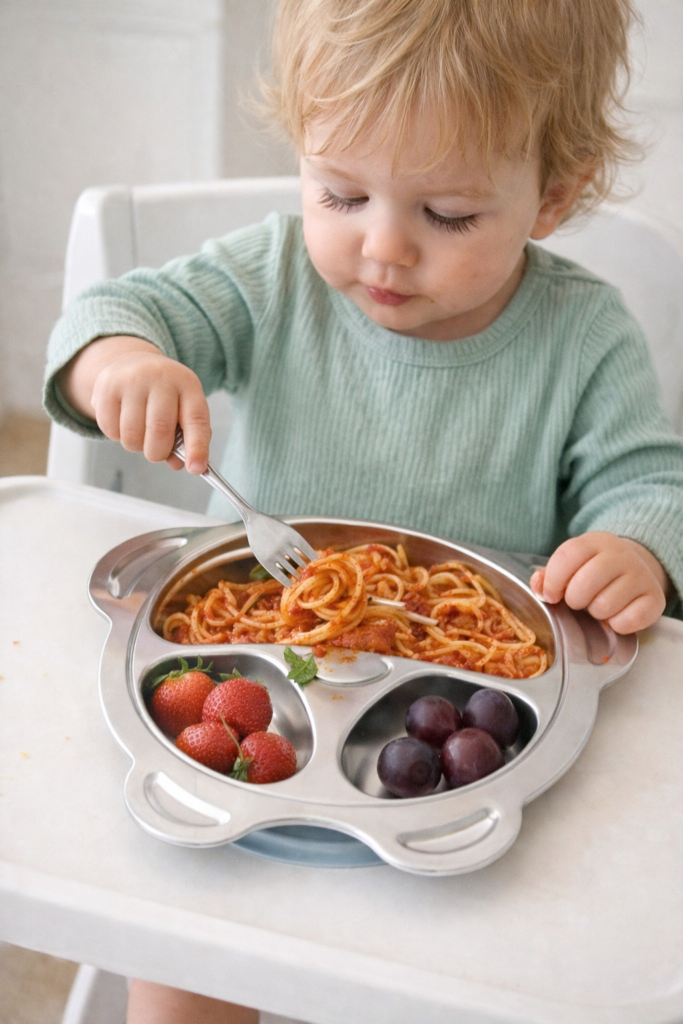
Plastic dishes are extremely light, which can make them easy for toddlers to push around or flip accidentally. Stainless steel plates tend to stay more stable on the table and feel more like the dishes children see adults using.
Many Montessori families choose simple stainless steel toddler plates because they are durable, dishwasher safe, and safe for daily use.
Using real materials also sends a subtle message to toddlers that they are participating in real family meals, not a separate “baby version” of eating.
Why Divided Plates Can Help Toddlers Focus
Another tool that often helps toddlers during this stage is a divided plate.
Toddlers are still learning to explore new foods, textures, and colours. When everything is mixed together on one plate, it can sometimes feel overwhelming.
Divided plates help by:
- visually separating foods
- making it easier to scoop small portions
- reducing frustration during self-feeding
This is particularly helpful when toddlers are practicing using spoons or forks.
Some parents choose stainless steel divided plates, while others use silicone versions that grip the table to prevent sliding. Both can work well, depending on your child’s stage and preferences.
The goal is not perfection — it is simply creating a setup that makes independent eating easier.
Why Montessori Encourages Using Real Cups
Montessori environments often introduce small open cups earlier than many traditional feeding approaches.
While sippy cups can feel convenient, they can sometimes delay the development of drinking coordination.
Small open cups encourage toddlers to practice:
- controlled movements
- careful pouring and sipping
- coordination between hands and mouth
This does not mean spills will never happen. In fact, small spills are part of the learning process.
Many Montessori families choose stainless steel toddler plates, utensils, and small cups because they are durable, safe, and appropriately sized for young children’s hands. Unlike lightweight plastic dishes, stainless steel provides better sensory feedback and helps toddlers develop coordination as they learn to eat and drink independently.
Some parents prefer to start with a complete Montessori-style toddler feeding set that includes a stainless steel plate, toddler-sized fork and spoon, and a small cup. These sets make it easier to create a simple, consistent mealtime setup where children can practice feeding themselves using real materials designed for their stage of development.
A stainless steel toddler feeding set like this one includes everything needed for independent meals — a divided plate, child-sized utensils, and a durable cup that fits comfortably in small hands.
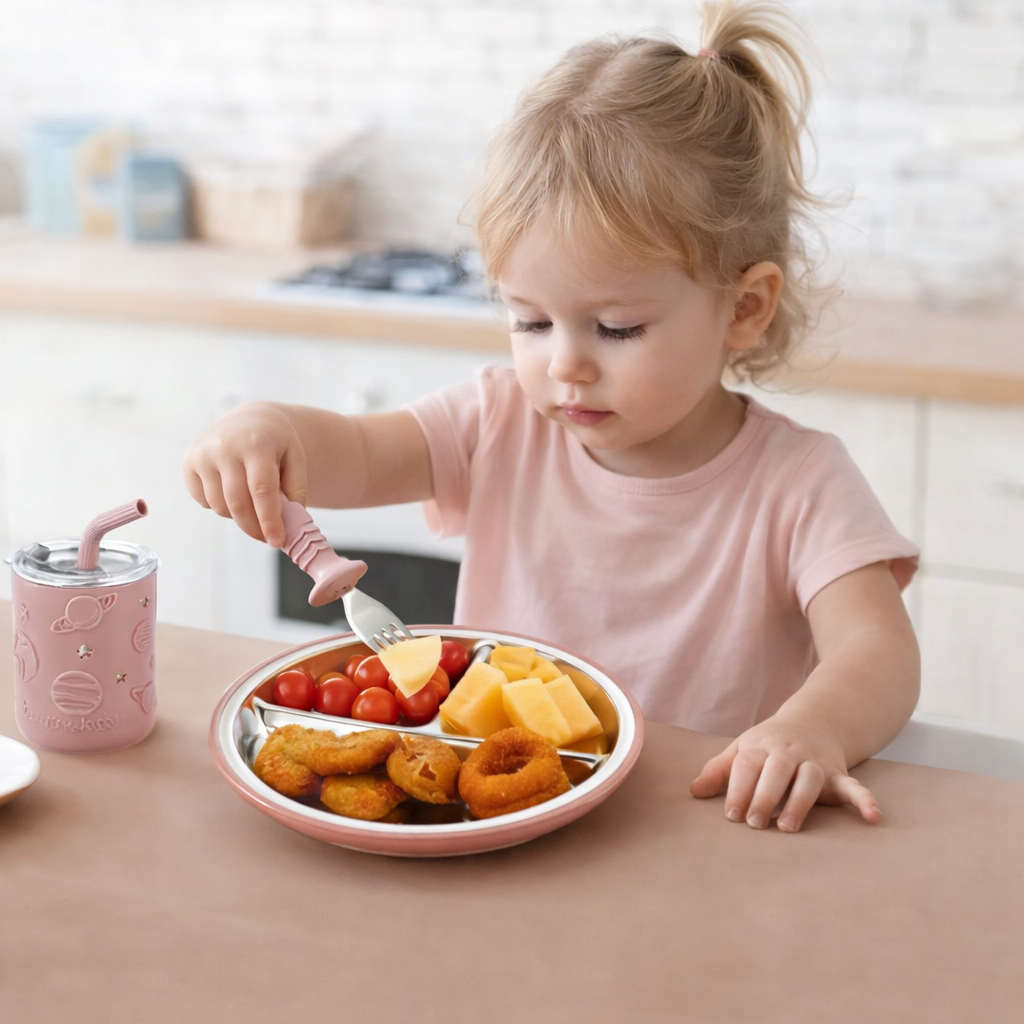
Over time, many parents are surprised by how quickly toddlers become capable of eating and drinking independently when they are given tools that support their growing coordination.
Why Toddlers Throw Food
Food throwing is one of the most frustrating behaviours many parents encounter during toddlerhood. Toddler throwing food during meals is often linked to developmental curiosity rather than deliberate defiance.
However, throwing food is often linked to developmental curiosity rather than deliberate defiance.
Toddlers throw food for several reasons:
1. Cause-and-effect learning
Young children are fascinated by what happens when objects fall. Dropping food allows them to observe gravity, sound, and reactions.
2. Communication
Toddlers sometimes throw food when they are finished eating but do not yet have the language to communicate it clearly.
3. Sensory exploration
Food provides interesting textures, smells, and colours. Toddlers may experiment with squeezing, dropping, or squishing food as part of exploration.
Understanding these motivations helps parents respond calmly rather than seeing the behaviour as intentional misbehaviour.
Creating opportunities for independent eating often reduces frustration-based food throwing.
How to Encourage Independent Eating at Home
Parents do not need to completely redesign their kitchen to support Montessori-style eating.
A few small changes can make a big difference.
Use child-sized furniture
If possible, a small toddler table and chair allow children to sit comfortably with their feet supported. This helps them focus on eating rather than balancing in a large chair.
Offer manageable portions
Large piles of food can overwhelm toddlers. Offering smaller portions makes self-feeding easier.
Allow time for practice
Toddlers need time to practice new skills. Meals may take longer during this stage, but the independence gained is valuable.
Model calm eating habits
Children learn by observing adults. Sitting together for family meals and demonstrating slow, calm eating helps toddlers develop similar habits.
A Gentle Reminder for Parents
Independent eating during toddlerhood is rarely tidy.
Spills, dropped spoons, and food experiments are all part of the learning process. While it can sometimes feel frustrating, these messy moments often represent important developmental milestones.
Montessori philosophy encourages parents to view these moments not as mistakes, but as opportunities for growth.
With supportive tools, realistic expectations, and a calm environment, toddlers gradually develop the coordination and confidence they need to participate in family meals.
Over time, many parents discover that encouraging independence actually makes mealtimes calmer, less stressful, and more enjoyable for everyone at the table.