The Five Principles of the Montessori Method Explained
If you’ve ever searched for Montessori ideas, you’ve probably noticed the same thing.
Beautiful wooden toys.
Perfectly organised shelves.
Neutral-coloured playrooms.
It’s easy to come away thinking that’s what Montessori is.
For a long time, I thought the same.
But the more I learned, the more I realised something surprising.
Those things aren’t Montessori.
They’re simply tools.
The real Montessori method is built on five ideas that have almost nothing to do with expensive toys.
Once you understand them, you’ll start seeing everyday parenting differently.
Let’s start with the question that sits at the heart of the Montessori method.
It All Starts With One Simple Question
Imagine two toddlers trying to pour themselves a glass of water.
One parent immediately steps in.
“Here, I’ll do it.”
The other waits.
The water spills.
It takes much longer.
The child keeps trying.
Eventually…
they manage it.
Which child learned more?
That’s the question Montessori asks over and over again.
Not:
“What’s the quickest way?”
But:
“What helps the child grow?”
Everything else grows from there.
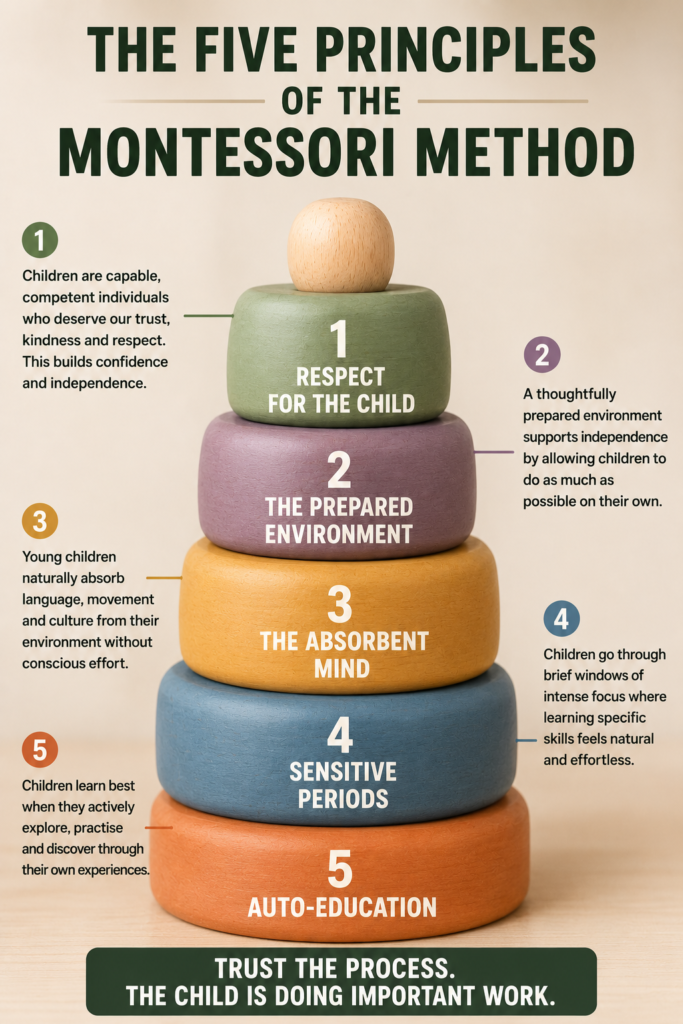
1. Respect for the Child
This is the first principle.
And it’s probably not what you think.
Respect isn’t about letting children make all the rules.
It’s about believing they’re capable of far more than we often expect.
It means slowing down long enough to let them try.
Listening before correcting.
Giving them opportunities instead of simply doing everything for them.
The goal isn’t perfect behaviour.
It’s growing confidence.
Once you begin looking through this lens, something interesting happens.
You start noticing just how often adults accidentally take learning opportunities away.
Which leads naturally to the second principle…
Imagine being two years old.
Everything you need is above your head.
Your books.
Your toys.
Your coat.
Your cup.
Even if you wanted to be independent…
you couldn’t.
Not because you aren’t capable.
Because your environment won’t let you.
That’s where Montessori makes another surprisingly simple observation.
2. The Prepared Environment
Children learn independence much more easily when the environment supports it.
That doesn’t mean turning your home into a classroom.
It simply means asking:
“What can my child do by themselves?”
Sometimes the answer is as simple as:
moving books onto a lower shelf.
Adding a child-height coat hook.
Keeping just a few toys available instead of dozens.
Suddenly, children don’t need permission quite so often.
They simply begin helping themselves.
And that’s exactly the point.
Creating a prepared environment doesn’t have to mean redesigning your entire home. Even a few thoughtful changes can make a big difference.
→ How to Design a Play Space That Encourages Independent Play
→ How to Set Up a Montessori Bedroom for Toddlers
Then something else begins happening…
The more opportunities children have to explore…
the more they learn.
Almost effortlessly.
Which brings us to one of Montessori’s most fascinating ideas.
3. The Absorbent Mind
Adults usually learn by trying.
Children often learn simply by living.
Listen to a toddler for long enough and they’ll suddenly repeat a phrase you had no idea they heard.
Watch them “cook dinner” in their play kitchen…
or sweep the floor…
or answer a toy phone exactly the way you do.
They’re constantly absorbing the world around them.
Not because anyone sat down to teach them.
Because their brain is designed to.
For the first few years of life, children are extraordinary observers.
They’re always learning.
Whether we realise it or not.
But have you ever noticed…
…that children suddenly become obsessed with one particular thing?
Maybe your toddler pours water fifty times.
Or insists on climbing everything.
Or wants the same book every single day.
It can feel random.
Montessori believed it wasn’t random at all.
Once you understand the absorbent mind, it also becomes much easier to see why Montessori favours simple, open-ended toys over toys that do everything for the child.
→ Best Montessori Toys for 1 Year Olds That Actually Get Used
→ Best Montessori Toys for 2 Year Olds That Actually Build Focus & Independent Play
4. Sensitive Periods
Children go through brief windows when certain skills seem almost impossible to resist.
Language.
Movement.
Order.
Small objects.
Practical life.
During these periods, learning feels surprisingly easy.
Not because children are being pushed.
Because their brain is ready.
It’s one reason toddlers happily repeat the same activity over and over again, long after adults have become bored of watching.
They’re not trying to entertain themselves.
They’re building their brain.
Once that window passes…
their interests often shift naturally to something new.
This is one reason many parents suddenly notice dramatic changes in behaviour around certain ages. What feels like your toddler changing overnight is often a sign they’re entering a new stage of development.
And finally…
Perhaps the biggest misconception about Montessori.
Many people assume adults teach.
Children learn.
Montessori gently flips that idea upside down.
5. Auto-Education
Maria Montessori believed children have an incredible ability to teach themselves.
Not completely alone.
But through exploration.
Through repetition.
Through making mistakes.
Our role isn’t to constantly entertain or instruct.
It’s to prepare opportunities.
Then step back just enough.
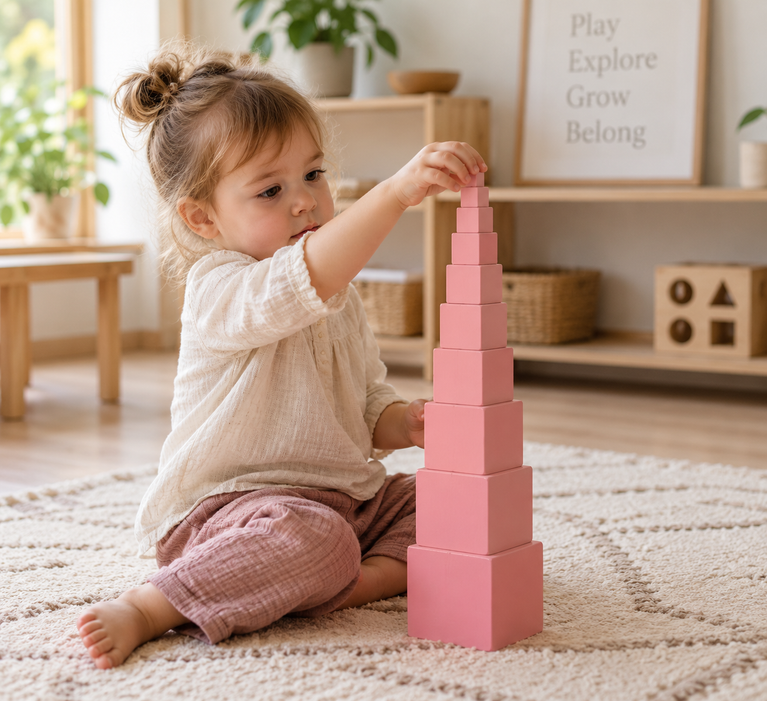
Think about a simple stacking toy.
You could show your child exactly how it works.
Or…
you could wait.
Watch.
Let them experiment.
Eventually they discover the solution themselves.
That tiny moment of triumph is far more valuable than if we’d simply demonstrated it.
Because they didn’t borrow our success.
They built their own.
And once you see this happen a few times, it becomes much easier to resist stepping in too quickly.
So… Is Montessori Really About Wooden Toys?
Not really.
The toys are probably the least important part.
You don’t need a perfectly organised playroom.
You don’t need beige walls.
You don’t need expensive shelves.
Those things can be lovely.
But they’re not what makes Montessori work.
The philosophy lives in much smaller moments.
Waiting five extra seconds.
Allowing mistakes.
Preparing the environment.
Trusting your child a little more today than yesterday.
You don’t need complicated activities to encourage independent learning. In fact, some of the most valuable Montessori experiences happen during everyday life—pouring water, wiping a table, carrying a basket or helping prepare a snack. These simple practical life activities build confidence because children discover what they’re capable of through doing.
→ Montessori Practical Life for Babies & Toddlers: Independence Begins at Home
The Real Thread That Connects Everything
At first, the five principles seem separate.
Respect.
Environment.
Absorbent mind.
Sensitive periods.
Auto-education.
But they’re really all saying the same thing.
Children already want to learn.
Our job isn’t to force that curiosity.
It’s to protect it.
Once you understand that…
Montessori suddenly feels much less like a method.
And much more like a different way of seeing childhood.
Perhaps that’s why its ideas still resonate with so many parents more than a century after Maria Montessori first introduced them.
You Might Also Find Helpful