What Makes a Toy Montessori — and Why Less Is More
If you search for Montessori toys, you’ll quickly notice a pattern.
Wooden shapes. Stacking toys. Simple puzzles. Posting boxes. Often no batteries, no flashing lights and very few bells and whistles.
Next to a toy that sings songs, teaches numbers and lights up at the press of a button, they can look almost suspiciously basic.
But that’s rather the point.
The less the toy does, the more the child has to do.
And once you understand that idea, Montessori toys start to make a lot more sense.
What Actually Makes a Toy Montessori?
First, let’s clear up one of the biggest misconceptions: wooden doesn’t automatically mean Montessori.
Plenty of wooden toys have very little to do with Montessori, while a toy doesn’t necessarily need to carry the Montessori label to reflect some of its principles.
Traditional Montessori materials were designed with a clear purpose. Rather than trying to entertain a child or teach several things at once, they often isolate one particular skill or concept. Many also allow children to discover for themselves whether something has worked, rather than relying on an adult to tell them.
Think about a simple shape sorter.
A child picks up a shape and tries an opening.
It doesn’t fit.
They turn it.
Try another opening.
Eventually, it drops through.
There was no flashing light telling them they were wrong. Nobody had to show them the answer. The toy itself gave them enough information to keep trying.
That’s a very Montessori idea.
You’ll see this principle in many of the simple Wooden Toys for 1 Year Olds we recommend — posting toys, stacking rings and shape sorters can look basic, but there’s often quite a lot for the child to figure out.
The Less the Toy Does, the More the Child Does
This is perhaps the simplest way to understand why Montessori toys often look so basic.
When a toy lights up, talks, moves or plays a song at the press of a button, much of the interesting action comes from the toy.
Press. Watch. Listen.
Take those features away and something changes.
Now the child has to create the action.
They have to stack the blocks. Fit the puzzle piece. Post the ball. Build the tower. Work out why something doesn’t fit and decide what to try next.
The toy may be doing less, but the child is doing considerably more.
And that can mean more opportunities to practise concentration, coordination, problem-solving and persistence.
This is also why we tend to favour Toys for 2 Year Olds That Encourage Independent Play: the child isn’t waiting for the toy — or an adult — to create the next part of the experience.
Why One Simple Activity Can Be Enough
We’ve become accustomed to children’s toys advertising how much they can do.
Five activities in one!
Teaches colours, numbers, shapes and letters!
Montessori takes almost the opposite approach.
A traditional Montessori material will often concentrate on one particular idea or difficulty at a time.
To an adult, that can make the activity seem rather limited.
To a young child, it removes a lot of unnecessary noise.
Instead of deciding between buttons, sounds, moving parts and several different activities, they can concentrate on the thing directly in front of them.
Pick it up.
Try it.
Repeat it.
Master it.
Then do it all over again — because, as anyone who has spent much time with a toddler knows, doing something once is rarely enough.
Perhaps the clearest example is the Montessori Pink Tower — one of the most recognisable Montessori materials.
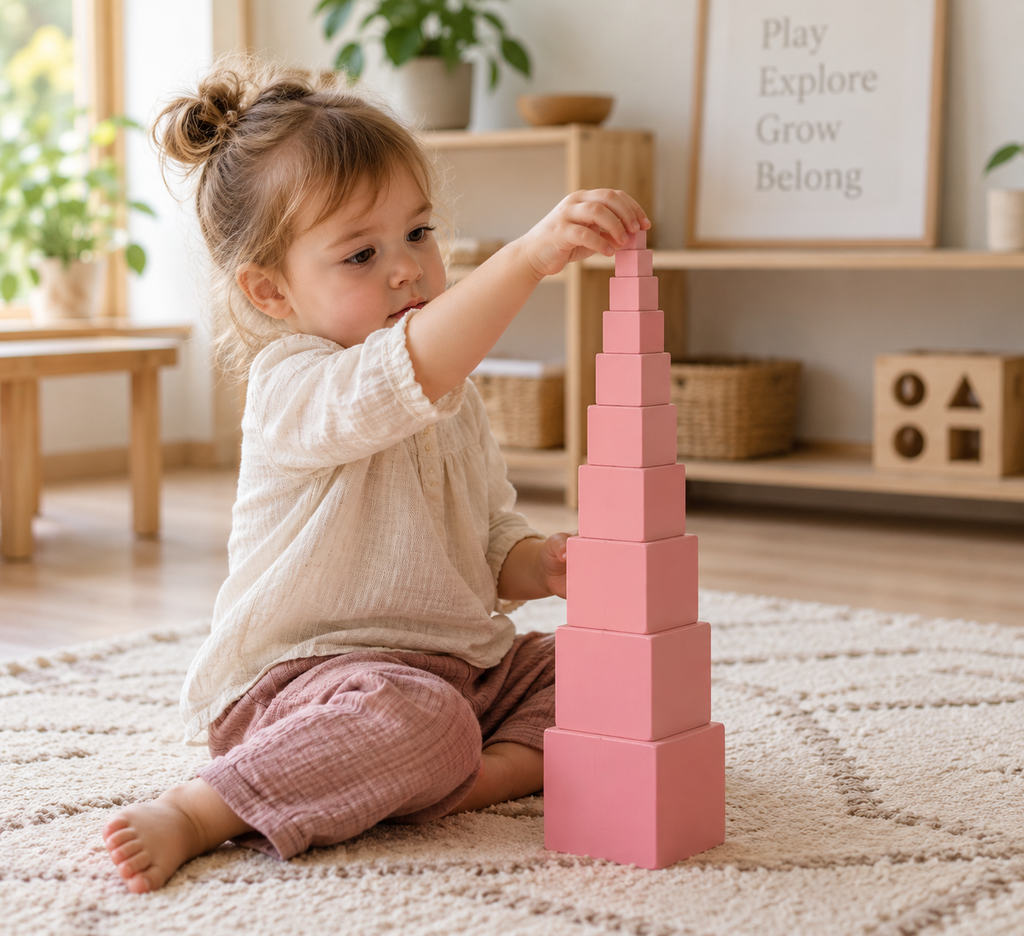
It consists of ten pink cubes that gradually increase in size. That’s it.
But to build the tower, the child has to compare the cubes, judge their size, put them in order and carefully position each one. If the sequence is wrong, the finished tower gives them a visual clue that something isn’t quite right.
There are no instructions, sounds or rewards. The tower does almost nothing — which means the child has to do almost everything.
Repetition Is Part of the Learning
Watching a toddler repeat exactly the same action twenty times can be baffling.
They’ve already put the ball through the hole. Why do it again?
Because knowing what happens isn’t necessarily the end of the activity.
Each attempt gives them another chance to refine the movement: reaching more accurately, turning an object the right way, remembering what worked before or simply becoming quicker and more confident.
That’s why a very simple toy can sometimes hold a child’s attention far longer than you might expect.
The repetition isn’t getting in the way of the learning. Often, it is the learning.
The Clever Part: Letting Children Spot Their Own Mistakes
There’s a Montessori principle called control of error.
It sounds much more complicated than it actually is.
Essentially, the material gives the child a way to recognise that something isn’t quite right without an adult immediately stepping in to correct them.
A puzzle piece doesn’t fit.
A tower won’t balance.
A cylinder is left over but there’s nowhere for it to go.
Something hasn’t worked.
So the child tries something else.
That creates a lovely little cycle:
Try → notice → adjust → try again.
A little like an engineer testing and refining a design, the child notices what isn’t working, makes an adjustment and tries again.
Montessori materials deliberately use this kind of self-correction to encourage more independent exploration.
And importantly, the adult doesn’t always have to provide the answer.
So, Do Montessori Toys Make Children Smarter?
This is where I’d be cautious.
There is research showing positive outcomes for children in Montessori education, including in areas such as academic learning and executive function. But Montessori education is an entire educational approach — not simply a collection of wooden toys.
Researchers can’t neatly separate the effect of a particular toy from everything else happening in a Montessori environment.
So buying a shape sorter isn’t going to magically boost your child’s intelligence.
But look at what the child might actually be doing while playing with one:
They’re concentrating.
Remembering what they tried.
Coordinating their hands and eyes.
Noticing when something doesn’t work.
Changing their approach.
Persisting.
Eventually succeeding without someone doing it for them.
Those are all useful opportunities for a developing child.
The same principle can start much earlier too — even simple toys that encourage babies to crawl can give babies a reason to reach, move and repeat an action for themselves.
Perhaps that’s a better way to think about the value of Montessori toys: not what the toy promises to teach, but what the child has to do while playing with it.
Does a Montessori Toy Have to Be Wooden?
No.
Wood and other natural materials are strongly associated with Montessori environments, but wood itself isn’t what makes a toy Montessori.
A brightly coloured plastic object could offer more purposeful, independent play than an expensive wooden toy marketed as “Montessori”.
This is particularly useful to remember now that Montessori has become an aesthetic as much as an educational philosophy.
Beige doesn’t make a toy educational.
Neither does wood.
That said, we still love wooden toys. They tend to last beautifully, make softer, more natural sounds during play and often have simpler colours and finishes that don’t compete for a child’s attention. With something like building blocks, for example, we’d usually choose plain wooden blocks over ones covered in letters, numbers or pictures — not because those things are bad, but because sometimes there’s value in letting the blocks simply be blocks.
And you certainly don’t need to replace every colourful plastic toy in your house with something made from sustainably harvested beechwood.
What matters more is the experience the toy creates for the child.
The same thinking extends beyond toys. Things like a learning tower can make everyday activities more accessible, giving children more opportunities to participate rather than simply watch.
And this raises another common question: What about open-ended toys?
This is another area where the Montessori label can get a little blurry.
Blocks, magnetic tiles, play silks and pretend-play toys are often described as Montessori because children can use them independently and creatively.
They’re wonderful toys — but they’re not necessarily traditional Montessori materials.
Many Montessori materials actually have a specific purpose and a particular way of being used. A cylinder block isn’t designed to become a castle one day and a spaceship the next.
That doesn’t make open-ended toys less valuable.
It simply means “good for independent play” and “Montessori” aren’t interchangeable terms.
A child’s toy collection can very happily contain both.
How Can You Tell If a “Montessori” Toy Is Actually Worth Buying?
Ignore the label for a moment and look at the toy itself.
Ask yourself:
What does my child actually have to do here?
Do they manipulate something themselves?
Is there something to work out?
Can they repeat the activity?
Can they discover when something hasn’t worked?
Can they use it without an adult constantly directing them?
Is it challenging enough to be interesting without being so difficult that it’s frustrating?
And, perhaps most importantly, is your child actually interested in the skill it offers right now?
Montessori places a great deal of emphasis on observing the individual child and providing activities appropriate to their current interests and abilities.
The most beautifully designed toy in the world isn’t particularly useful if your child has no interest in playing with it.
You Probably Don’t Need as Many Toys as You Think
There’s another consequence of this approach that I particularly like.
You don’t need a toy that “teaches” every individual skill.
And you don’t need an enormous toy box.
A smaller collection of accessible toys can make it easier for children to see what is available, choose something independently and actually settle into playing with it. The Montessori approach also places toys and activities within a carefully organised environment rather than burying everything together in a large toy box.
That doesn’t mean you need a perfectly styled Montessori shelf.
It might simply mean putting fewer toys out and rotating some away.
Sometimes less really is more.
How toys are presented can matter too. A simple, accessible Montessori play space makes it easier for a child to see what’s available, choose something and begin playing without needing an adult to get everything out.
The Montessori Label Isn’t the Point
Perhaps this is the biggest thing worth taking away.
You don’t need a house full of expensive Montessori toys to borrow something useful from the philosophy.
You don’t need everything to be wooden.
You don’t need a perfectly curated beige playroom.
And you don’t need to throw away the electronic toys your child already loves.
Instead, when you’re choosing a new toy, try looking past everything the packaging promises it can do.
Look at what your child will have to do.
Will they press a button and watch?
Or will they pick up, investigate, build, manipulate, attempt, fail, adjust and eventually master something for themselves?
Because sometimes the toy that appears to do almost nothing is giving the child the most to do.
And that’s really why less can be more.
Frequently Asked Questions
What makes a toy Montessori?
A Montessori toy or material is typically simple, purposeful and designed for hands-on exploration. It often focuses on one skill or concept at a time and, where possible, allows children to notice and correct mistakes independently.
Do Montessori toys have to be wooden?
No. Natural materials are common in Montessori environments, but being wooden doesn’t make a toy Montessori. How the child interacts with the toy matters much more than what it’s made from.
Are Montessori toys better for child development?
Not necessarily. There’s no evidence that simply buying toys labelled “Montessori” will make a child develop faster or become smarter. Their value lies in the opportunities they can provide for concentration, coordination, problem-solving, repetition and independent exploration.
Are electronic toys bad for children?
No. There’s no need to eliminate electronic toys altogether. The useful question is how much the toy does for the child. A toy that requires children to manipulate, investigate, make decisions and solve problems gives them a different kind of play experience from one they mainly press a button to watch.
You Might Also Find Helpful