Why Your Toddler Won’t Go to Sleep (And How to Make Bedtime Easier)
If your toddler won’t go to sleep, you’re not alone.
Bedtime can suddenly turn into delays, call-backs, extra hugs, and repeated trips out of the room. It may feel like they are fighting sleep on purpose — even when they are clearly exhausted.
But when a toddler won’t go to sleep, the problem usually isn’t sleep itself. It’s what’s happening in the body and environment before bedtime.

Disclaimer: This post contains affiliate links. As an Amazon Associate I earn from qualifying purchases at no extra cost to you.
Sleep isn’t just about what happens at bedtime.
It’s influenced by the entire day — movement, stimulation, connection, environment, light, rhythm.
If you’re not sure what that looks like in practice, a simple daily rhythm can make a big difference. You can see an example in this guide to simple daily routines for toddlers.
→ Montessori Practical Life for Babies & Toddlers: Simple Daily Routines
When you optimise those inputs, bedtime resistance often decreases without power struggles.
This isn’t about sleep training.
It’s about making rest easier than resistance.
Why toddlers resist sleep
Between 18–36 months, several things are happening developmentally:
- independence is increasing
- imagination is expanding
- separation awareness is stronger
- physical energy peaks
- language is exploding
Sleep means stopping.
And stopping can feel like loss of control.
So instead of asking, “How do I make them sleep?”
it helps to ask, “What makes sleep feel harder for their nervous system?”
1. Movement before rest
Toddlers regulate through their bodies.
If the body hasn’t had enough heavy movement, it will seek stimulation at bedtime.
Look at the late afternoon and early evening:
Did they climb?
Carry?
Push?
Hang?
Jump?
Outdoor play before dinner often reduces bedtime resistance more than longer bedtime routines.
Sleep improves when the body feels used.
If your toddler seems “wired” at night, it may be under-movement — not defiance.
2. Light is stronger than you think
Light directly affects melatonin production.
Bright overhead lighting in the evening tells the brain: stay alert.
Sleep optimisation often begins 60–90 minutes before bedtime by dimming lights earlier than feels necessary.
Switch to:
- warm light
- softer lamps
- slower speech
- quieter activities
A dimmable night light with remote control and adjustable colour settings can be especially helpful here. Being able to gradually shift the room from brighter warm light during books to a very soft amber tone during wind-down supports the body’s natural sleep signals without overstimulating your toddler.
The key isn’t colour as entertainment — it’s control.
You want the light to become softer and less stimulating as the routine progresses.
Light guides the nervous system more than we realise.
↗ Check the price for dimmable night light with remote control

3. The bedtime routine should regulate, not excite
Many routines accidentally overstimulate:
Tickle games
Fast-paced books
Bright bathrooms
Loud splashing
Bath time can be calming — or activating — depending on how it’s approached.
Warm water naturally lowers cortisol, but the sensory input matters.

Using a gentle wash like Aveeno Baby KIDS Bubble Bath & Wash can support calmer skin and reduce irritation, especially if your toddler struggles with dryness or sensory discomfort at night. Sometimes “bedtime resistance” is actually subtle body discomfort.
↗ Check the current price on Amazon

Keep bath lighting dim.
Slow your movements.
Lower your voice.
The routine should feel predictable, not stimulating.
Sleep likes rhythm.
Books can play a simple but powerful role in a calming bedtime routine. Gentle, repetitive stories signal the end of the day. Toddler favourites like I Love You to the Moon and Back and Goodnight Moon are gentle reads that help signal the end of the day, with soothing, repetitive language that encourages relaxation. Pairing a cosy story with a calm Montessori bedroom setup helps make bedtime feel familiar, predictable and secure.
↗️ Check the current price on Amazon:

↗️ Check the current price on Amazon:

4. Watch the overtired window
An overtired toddler rarely looks sleepy.
They look:
Silly
Hyper
Clingy
Defiant
Chaotic
When cortisol rises, the body fights rest.
If bedtime has become a battle, experiment with moving it earlier by 15–30 minutes for a week.
Optimisation sometimes means less effort — not more.
5. Simplify the sleep environment
The bedroom should not compete with sleep.
Too many toys, bright colours, busy shelves, or stimulating artwork keep the brain alert.
A calmer space supports faster settling:
Neutral tones
Minimal visible toys
Consistent temperature
Predictable layout
Many families notice improvement when bedrooms are simplified rather than decorated further.
Sleep improves when the environment feels boring.
6. Keep the response predictable
When toddlers get up repeatedly, the adult response often determines whether the cycle escalates.
The nervous system relaxes with predictability.
Use one calm, repeatable phrase:
“I won’t let you leave the room. It’s time for sleep.”
Walk them back.
No new language.
No added emotion.
No negotiation.
Security builds through repetition.
7. Optimise connection before separation
Bedtime resistance sometimes increases when toddlers feel disconnected during the day.
A short, undistracted connection ritual before bed can reduce multiple call-backs.
Try:
5 minutes of full attention
No phone
No instructions
Just presence
Fill the connection need before expecting separation.
8. Accept developmental waves
Sleep isn’t linear at this age.
Language leaps
Growth spurts
Separation phases
Toilet learning
New fears
All affect sleep temporarily.
Optimisation isn’t about eliminating every wake-up.
It’s about reducing unnecessary friction so developmental changes don’t become full battles.
Putting it all together
Toddler sleep optimisation isn’t about control.
It’s about:
Enough movement
Less evening light
A calm routine
Comfortable skin
A simplified bedroom
Consistent boundaries
Strong connection
When these pieces align, sleep often becomes easier — not because you forced it, but because the body is ready.
If bedtime has been chaotic, you didn’t fail.
You may just need small adjustments across the whole day.
And sometimes, shifting the environment works better than shifting the child.
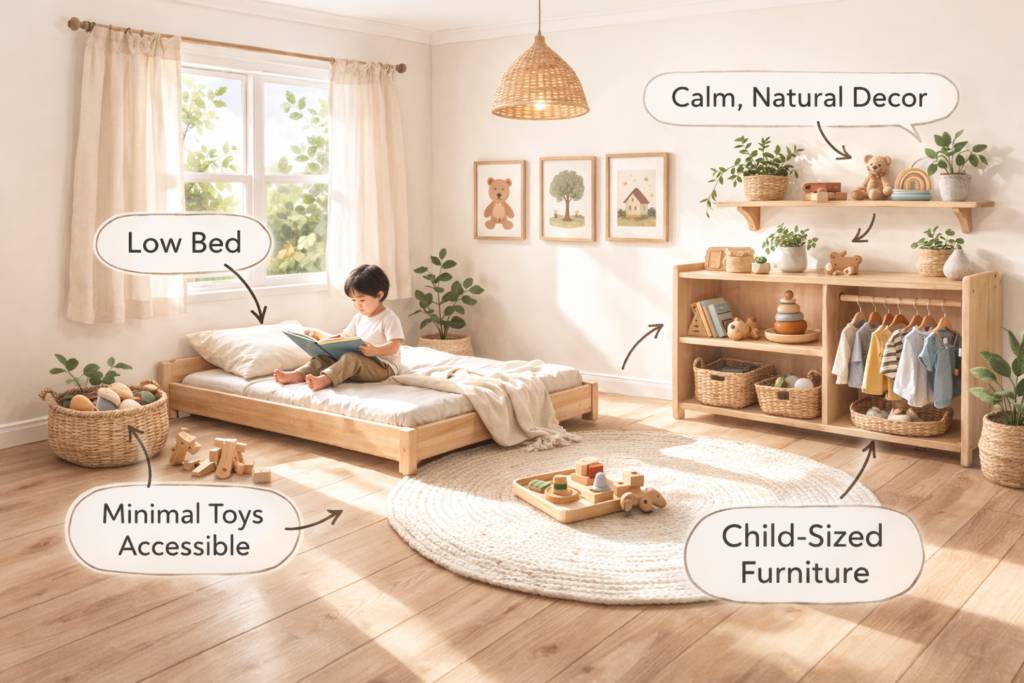
If your toddler’s room feels busy or overstimulating, adjusting the layout can make a noticeable difference. A calmer, more accessible space often reduces bedtime resistance more effectively than changing the routine itself. You can read more about how to create a simple Montessori bedroom setup here and if you’re navigating sleep challenges with a younger baby, you might also find it helpful to understand why your baby might be waking up when put down.
→ Montessori Bedroom Setup for Toddlers (Full Guide for 1–3 Years)
→ Baby Wakes Up When Put Down — Here’s Why (And What Actually Helps)