What to Say When Your Toddler Says NO
You ask a simple question and immediately get a loud refusal… even when they actually want the thing.
It’s confusing, frustrating, and sometimes embarrassing in public.
Disclaimer: This post contains affiliate links. I may earn a small commission at no extra cost to you.

The good news is that this phase is incredibly normal — and it doesn’t mean your child is becoming defiant.
It usually means their brain has reached a new stage of independence.
Toddlers don’t say “no” because they want conflict.
Toddlers say “no” because they’ve discovered they are a separate person from you.
Between ages 1 and 3, children develop autonomy — the ability to control their own actions. But they don’t yet have the skills to express control calmly.
So their brain uses the fastest tool it has: refusal.
When adults keep asking questions, giving instructions, or moving too quickly, toddlers use “no” to protect their sense of control.
This isn’t misbehaviour.
It’s a developmental milestone.
Many common reactions accidentally make the phase stronger.
Repeating requests louder. Asking more questions. Negotiating. Distracting. Forcing immediate compliance
. These create a power struggle, and toddlers defend their “no” even harder.
Instead of trying to remove the “no”, it helps to give it a safe place to exist while keeping the boundary.
One of the simplest changes is to stop asking questions.
Questions invite refusal.
Instead of asking,
“Can you put your shoes on?”
Say,
“It’s time for shoes.”
You remove the opportunity to oppose while staying calm and respectful.
Toddlers also cooperate more when they feel included in the decision. Offer a controlled choice that works either way:
“You can walk to the car or I will carry you.”
Both options move things forward, but your child still experiences control.
When children feel unheard, the “no” usually gets louder. Acknowledging it first often reduces resistance:
“You don’t want to leave. It’s hard to stop playing.”
Then calmly hold the limit:
“We are leaving. You can walk or I will help.”
Long explanations tend to invite debate. A predictable sentence works better when repeated every time:
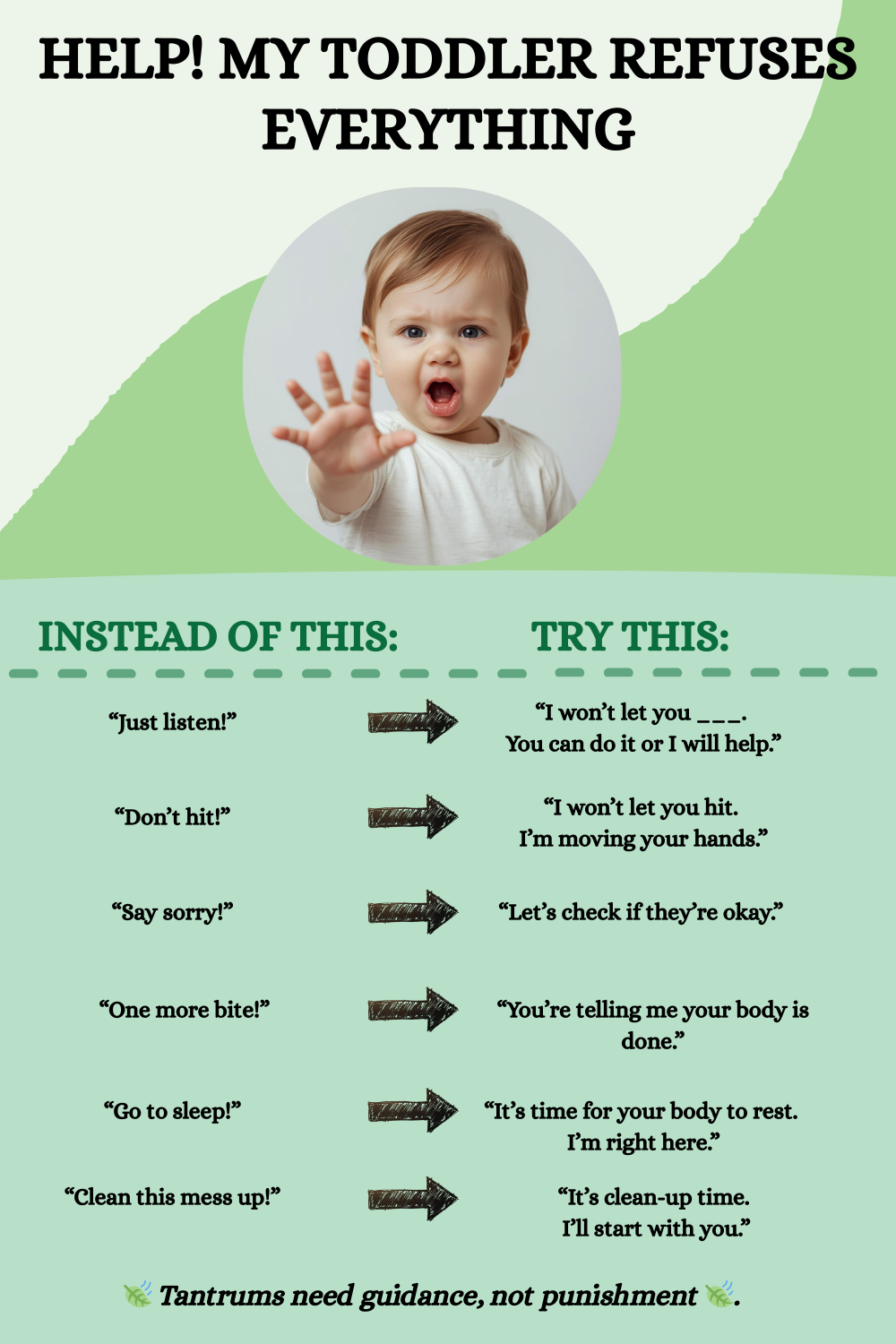
“I won’t let you ____. You can do it, or I will help.”
Consistency makes toddlers stop testing because the answer never changes.
Many refusals also come from tasks that are physically difficult. When children can participate independently, resistance drops. Simple environment changes — like a low clothes rack for coats or an accessible place for shoes — allow toddlers to act instead of waiting for help, which often removes the automatic “no”.
The “no phase” isn’t about disobedience — it’s about control.
When control feels safe, children stop defending it constantly.
Instead of arguing, focus on a few predictable responses: stop asking questions, offer a controlled choice, acknowledge feelings, repeat one calm script, and make tasks easier to do independently.
Over time, the automatic refusal fades because the need behind it is satisfied.
This phase feels intense, but it’s actually a sign of healthy development. Your toddler is learning they are their own person — they just don’t yet know how to cooperate at the same time.
With calm limits and predictable responses, everyday moments become easier again.

Disclaimer: As an Amazon Associate I earn from qualifying purchases.