Montessori Feeding Tools for Toddlers Learning to Eat Independently
Many parents are surprised when their toddler suddenly insists on feeding themselves.
One day they’re happily accepting help. The next they’re grabbing the spoon, pushing your hand away, and determined to do everything on their own.
While it can feel messy and chaotic, this is actually a sign of healthy development.
The desire for independence doesn’t appear overnight. It begins much earlier during weaning, when babies first start exploring food with their hands. Long before they become skilled eaters, they are touching, squishing, dropping, and investigating everything in front of them.
By toddlerhood, those early experiments naturally evolve into something more purposeful. Children begin wanting to use utensils, drink from cups, serve themselves, and participate more actively in family mealtimes.
If you’ve ever tried eating with oversized cutlery or drinking from an awkwardly large cup, you’ll know how frustrating it can feel. Now imagine learning those skills for the very first time. Many everyday feeding tools are simply too large, heavy, or difficult for toddlers to use successfully.
In Montessori, independent eating is encouraged from an early age because it supports coordination, confidence, and a child’s growing desire to participate in everyday life. The goal of Montessori feeding tools is not to make mealtimes perfectly tidy, but to make independence possible.
With appropriately sized plates, cups, and cutlery, mealtimes become about far more than nutrition. They become one of a toddler’s first opportunities to develop real confidence, capability, and independence.
Disclaimer: This post contains affiliate links. I may earn a small commission at no extra cost to you. As an Amazon Associate I earn from qualifying purchases.
Why Toddlers Want to Feed Themselves
Between 18 and 24 months, many toddlers become noticeably more determined to do things for themselves.
They reach for the spoon you’re holding, insist on carrying their own cup, and sometimes refuse help altogether.
While this can feel frustrating, it is actually a sign of healthy development.
Maria Montessori described this stage with the phrase, “Help me do it myself.” Toddlers are not simply trying to eat. They are trying to participate.
Mealtimes give children the opportunity to practise coordination, build confidence, and experience a growing sense of independence. When they are given tools that fit their hands and abilities, they are often more successful and less frustrated.
This is one reason Montessori feeding tools are designed to make participation easier. Small adjustments, such as child-sized cutlery, plates, and cups, can help toddlers build confidence through everyday practice.
Why Toddler-Sized Cutlery Matters
One of the simplest ways to support independent eating is to offer utensils that are designed for toddler hands rather than expecting children to manage standard adult cutlery.
Adult forks and spoons are often longer, heavier, and more difficult for young children to control. While adults rarely notice these differences, they can make self-feeding significantly more challenging for a toddler who is still developing coordination.
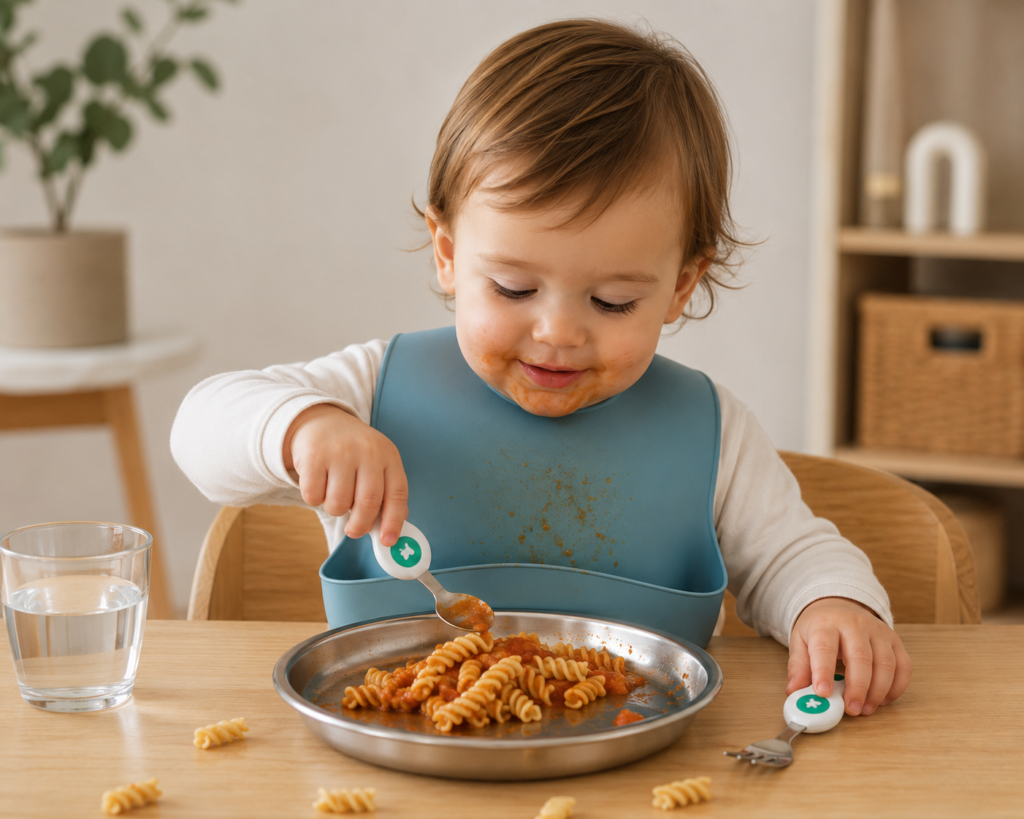
Toddler-sized cutlery is designed with shorter handles, lighter weight, and easier-to-grip shapes that allow children to practise movements more successfully. Rather than struggling to hold and control the utensil, toddlers can focus on learning how to scoop, spear, and bring food to their mouth independently.
This might seem like a small change, but it often has a noticeable impact on mealtimes. When children experience success with a spoonful of yoghurt or manage to spear a piece of fruit on their own, they begin developing the confidence that encourages them to keep practising.
We’ve been using this stainless steel toddler cutlery set since our child was around one year old and continue to use it well into toddlerhood. The size feels comfortable for small hands, the weight is substantial without being heavy, and it has held up remarkably well to daily use.
Why Montessori Often Uses Real Materials
One of the things that often surprises parents about Montessori is the preference for real materials.
Rather than relying heavily on plastic plates, bowls, and cups, Montessori environments often use stainless steel, ceramic, glass, and wood wherever practical. The goal is not to make mealtimes look a certain way. It is to give children the opportunity to interact with materials that feel authentic and purposeful.
Real materials tend to have a natural weight and texture that helps toddlers develop a better understanding of how objects move and behave. A plate that stays in place, a bowl with a little weight to it, or a cup that feels substantial in the hand can make everyday movements easier to control and repeat.
There is also something valuable about children using tableware that resembles what the rest of the family uses. Rather than eating from a separate “baby version” of everything, toddlers are gradually invited into the same mealtime experience as everyone else.
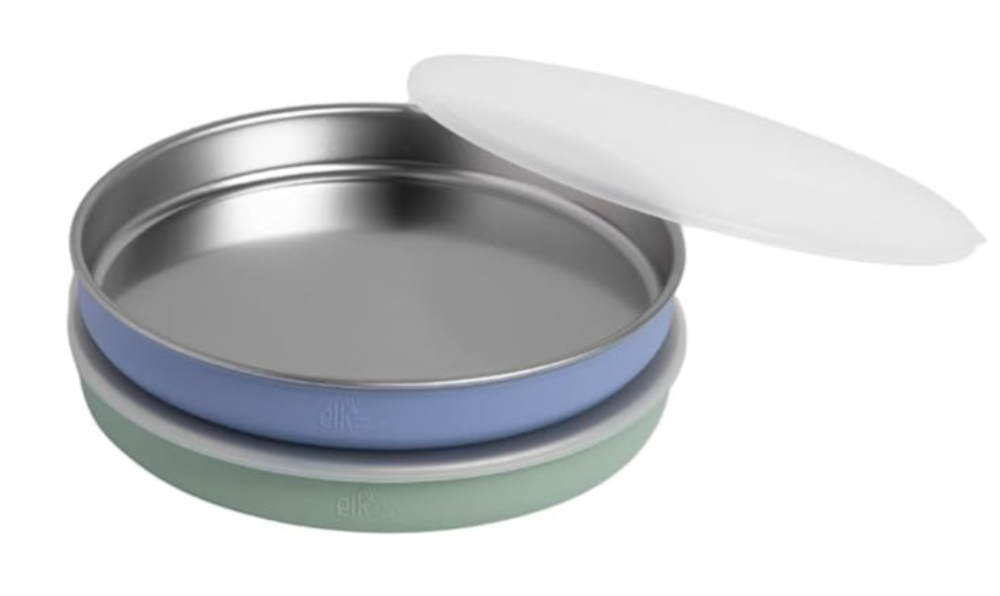
For many families, a simple stainless steel plate is an easy place to start. It is durable, practical, and easy to use while still feeling like a genuine piece of tableware rather than specialised toddler equipment.
Montessori also tends to favour simple plates over heavily divided designs. While divided plates can be helpful in some situations, children are generally encouraged to experience meals as a whole rather than as separate compartments. A simple plate also allows for more natural scooping, serving, and movement as toddlers develop coordination and confidence during mealtimes.
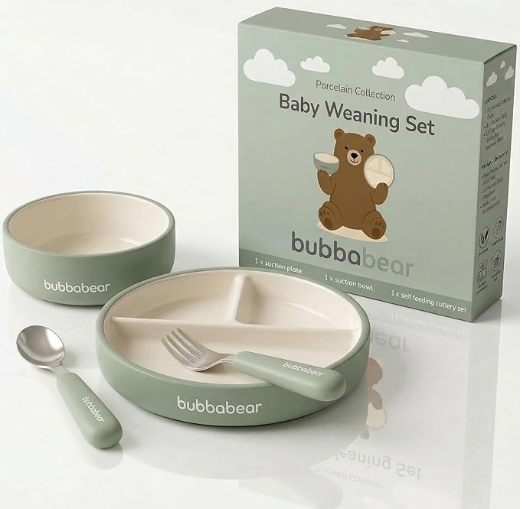
For families who prefer ceramic over stainless steel, a porcelain feeding set can be a nice middle ground. Unlike lightweight plastic alternatives, porcelain has a more substantial feel that helps keep plates and bowls stable during mealtimes, while the silicone suction base provides extra security for younger toddlers who are still developing coordination.
We particularly like this set because it combines many of the benefits of real materials with some of the practicality parents often appreciate during the early stages of independent eating. The simple design keeps the focus on the meal rather than the tableware, while the suction base helps reduce frustration caused by sliding plates and bowls.
Why Montessori Encourages Using Real Cups
Montessori environments often introduce small open cups earlier than many traditional feeding approaches.
While sippy cups can feel convenient, they can sometimes delay the development of coordination by allowing children to drink without controlling the flow. Small open cups encourage toddlers to practise careful movements, develop hand-to-mouth coordination, and gain confidence through real experience.
This does not mean spills won’t happen. In fact, small spills are often part of the learning process.
Many Montessori families choose simple glass or stainless steel cups rather than specialised toddler drinkware. The goal is not perfection but providing children with real tools that allow them to participate more independently.
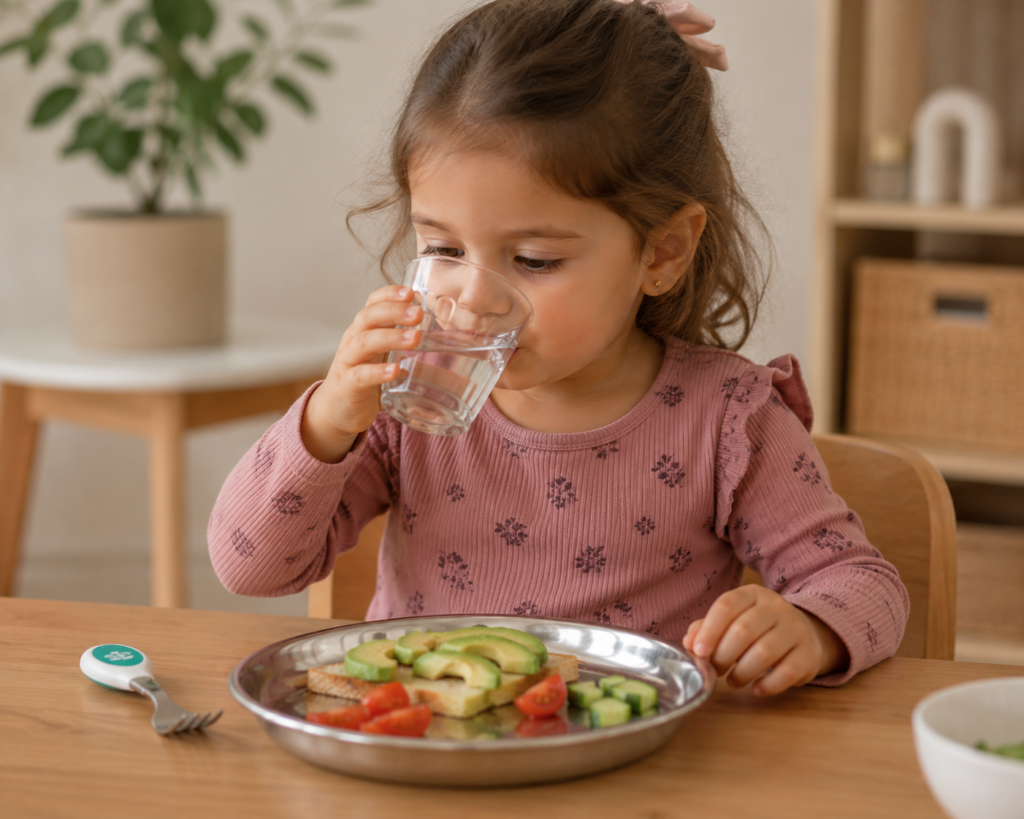
One of our favourite options is a small Duralex tumbler. The size is comfortable for toddler hands, the weight provides useful sensory feedback, and it looks just like the glasses used by the rest of the family. Rather than using a separate “baby cup,” children are able to participate in mealtimes using a scaled-down version of a real drinking glass.
An added benefit is that Duralex glasses are made from tempered glass. While no glass is completely unbreakable, tempered glass is designed to be significantly more resistant to everyday knocks and drops than standard glassware. If it does break, it shatters into blunt fragments rather than sharp shards, making it a practical choice for families who want the benefits of real glass while keeping safety in mind.
When toddlers are given opportunities to practise with appropriately sized open cups, many become capable and confident drinkers far sooner than parents expect.
We’ve used these small Duralex glasses because they feel like real drinking glasses while still being a comfortable size for toddler hands. They’re simple, durable, and allow children to practise drinking independently using the same type of cup as the rest of the family.
View the Duralex glasses we use
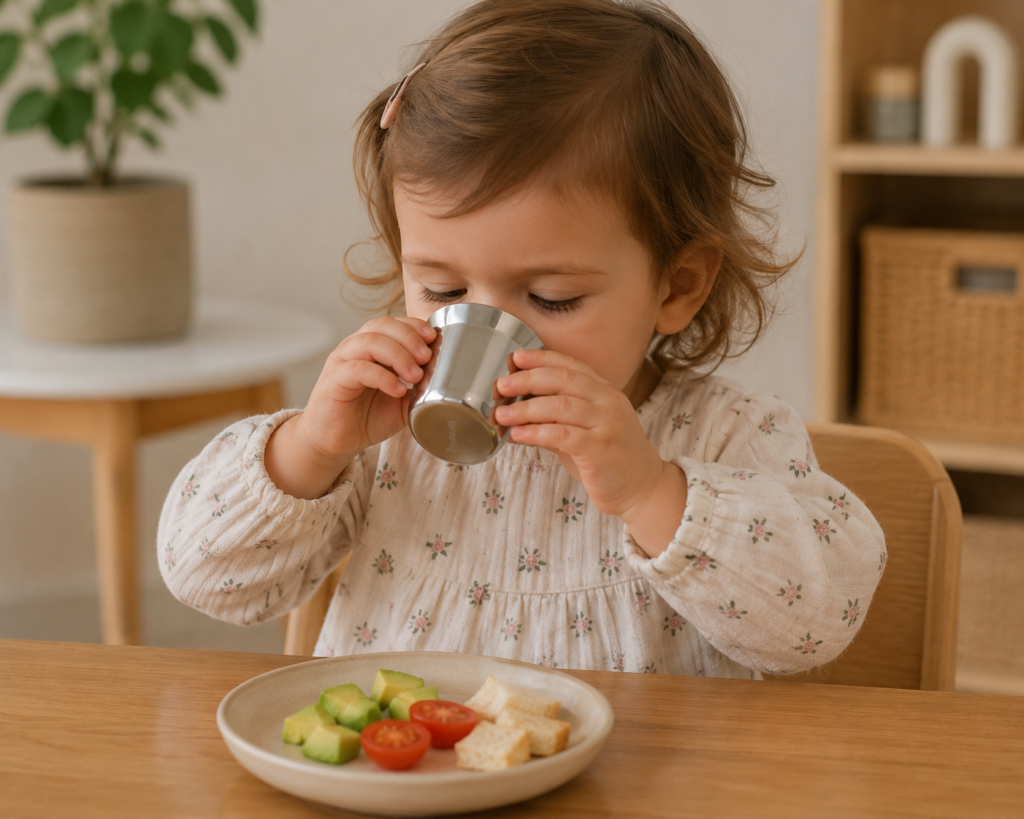
If you’d prefer something less breakable while your child is still building confidence, a small stainless steel cup can be an excellent alternative. It offers many of the same benefits as glass — durability, realistic weight, and a simple design — while giving some parents extra peace of mind during the early stages of independent drinking.
See the 75ml Stainless Steel Cup
Why Toddlers Throw Food
Food throwing can feel frustrating, but it is often part of normal development rather than deliberate misbehaviour.
Toddlers may throw food while exploring cause and effect, experimenting with textures, communicating that they are finished, or becoming frustrated when they cannot participate as independently as they would like.
In many cases, food throwing decreases as coordination improves and children gain more control over their eating.
If you’d like a deeper explanation of why this happens and how to respond calmly, you might find this helpful:
→ Why Toddlers Throw Food (And What It Really Means)
How to Encourage Independent Eating at Home
Parents do not need to completely redesign their kitchen to support Montessori-style eating.
A few small changes can make a big difference.
Use child-sized furniture
If possible, a small toddler table and chair allow children to sit comfortably with their feet supported. This helps them focus on eating rather than balancing in a large chair.
Offer manageable portions
Large piles of food can overwhelm toddlers. Offering smaller portions makes self-feeding easier.
Allow time for practice
Toddlers need time to practice new skills. Meals may take longer during this stage, but the independence gained is valuable.
Model calm eating habits
Children learn by observing adults. Sitting together for family meals and demonstrating slow, calm eating helps toddlers develop similar habits.
A Gentle Reminder for Parents
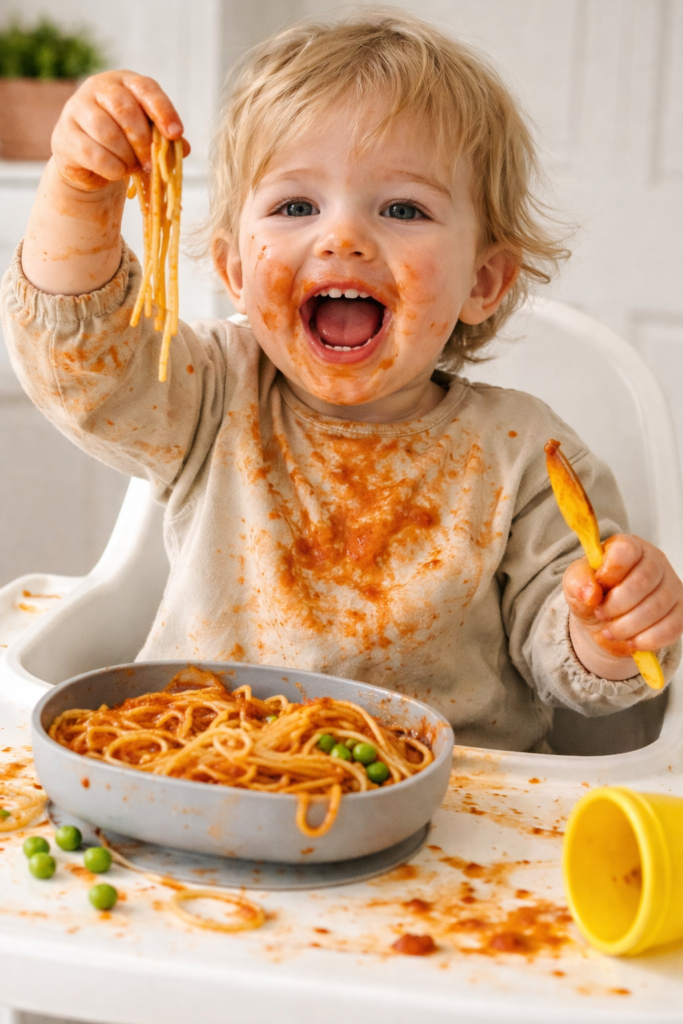
Independent eating during toddlerhood is rarely tidy.
Spills, dropped spoons, and food experiments are all part of the learning process. While these moments can feel frustrating, they are often signs that your child is developing coordination, confidence, and increasing control over their movements.
Montessori encourages us to see these experiences not as mistakes, but as practice.
With appropriately sized feeding tools, realistic expectations, and plenty of opportunities to participate, toddlers gradually become more capable and confident at mealtimes.
Final Thoughts
The goal isn’t a perfectly clean meal or a toddler who never drops food.
The goal is a child who feels capable, involved, and trusted.
When children are given the right tools and enough opportunity to practise, mealtimes become about far more than eating. They become one of the first places where independence begins to grow.
You Might Also Find Helpful