How to Help Your Toddler Play Independently (Montessori Guide That Actually Works)
You set up the toys.
You step away.
Thirty seconds later:
“Play with me.”
For many parents, independent play can feel impossible — especially during the toddler years.
But toddlers are not born knowing how to play independently.
Independent play is a skill that develops gradually through repetition, environment and trust.
Not through pressure.
Not through ignoring your child.
And not through constantly entertaining them either.
Usually, it develops through calm guidance and small moments of success repeated over time.
Disclaimer: This post contains affiliate links. As an Amazon Associate I earn from qualifying purchases at no extra cost to you.
Why Toddlers Struggle to Play Alone
When toddlers constantly follow adults around or seem unable to play without help, it is usually not because they are “too dependent.”
More often, they simply do not yet know what to do with themselves independently for long periods of time.
Independent play requires several skills that are still developing during toddlerhood:
- imagination
- sequencing actions
- decision-making
- internal motivation
- confidence without constant feedback
And when those skills feel too difficult, many toddlers naturally turn back toward the person who feels safest and most predictable:
you.
That is why independent play often works best when it is taught slowly rather than expected immediately.
Step 1 — Start by playing together
Independent play usually begins as connected play first.
Sit beside your child and interact with the materials slowly and calmly.
Not by performing.
Not by entertaining.
And not by trying to make the play “exciting.”
Instead, think of yourself as gently introducing how the materials can be used.
For example, instead of:
“Look! The cow is flying!”
try:
“The cow goes in the barn.”
Simple movements.
Simple language.
Repeated calmly.
At first, toddlers are often learning the structure of play itself.
After a few minutes, begin talking less.
Allow small moments of silence to appear naturally.
Very often, that quiet pause is where the first signs of independent concentration begin.
Simple, repetitive activities often make this transition much easier because toddlers can understand the goal clearly without needing constant guidance.
See this for more ideas about repetitive activities → Independent Play Ideas for Toddlers — Posting Activity
Step 2 — Choose fewer toys (much fewer)
One of the biggest barriers to independent play is often too much choice.
Adults tend to assume more toys create more engagement.
For toddlers, the opposite is often true.
When too many materials are visible at once, the environment can begin to feel mentally overwhelming rather than inviting.
Instead of engaging deeply, many toddlers move rapidly between toys or ask adults what to do next.
A smaller, calmer setup usually works far better.
Try limiting the play space to just a few clearly presented materials:
- a small puzzle
- stacking cups
- a basket of animals
- blocks
- one practical life activity
Not entire toy categories.
Just a small number of actual items.
Low shelves also help significantly because toddlers can see what is available without needing adult help or constant searching.
And when the environment feels visually calmer and more predictable, concentration often lasts much longer naturally.
If your child frequently jumps between toys or loses interest quickly, rotating a smaller number of toys can also make a noticeable difference without needing to constantly buy new things.
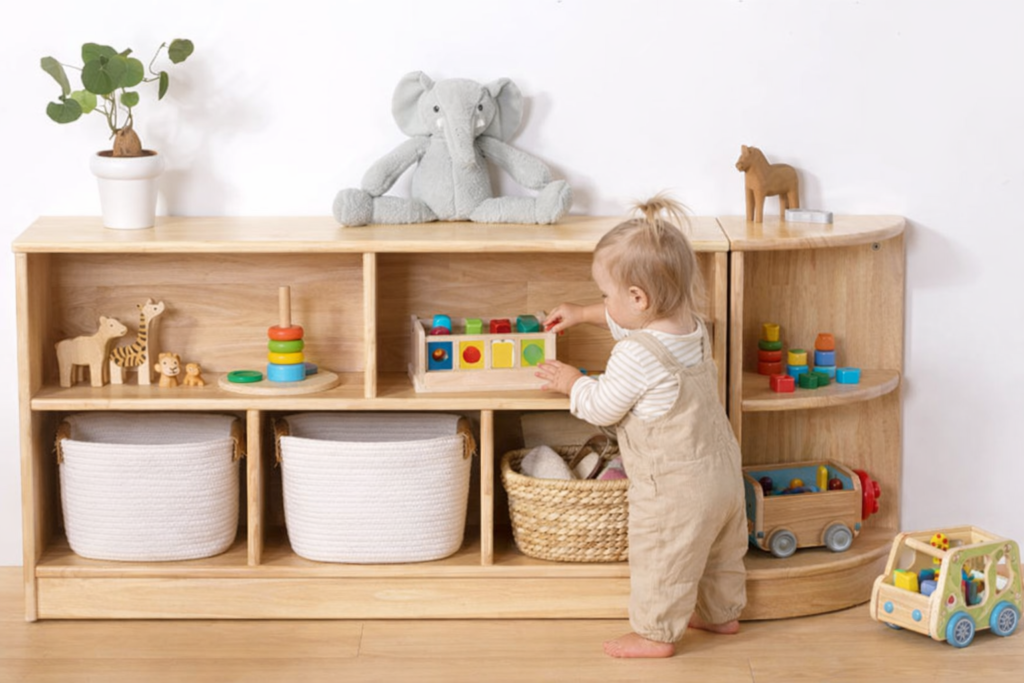
View this toy shelf on Amazon UK
Even a simple storage unit or repurposed shelf can work well if it allows your child to see and access their toys independently.
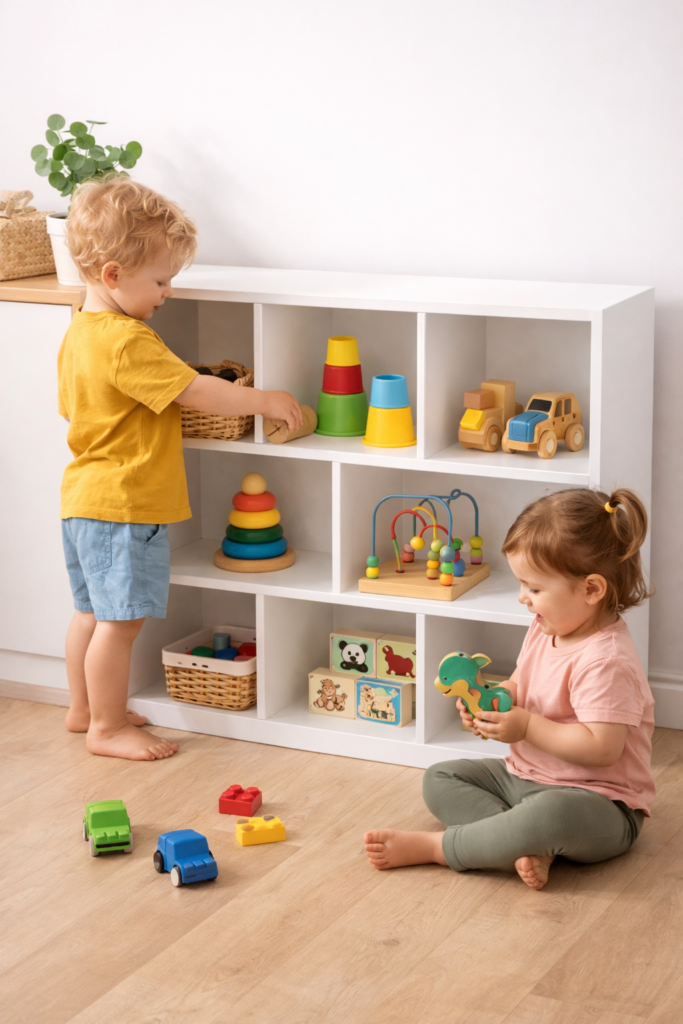
If your toddler moves quickly between toys or seems overwhelmed, simplifying the play space can make a big difference → Montessori Toy Rotation: The Simple System That Keeps Toddlers Engaged
Step 3 — Don’t disappear suddenly
One of the most common mistakes during independent play is:
playing together → walking away suddenly → expecting the child to continue.
For many toddlers, the activity and the adult still feel emotionally connected.
So when the adult disappears, the play often collapses too.
Instead:
- stay nearby
- stop participating gradually
- remain calm and available
- allow the child to continue independently while still feeling secure
You become less of a play partner and more of a quiet anchor in the environment.
Often, this is the stage where real independent play begins to emerge.
A child starts realising:
“I can continue even without constant interaction.”
Over time, your physical presence becomes less necessary because the child begins trusting the activity itself.
Step 4 — Resist narrating or correcting
Many adults unintentionally interrupt concentration constantly during toddler play:
“Good job!”
“No, like this”
“What are you making?”
“Careful!”
Even well-meaning comments can pull toddlers back into depending on adult feedback.
During independent play, silence is often incredibly supportive.
That does not mean becoming emotionally distant.
It simply means allowing the child to remain inside their own concentration without constantly pulling their attention outward.
Often, the deepest focus appears during quiet moments.
Step 5 — Finish before frustration begins
Independent play does not need to end in tears or exhaustion to be successful.
In fact, stopping while the activity still feels manageable often helps toddlers return more willingly next time.
You might gently say:
“You worked carefully with those today.”
“The activity will be ready for you again later.”
This helps toddlers gradually understand:
- play has a beginning and an end
- stopping feels safe
- activities can be returned to later
- success does not require perfection
And over time, something important shifts:
they begin starting faster,
staying longer,
and needing less support to continue.
What independent play actually looks like (realistic expectations)
At first, independent play is often very short.
Two minutes can be a genuine success.
Then gradually:
- five minutes
- ten minutes
- twenty minutes
Not because the child was forced.
But because their confidence slowly increased.
The goal is not creating separation from your child.
The goal is helping them experience:
“I can do something successfully on my own.”
And once toddlers begin feeling capable inside play, many naturally become more curious, exploratory and confident overall.
A Gentle Reminder
If your toddler constantly wants you nearby, nothing is wrong.
They are not failing at independence.
They are still practising it.
Independent play is not a personality trait some children magically have and others do not.
It usually develops through:
- preparation
- environment
- repetition
- emotional safety
- patience
And most often, it grows quietly — one calm moment at a time.
You Might Also Find Helpful