How to Teach An 18 Month Old to Share
A Montessori approach to cooperation, boundaries, and early social skills
If you’re wondering how to teach an 18 month old to share, you’re not alone.
It’s one of the most common toddler struggles. You’re at the park. Another child reaches for the toy. Your toddler clutches it tighter. Maybe there’s yelling. Maybe there’s grabbing. Maybe there are tears… from everyone.

At 18 months, sharing can feel impossible.
But here’s something important to understand:
An 18 month old is not refusing to share.
They are not being selfish.
Developmentally, they are not ready to share in the way adults expect.
Before we teach sharing, we need to understand what’s actually happening at this age and how a Montessori approach can guide us.
Why an 18 Month Old Isn’t Ready to Share Yet
At 18 months, toddlers are in a powerful stage of development:
- They are building autonomy.
- They are discovering ownership.
- They are strengthening attachment.
- They are developing language, but still limited.
Most importantly, they are in what many parents call the “mine” phase.
This isn’t selfishness. It’s cognitive development.
At 18 months, attachment awareness also increases, which is why many parents notice more emotional intensity and clinginess during this stage. (Read more about why toddlers become suddenly clingy.)
Ownership helps toddlers:
- Feel secure
- Develop identity
- Understand boundaries
- Practice control
When a toddler says “mine,” they are not rejecting others.
They are establishing self.
And that’s healthy.
Why Forcing Sharing Often Backfires
Many well-meaning adults say:
“Share.”
“Let them have it.”
“You have to share.”
But forced sharing often creates:
- Resentment
- Insecurity
- Power struggles
- Escalation
From a Montessori perspective, we don’t force generosity.
We prepare the environment and guide cooperation.
True sharing grows from security, not pressure.
A child who feels safe with their belongings is more likely to eventually offer them.
A child who feels forced to give something up learns that adults control access.
That does not build empathy.
It builds compliance.
Montessori focuses on teaching cooperation, not obedience.
What You Can Teach Instead at 18 Months
At 18 months, instead of teaching “sharing,” we teach:
- Taking turns
- Waiting
- Respect for others’ use
- Language for social interaction
These are the foundations of sharing.
Sharing is the outcome.
Turn-taking is the skill.
Step 1: Respect Ownership First
One of the most powerful Montessori principles is respect, including respect for a toddler’s attachment to an object.
If your child is actively using something, you can say:
“You’re still using it.”
This simple phrase:
- Validates ownership
- Reduces panic
- Models boundary-setting
If another child wants the toy, you can calmly say:
“They’re still using it. When they’re finished, you can have a turn.”
You are not refusing sharing.
You are introducing turn-taking.
And that is developmentally appropriate.
Step 2: Teach Turn-Taking Language
An 18 month old cannot yet negotiate socially.
But they can begin to learn simple scripts.
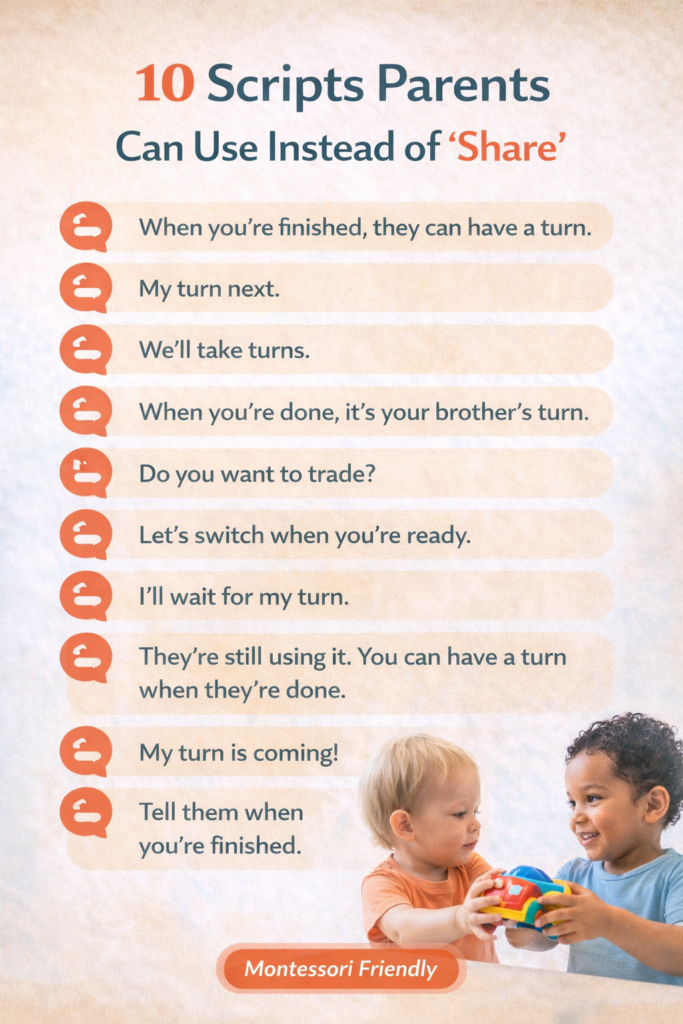
Instead of saying “Share,” try:
“When you’re finished, they can have a turn.”
“My turn next.”
“We’ll take turns.”
“Do you want to trade?”
You can model these repeatedly.
Even if your child cannot say them clearly yet, hearing them builds understanding.
Repetition builds language.
Language builds cooperation.
If you’re trying to reduce power struggles more generally, these alternative phrases to saying “no” can also help support cooperation.
Step 3: Prepare the Environment to Reduce Conflict
Montessori emphasizes the prepared environment.
When toddlers have access to:
- Duplicate toys
- Open-ended materials
- Predictable routines
- Calm adult responses
Conflicts decrease naturally.
If you’re hosting a playdate, consider:
- Having similar toys available
- Rotating special toys out of reach
- Creating defined play spaces
Preparation prevents escalation.
It is easier to guide sharing in a calm environment than during chaos.
If your toddler struggles to play alone or constantly seeks your attention, the setup matters more than you think. The right materials can dramatically increase focus and confidence. I’ve shared a full breakdown of the best Montessori tools for independent play here, including practical life activities and simple shelf setups that actually work at home.
Sometimes the challenge isn’t motivation, it’s regulation. If your toddler struggles with sensory overload, adding the right calming materials can make independent play feel safer and more manageable. Thisguide to Montessori-inspired sensory toys for autistic toddlers outlines practical tools that support focus while respecting sensory needs.
Step 4: Guide, Don’t Label
Avoid phrases like:
“You’re not being nice.”
“That’s selfish.”
At 18 months, these words don’t teach social skills.
They create confusion and shame.
Instead, describe what you see:
“You don’t want to give it up right now.”
“They would like a turn.”
Then guide:
“We’ll take turns.”
Calm tone matters more than perfect wording.
Your regulation teaches regulation.
Step 5: Model Sharing in Everyday Life
Children learn generosity by watching it.
You can model:
“I’m finished with this. Would you like it?”
“I’ll wait for my turn.”
“Thank you for letting me use that.”
Real-life modelling is more powerful than lectures.
Montessori is rooted in example.
Children absorb what they observe.
What to Do When Your 18 Month Old Refuses to Share
At this age, emotional regulation is still developing.
(Sleep disruption and overtiredness can also increase emotional reactions at this age. You can read more about why 18 month olds get hyper before bed here.)
When another child grabs a toy, your toddler may:
- Cry intensely
- Hit
- Grab back
- Collapse into tears
This is not manipulation.
It’s emotional immaturity.
You can respond calmly:
“I won’t let you hit. You’re upset. We’ll take turns.”
Firm boundary.
Soft tone.
Clear direction.
This combination builds safety.
If big emotions are frequent right now, you may also find helpful language in our guide to what to say during a toddler meltdown.
When Will Sharing Develop Naturally?
Around ages 2.5–3, something shifts.
As language develops and impulse control strengthens, toddlers begin to:
- Offer toys spontaneously
- Negotiate turns
- Trade willingly
- Express empathy
That generosity feels genuine.
Because it is.
It grows from:
Security
Boundaries
Practice
Observation
Time
You are not behind if your 18 month old struggles with sharing.
They are exactly where they should be.
A Simple Montessori Script to Use Today
When a conflict happens, try this sequence:
- Observe without panic.
- Protect physical safety.
- State what’s happening.
- Offer turn-taking.
For example:
“You’re still using the truck. They’d like a turn. When you’re finished, they can have it.”
If grabbing occurs:
“I won’t let you grab. We’ll take turns.”
Simple.
Clear.
Consistent.
Over time, these phrases build understanding.
Final Thoughts on Teaching Sharing at 18 Months
Teaching an 18 month old to share is not about creating a generous toddler overnight.
It’s about:
- Protecting security
- Teaching boundaries
- Introducing turn-taking
- Modelling respect
- Supporting emotional growth
The “mine” phase is not a flaw.
It’s a foundation.
By respecting ownership, modelling turn-taking, and guiding calmly, you are laying the groundwork for real cooperation, not forced compliance.
One day, your child will hand a toy to another child willingly.
And it will feel natural.
Because it grew from understanding.
Not pressure.
Remember…
Toddlers aren’t refusing to share. They’re learning about ownership and turn-taking. Instead of forcing sharing, try guiding cooperation with clear, calm language like the scripts below.