Simple and Safe Montessori Toys That Encourage Crawling
Most babies begin to crawl somewhere between 6 and 10 months.
But it’s not a fixed timeline.
Some babies move earlier.
Some take their time.
Some skip traditional crawling altogether and find their own way to move.
All of this can be completely normal.
What matters most isn’t when crawling starts — but whether your baby has the space, opportunity, and motivation to move.
Crawling doesn’t need to be taught.
In Montessori, it’s something that emerges naturally when the environment invites it.
That means:
- space to move
- objects worth reaching for
- and just enough challenge
Not noise.
Not flashing lights.
Not constant stimulation.
Just movement + curiosity
Why Crawling Matters (Montessori Perspective)
Crawling isn’t just about getting from A to B.
It supports:
- coordination between both sides of the body
- spatial awareness
- early concentration
- persistence
And most importantly, it connects movement with thinking
Montessori education is built on this idea:
movement drives development
Disclaimer: This post contains affiliate links. As an Amazon Associate I earn from qualifying purchases at no extra cost to you.
What Actually Encourages Crawling
In Montessori, the best “toys” are often:
- simple
- predictable
- movement-based
You’re not trying to entertain your baby.
You’re giving them: a reason to move forward
Rolling, reaching, pushing, following. That’s what leads to crawling.
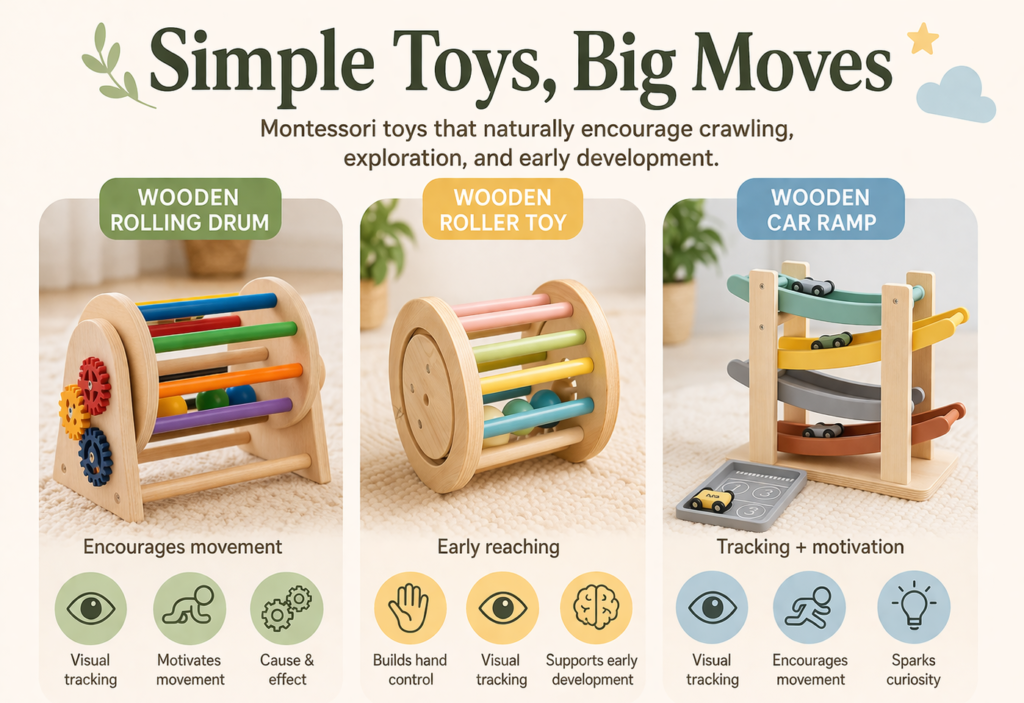
3 Montessori Toys That Encourage Crawling
Best Overall: Wooden Rolling Drum (Movement Invitation)
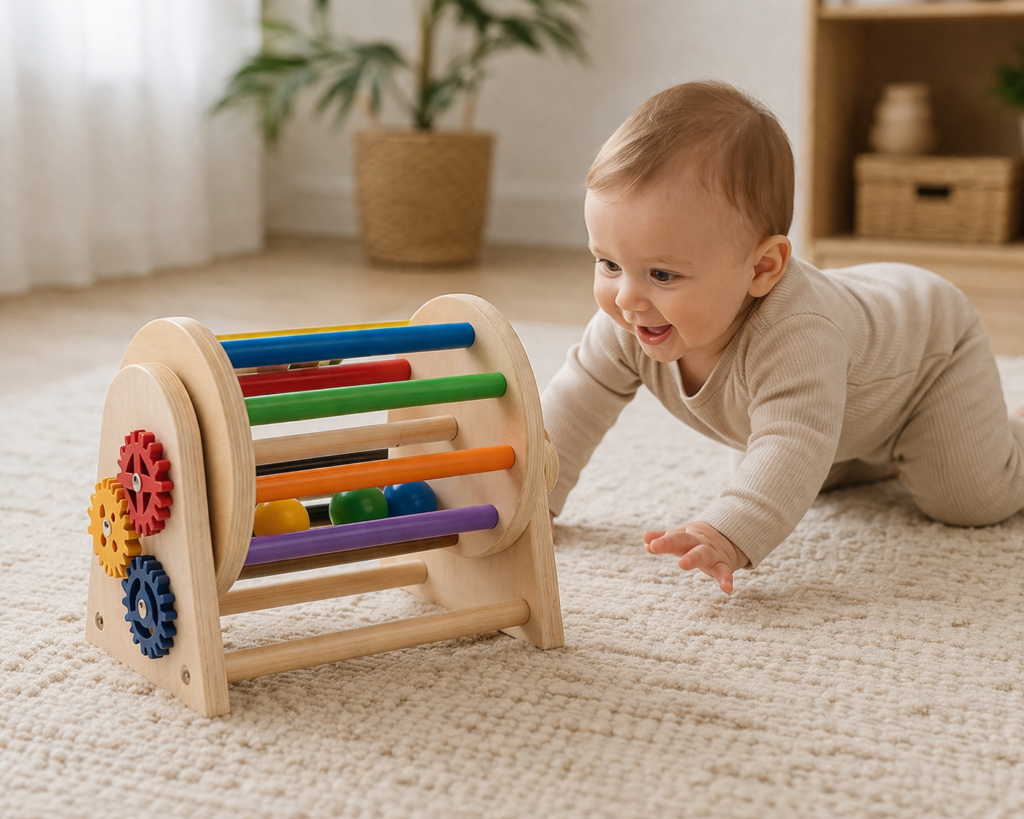
➤ View this simple wooden rolling drum toy on Amazon
Why it works:
- Rolls slowly → invites movement without frustration
- Soft internal, natural sound (not electronic)
- Encourages pushing, reaching, and chasing
This gently encourages babies to move without overwhelming them.
Best Minimal Option: Wooden Roller Rattle
A lightweight wooden roller that encourages grasping, rolling, and early crawling without overstimulation.
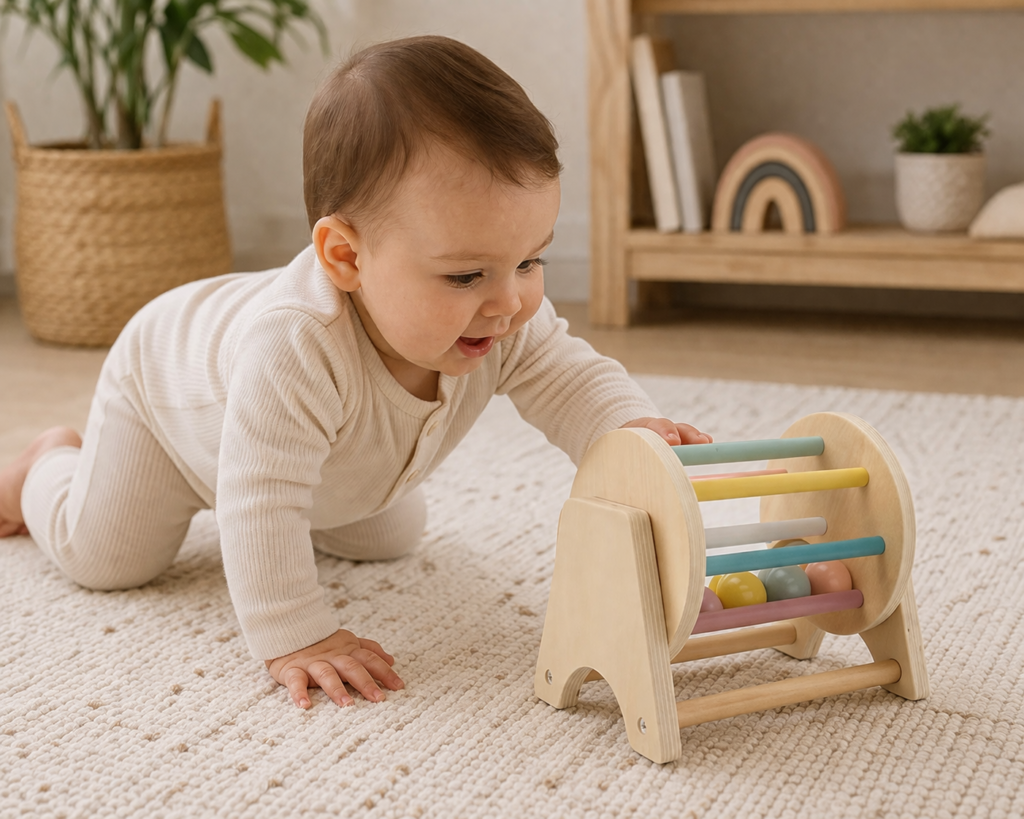
➤ View this montessori wooden roller on Amazon
Why it works:
- Easy to grip and push
- Moves just enough to invite pursuit
- No lights, no noise, no overwhelm
Ideal for younger babies just starting to reach and pivot
Best Stationary-to-Movement Bridge: Wooden Ball Track
A simple wooden car ramp that encourages babies to move closer, watch, and retrieve rolling cars.
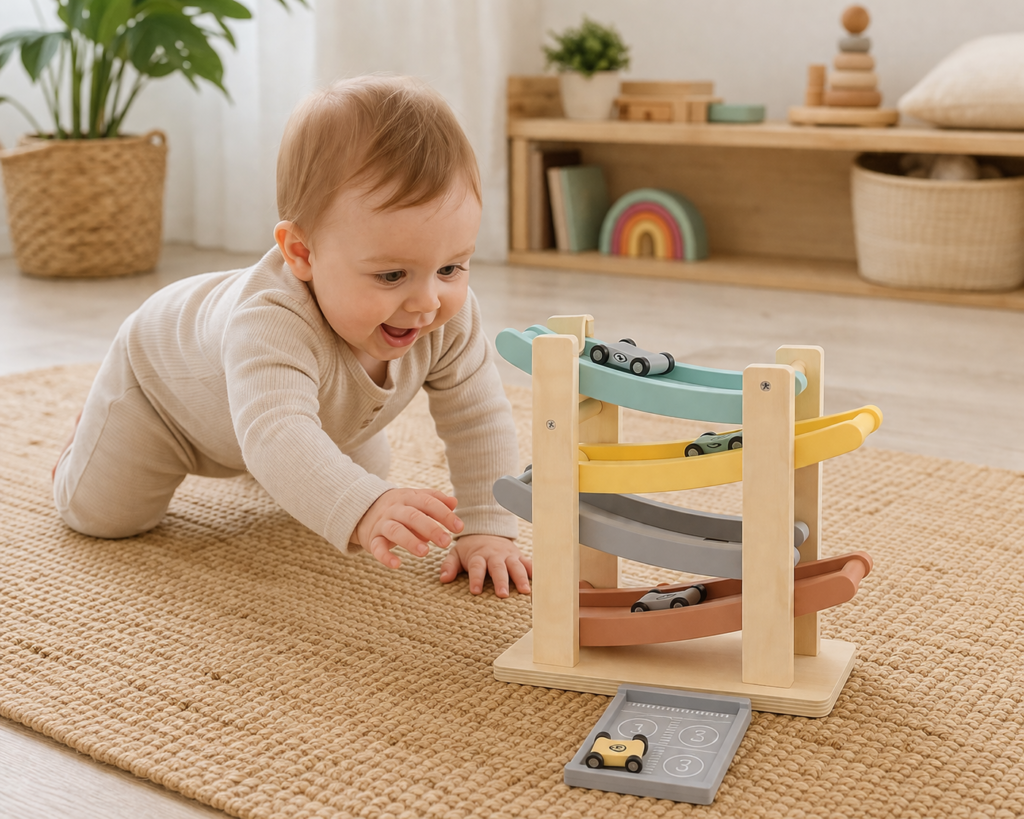
➤ View this wooden track ramp toy on Amazon
Why it works:
- Builds visual tracking
- Encourages reaching forward
- Motivates babies to move toward moving objects
Cars rolling down a ramp are especially engaging because they move in a predictable, repeatable way—which naturally invites babies to follow, reach, and eventually crawl toward them.
Quick Comparison
| Toy | Best For | Stimulation |
|---|---|---|
| Wooden Rolling Drum | Encouraging movement | Low |
| Wooden Roller Toy | Early reaching | Very low |
| Wooden Car Ramp | Tracking + motivation | Low |
What to Avoid (Very Important)
Many “baby crawling toys” go against Montessori principles.
Avoid:
❌ flashing lights
❌ loud sounds
❌ fast-moving electronic toys
❌ overstimulation
These don’t support focus — they interrupt it.
Montessori is about:
intrinsic motivation, not entertainment
You Don’t Actually Need Toys
Some of the most effective setups are simple:
✔ Place an object just out of reach
✔ Use floor time daily
✔ Let your baby struggle (a little)
✔ Stay nearby, but don’t intervene quickly
Even a wooden spoon or soft ball can be enough.
A Helpful Perspective
If your baby isn’t crawling yet, it’s not something to rush.
Some babies:
- roll
- shuffle
- bottom-scoot
What matters is:
👉 freedom to move
Final Thoughts
Montessori doesn’t push milestones.
It prepares the environment.
The goal isn’t:
❌ “getting your baby to crawl faster”
It’s creating a space where movement feels natural
Start simple.
One object.
A little distance.
Time to explore.
That’s often enough.
Related
If you’re building movement and independence:
→ Independent Play Tools for Toddlers (Simple Montessori Ideas That Work)