Signs Your Autistic Toddler Is Overwhelmed And How to Help
One of the most difficult parts of parenting an autistic toddler is that overwhelm can appear to come out of nowhere.
A child who seemed happy moments ago may suddenly be crying, covering their ears, pushing things away, trying to escape, or shutting down completely.
From the outside, these reactions can feel confusing. Parents are often left wondering what triggered the change and why seemingly small events can lead to such intense distress.
But overwhelm rarely appears as suddenly as it seems.
For many autistic toddlers, sensory information, expectations, transitions, emotions, and everyday experiences build up throughout the day. In some cases, this can lead to sensory overload, where the brain is struggling to process everything at once.
Understanding what overwhelm feels like from your child’s perspective can make these moments easier to recognise, respond to, and support with greater confidence.

Disclaimer: This post contains affiliate links. As an Amazon Associate I earn from qualifying purchases at no extra cost to you.
Why Overwhelm Happens
When an autistic toddler becomes overwhelmed, their behaviour is usually a response to stress within the nervous system rather than a deliberate choice.
Many autistic children experience differences in how they process sensory information, transitions, emotions, and changes in their environment. When too many demands build up at once, this can contribute to sensory overload and feelings of overwhelm. Sounds may feel louder, lights brighter, clothing more distracting, or unexpected events more difficult to predict.
At the same time, young children are still developing the ability to understand, communicate, and regulate what they are experiencing.
When multiple demands build up at once, the nervous system can reach a point where it struggles to process any more information effectively. What follows may look like a sudden reaction, but it is often the result of overwhelm that has been building beneath the surface.
This is one reason parents are sometimes surprised by a meltdown. The event that appears to trigger it is not always the cause. Many parents recognise this pattern when a toddler seems to cope well during a busy outing, only to melt down later over something that would not normally upset them. It may simply be the final demand placed on an already overloaded system.
Why It Can Escalate So Quickly
One of the most confusing things about overwhelm is how sudden it can appear.
A toddler may seem happy one moment and deeply distressed the next. But in many cases, overwhelm has been building long before it becomes visible.
Young children are still learning how to recognise, communicate, and manage what they are feeling. They cannot always tell you that a room feels too noisy, a transition feels stressful, or that they are struggling to process everything happening around them.
For autistic toddlers, this can be even more challenging. By the time distress becomes visible, their nervous system may already have been working hard for quite some time.
This is why parents are often left wondering what changed so suddenly. In reality, the overwhelm may have been building quietly long before the meltdown occurred.
What a Meltdown Can Feel Like
Every autistic child experiences overwhelm differently, but many parents find it helpful to think about what the experience might feel like from their child’s perspective.
Imagine being unable to filter background noise, organise your thoughts, communicate what is wrong, or leave a situation that feels overwhelming. Now imagine all of that happening at once.
For some children, sensory overload can make everything feel too loud, too bright, too fast, or too unpredictable. They may know something feels wrong but have no way to explain it. Their body may feel out of control, and their only instinct is to make the experience stop.
This is why a meltdown is not the same as a tantrum.
A tantrum is typically driven by a goal or desire. A meltdown happens when a child’s nervous system becomes overwhelmed and can no longer cope with the demands being placed upon it.
In those moments, what you say often matters less than how you say it. A calm voice, reduced demands, and a sense of safety are usually far more helpful than explanations or instructions.
→ You might also find this helpful: 10 Things To Say During a Toddler Meltdown
Think of It Like a Bucket Filling Up
Many parents find it helpful to think of overwhelm as a bucket that slowly fills throughout the day.
Every demand adds a little more to the bucket:
- a noisy environment
- an unexpected change
- a difficult transition
- bright lights
- frustration communicating
- tiredness
- excitement
Some of these things may seem small on their own. In fact, your child may appear to cope with many of them without any obvious difficulty.
The challenge is that the bucket keeps filling.
Eventually, something seemingly minor — being asked to leave the park, putting on shoes, hearing a loud noise, or being told “no” — may become the final drop that causes the bucket to overflow.
From the outside, it can look as though the meltdown was caused by that single event.
In reality, the event was often just the last demand placed on a nervous system that had already been working hard for quite some time.
This is one reason autistic overwhelm can feel so unpredictable to parents. The trigger is not always the cause.
Why Overwhelm Doesn’t Always Look the Same
Not all autistic toddlers respond to overwhelm in the same way.
Some children become visibly distressed. They may cry, scream, throw objects, push people away, or try to escape the situation altogether.
Others respond in the opposite direction. They become quiet, withdrawn, avoid eye contact, freeze, or seem to shut down completely.
While these reactions can look very different from the outside, they often stem from the same underlying experience: a nervous system that has become overloaded.
Meltdown vs Shutdown
Many parents are familiar with meltdowns, but shutdowns are less often discussed.
A meltdown tends to be outwardly expressed through crying, shouting, movement, or visible distress. A shutdown is more inward. A child may become unusually quiet, withdrawn, or appear unresponsive while they recover from overwhelm.
Neither response is a choice. Both are signs that your child’s nervous system is struggling to process everything happening around them.
How to Help When Your Child Feels Overwhelmed
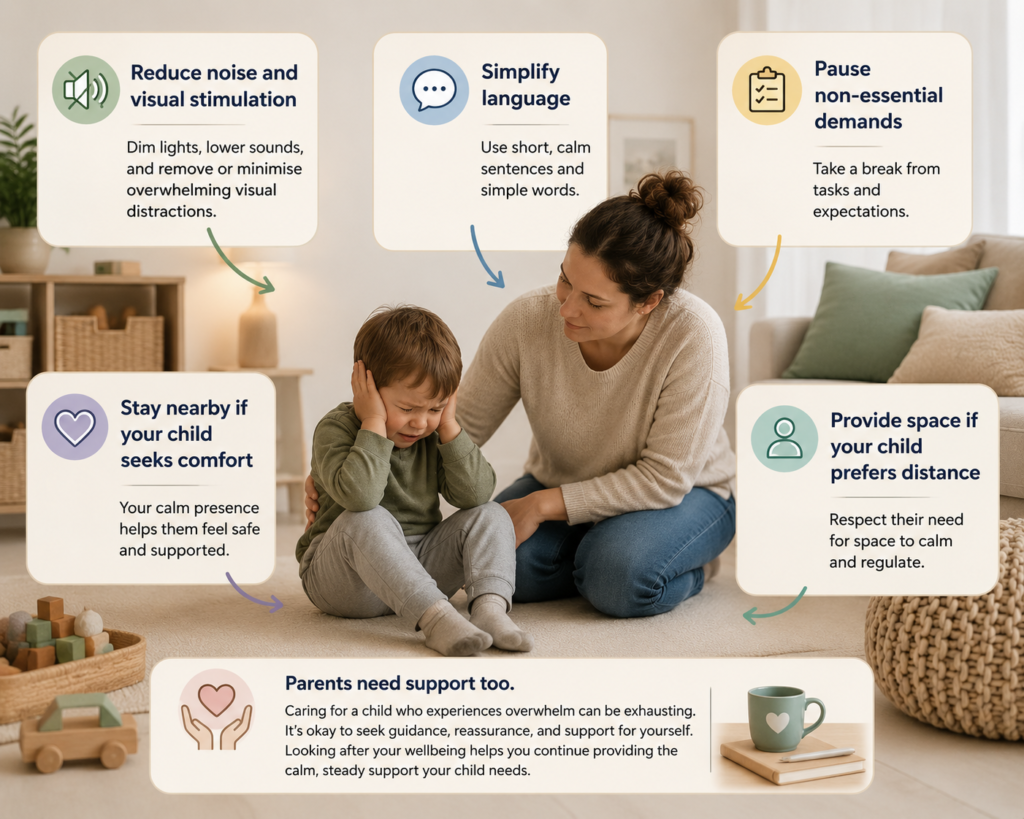
When a child is overwhelmed, the goal is not to reason, correct behaviour, or teach a lesson.
The priority is helping their nervous system feel safe enough to recover.
This often means reducing sensory input, lowering demands, and offering calm support rather than additional instructions.
Many parents find it helpful to:
- reduce noise and visual stimulation
- simplify language
- pause non-essential demands
- stay nearby if your child seeks comfort
- provide space if your child prefers distance
Your calm presence often matters more than finding the perfect words.
Ways to Reduce Overwhelm in the Moment
Every autistic child is different, and no sensory tool works for everyone. However, some families find that certain supports can make overwhelming situations feel more manageable by reducing sensory input or helping a child feel more regulated.
Ear Defenders for Noise Sensitivity
For some toddlers, everyday sounds can be surprisingly intense. Busy shops, family gatherings, travel, hand dryers, vacuum cleaners, and crowded environments can all contribute to sensory overload.
In these situations, ear defenders can help reduce the amount of sound reaching the child, making the environment feel more predictable and less overwhelming.
We generally think of these as occasional support tools rather than something children need to wear all the time.
Deep Pressure Supports
Some children find deep pressure input calming when they feel overwhelmed. This might come from a firm hug, being wrapped in a blanket, or using a weighted item under supervision.
Deep pressure may help some children feel more grounded, organised and aware of their body.
It’s important to remember that not every child enjoys or benefits from deep pressure. Sensory preferences vary significantly from one child to another.
For families exploring this type of support, weighted lap pads or weighted plush toys are often used as a gentler introduction.
We’ve noticed with our own daughter that the type of support she wants often depends on how overwhelmed she is feeling. When we can see the early signs of overwhelm building, a quick cuddle, a calm voice and some quiet reassurance are often enough to help her regulate.
Once she crosses a certain threshold, however, she usually wants the opposite. Rather than seeking comfort from us, she prefers space and will often make her way to her calm corner, where she sometimes seeks out her weighted plush toy independently.
Every child is different, but experiences like this can be a helpful reminder that a child’s sensory needs may change depending on how overwhelmed they are feeling in that moment.
Some children also benefit from having a predictable, low-stimulation space they can retreat to when the world feels overwhelming.
Many adults do something similar without really thinking about it. After a stressful day, an upsetting conversation, or a heated argument, we often seek out a quieter room where we can be alone with our thoughts and allow our nervous system to settle. For some children, a calm corner serves a very similar purpose.
Learn how to create one → How to Create a Simple Calm Corner
After the Overwhelm Passes
Once your toddler has regulated again, that is when learning, reflection, and connection become possible — not during the meltdown itself.
Over time, many families find that small environmental adjustments can significantly reduce how often overwhelm occurs. Predictable routines, simpler environments, gradual transitions, and recognising early signs of distress can all help reduce the demands placed on a child’s nervous system.
Some families also find that carefully chosen sensory toys provide opportunities for regulation, movement, and sensory input during calmer parts of the day, which may help children feel more settled overall.
→ How to Choose Sensory Toys for Neurodivergent Toddlers
One of the most valuable skills is learning to spot overwhelm before it reaches breaking point.
Many autistic toddlers show subtle signs that they are beginning to struggle, such as:
- increased movement or restlessness
- covering their ears or avoiding eye contact
- becoming unusually rigid or resistant
- sudden clinginess, withdrawal, or fatigue
These signs are not always obvious at first, but recognising them early can make it easier to reduce demands and offer support before overwhelm escalates.
Overwhelm can affect many areas of daily life. Some children find it harder to play independently when their environment feels busy or unpredictable, while others may respond by throwing, pushing, or seeking intense sensory input as a way of releasing tension.
→ How to Help Your Toddler Play Independently (Montessori Guide That Actually Works)
It’s Not Something to “Fix”
One of the most important things to understand about overwhelm is that it is not a behaviour problem.
It is a signal.
Your toddler’s nervous system is working hard to process a world that can sometimes feel louder, brighter, faster, and more demanding than it does for other children.
The goal is not to eliminate overwhelm completely. The goal is to help your child feel safe, understood, and supported when it happens.
With time, experience, and the right environment, children gradually learn what helps them feel regulated, how to communicate their needs, and which situations feel manageable or challenging.
And parents learn too.
They learn which environments are difficult, which routines help, and which signs appear before overwhelm takes hold.
If staying calm feels difficult in these moments, you’re not alone.
→ How to Stay Calm During Toddler Meltdowns
Final Thoughts
When an autistic toddler becomes overwhelmed, they are not trying to challenge you.
They are trying to cope.
Understanding what is happening beneath the surface changes how you respond. Instead of seeing difficult behaviour, you begin to see a child whose nervous system is asking for support.
And often, that shift in perspective is where things begin to change. Instead of trying to stop the behaviour, you begin to understand the need beneath it — and that understanding is often the foundation of better support, greater trust, and calmer moments for both of you.
When to Seek Additional Support
While occasional overwhelm is a normal part of life for many autistic children, it may be worth speaking with your child’s healthcare professional, paediatrician, occupational therapist, or other support provider if overwhelm is becoming frequent, severe, affecting daily activities, causing significant distress, or creating safety concerns.
Parents need support too. Caring for a child who experiences frequent overwhelm can be emotionally demanding, and it is okay to seek guidance, reassurance, and practical support for yourself as well. Looking after your own wellbeing helps you continue providing the calm, steady support your child needs.
Frequently Asked Questions
What is sensory overload in autistic toddlers?
Sensory overload happens when an autistic toddler receives more sensory information than their brain can comfortably process. Loud noises, bright lights, crowded environments, strong smells, unexpected touch, or multiple demands at once can all contribute to sensory overload. When this happens, a child may become distressed, experience a meltdown, or withdraw into a shutdown as their nervous system struggles to cope.
What causes an autistic toddler to become overwhelmed?
An autistic toddler becomes overwhelmed when their brain receives more sensory or emotional input than it can process. This can include noise, bright lights, busy environments, transitions, or strong emotions. When an autistic toddler is overwhelmed, their nervous system reacts quickly, which can lead to distress or meltdowns.
What are the signs an autistic toddler is overwhelmed?
Common signs include covering ears, avoiding eye contact, increased movement, crying, throwing objects, or suddenly becoming quiet and withdrawn. These are early indicators that an autistic toddler may be overwhelmed and struggling to process their environment.
Is a meltdown the same as a tantrum?
No. A meltdown happens when an autistic toddler is overwhelmed and their nervous system reaches its limit. It is not a choice or a way to get something. A tantrum is usually goal-driven, while a meltdown is a response to overload.
How do you calm an overwhelmed autistic toddler?
When an autistic toddler is overwhelmed, the focus should be on reducing sensory input and creating a calm environment. Lower noise, reduce demands, use simple language, and stay physically close if your child is comfortable. Some toddlers also benefit from tools like ear defenders or gentle deep pressure for calming support.
How can I prevent my autistic toddler from becoming overwhelmed?
You can reduce overwhelm by creating predictable routines, simplifying the environment, limiting sensory input, and recognising early warning signs. Over time, these adjustments help an autistic toddler feel safer and more able to regulate.
Do sensory tools help autistic toddlers with overwhelm?
Yes, some sensory tools can help reduce overwhelm. For example, ear defenders can reduce noise, and weighted items can provide calming deep pressure. However, not every child benefits from the same tools, so it’s important to observe what works best for your toddler.
Can sensory overload cause an autistic toddler to throw things?
Yes. Some autistic toddlers throw objects, push things away, or seek intense movement when they feel overwhelmed. These behaviours are often a response to distress or an attempt to reduce sensory discomfort rather than deliberate misbehaviour.
You Might Also Find Helpful